
Gov. DeSantis Signs Big-Government Bill Attacking Florida's Gold Industry
 Verstappen wins chaotic Singapore sprint after Russell crashes

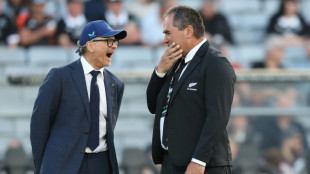 Kiss tells Wallabies to 'return fire' after first loss as coach
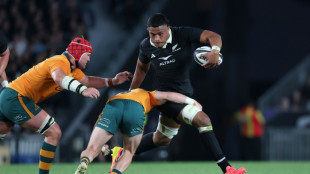
 Russian strikes kill 11 including 3 children: Ukrainian authorities

 Russian teenager Andreeva breezes into China Open final
 Major earthquake hits Panama, injures at least 27

 India detains 'cockroach' leaders ahead of election protest

 'No divisions, no borders', French astronaut says of seeing Earth

 India's 'cockroach' movement chief detained ahead of major protest

 Year later, Gaza ceasefire promises mostly unfulfilled

 Taiwan's leader says increasing defence spending to 'deter war'

 Major quake hits Panama, no deaths reported

 Hurricane Isaias makes landfall in Florida

 Brazil prosecutors sue Shell for $108 mn over deadly 2024 floods

 Major earthquake destroys buildings, roads in Panama

 Anthropic AI model sent fake murder tip to Philadelphia police

 7.7-magnitude quake rocks Panama, triggers tsunami warning

 Prince Harry booed at English rugby match

 Kiplimo and Feysa seek repeat Chicago Marathon wins

 Fuellkrug halts Dortmund after late goal flurry

 Injured Ravens quarterback Jackson ruled out of Falcons clash

 Brewers aim to take down two-time defending champion Dodgers in NLCS rematch

 Tsunami alert after major earthquake rocks Panama

 Outer bands of Hurricane Isaias lash US Gulf Coast

 Hope, Rutherford fire West Indies to record T20 chase of 250

 Farhan leads Pakistan to T20 win over Sri Lanka

TALLAHASSEE, FL / ACCESS Newswire / July 14, 2026 / How do you turn a sound money bill into a big-government bill? Florida has just shown us.
When Florida lawmakers approved so-called 'transactional gold' legislation, supporters claimed it was a historic step toward restoring gold and silver as constitutional money.
Governor Ron DeSantis, who is often thought to be a champion of economic freedom, almost certainly believed he was signing legislation that would expand liberty rather than government.
But intentions and results are not always the same.
Instead of simply recognizing gold and silver as lawful money, Florida's law reaches much further - and in exactly the wrong direction.
It expands the state's Money Services Business framework into the precious-metals marketplace, subjecting dealers, depositories, and other businesses to licensing, examinations, compliance programs, reporting obligations, and regulatory oversight more commonly associated with banks and money transmitters than neighborhood coin shops.
That negative outcome was neither inevitable nor unforeseen.
Before the Governor signed HB 1311, sponsored by Rep. Doug Bankson, industry participants and sound money advocates warned that the legislation would do exactly this - and urged a veto.
Our concern was never with innovation. Companies offering gold-backed payment technologies were already free to operate in Florida. They did not need legislative permission to compete.
What they sought was a marketing advantage and the ability to claim the State of Florida has formally blessed their product offering. And in tandem, long-established dealers and precious metals depositories were thrown under the bus, inheriting new compliance burdens and uncertainty.
That's not free-market competition; it's cynically weaponizing government for competitive gain.
The irony is particularly striking because precious-metals businesses were already subject to extensive regulation before the self-serving vendors marched in with poorly written legislation to impose much more.
Federal anti-money-laundering laws, the Bank Secrecy Act, IRS reporting requirements, and numerous state and federal consumer-protection statutes already govern the industry. Florida added a new layer without bothering to demonstrate why existing safeguards were insufficient.
The legislative history makes matters worse.
The original measure was drafted last year without meaningful participation from established dealers, depositories, sound-money scholars, or even the regulators later charged with implementing it.
After its unintended consequences became apparent, regulators worked with industry representatives on corrective legislation. That effort stalled this year. Instead, Florida lawmakers permanently codified the original framework.
This debate ultimately isn't even about mom-and-pop coin shops being thrown under the bus. It's about first principles.
The modern sound money movement has always sought to reduce government's control over money, increase competition, protect financial privacy, and expand individual choice.
Ludwig von Mises, F.A. Hayek, and Dr. Ron Paul did not advocate replacing one regulatory system with another. They argued that governments should stop placing unnecessary obstacles between citizens and honest money.
Florida has an opportunity to correct course. Lawmakers should repeal all the new licensing and money services provisions that threaten competition and increase compliance costs.
The broader lesson extends well beyond the Sunshine State. Assuming good intentions were actually at play here, good intentions alone are not enough.
Folks with no practical knowledge of the precious metals industry or with self-serving motivations to use government to gain an advantage over their competitors should be sidelined.
And every legislative proposal involving precious metals should be judged by a simple question: Does it make it easier for free people to own and use gold and silver, or does it expand government's power over those who do?
If the answer is the latter, then it is time to go back to the drawing board.
Jp Cortez is the executive director of the Sound Money Defense League, the nation's leading public policy group on issues pertaining to gold and silver at the state and federal level since 2014. He is a graduate of Auburn University and a multiple time Mises University alumnus. Cortez is the lead author of the Sound Money Index and the Editor-in-Chief of the Sound Money Review. Follow him on X (Twitter) @JpCortez27.
SOURCE: Sound Money Defense League
View the original press release on ACCESS Newswire
L.Mason--AMWN