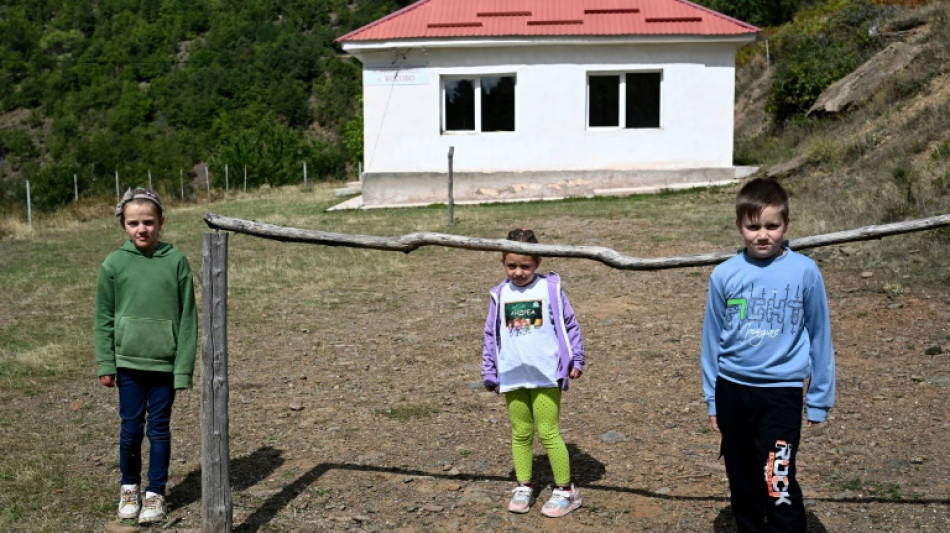
Rural schools empty in North Macedonia due to exodus / Photo: Robert ATANASOVSKI - AFP
 Allen rushes Bills to thrilling 37-34 win over Rams
 India youth shift tactics as police clamp down on election protest
 Malaysia's Firefly extends flight cancellations due to haze

 IMF upgrades 2026 growth forecast but warns of 'split' outlook
 Infantino could pull off 'Houdini' act as critics struggle for candidate

 France braces for fresh nationwide student demonstrations
 Ahead of Israel vote, desert town becomes frontline against ultra-Orthodox expansion

 El Nino Watch: the impacts around the world this week

 Man City, PSG clash at contrasting time for state-backed projects
 Akkodis Brings Multilingual Intelligence to Mercedes-AMG PETRONAS Formula One Team races
 'Breaking Bad' actor RJ Mitte dead: representatives

 Former DR Congo president Kabila forms new force with M23 armed group
 Tom Cruise's 'Digger' tanks, leaving studio with $250 mn hole
 US actress Selma Blair arrested after flight altercation

 One dead as Hurricane Simon creeps along Mexico's Pacific coast

 Carrick's Man United 'hungry and eager' to fix worst start in decades

 Fury as US federal agents search anti-Trump lawmaker's home

 One goal enough for Flick as Barca enter Galatasaray cauldron
 A7 to unveil a service that will re-invent the international payments market

 'Status quo' with EU 'not good enough', UK PM says as summit date set
 Stolen Renoir paintings found behind wall in France

 French supermarkets suffer refrigerator shutdown after 'unprecedented' cyberattack

 Arsenal lose Hincapie and Zubimendi in freak double blow
 Saudi says resilience tested, vows response after deadly airport attacks
 Alcaraz exits Shanghai Masters in straight-sets loss
Teacher Zarko Blazevski spends nearly an hour crossing empty mountain passes to reach his remote school with only three students in North Macedonia.
With a spiralling population decline, enrolments have plummeted and the future of schools such as the one where Blazevski has taught for nearly a decade is uncertain.
Located in the village of Kosovo -- which shares the same name as the neighbouring Balkan nation to the north -- Blazevski has however seen only the smallest fluctuations in numbers in the school.
"We first had four, later nine, which was the highest number. And now we have three students," Blazevski told AFP.
Since declaring independence in 1991, North Macedonia has seen vast chunks of its people emigrating amid a stagnating economy.
According to the last census conducted in 2021, it has just 1.8 million inhabitants, a drop of nearly 10 percent in less than two decades.
A report published in September by the Center for Civil Communications NGO said elementary schools have lost some 10,000 pupils in the past decade.
"The decrease of the number of students is especially seen in secondary education where in 10 years the number of students dropped by 20 percent," said the report, based on figures from the national statistical office.
The decline covers both rural communities and urban areas.
North Macedonia's new government, which was elected in June, has pledged to tackle this but it is an uphill task.
Led by the right-wing VMRO-DPMNE party, the government has created a ministry for social policy, demography and youth but has not spelt out how it plans to stem the exodus.
- No children, no future -
The effects are most visible in the countryside.
Abandoned villages and crumbling homes dot the mountainous landscape, where summer forest fires are often allowed to rage as they do not threaten inhabited areas.
At the remaining village and town schools, education officials are often faced with the difficult decision of whether to close, thereby forcing pupils to take lengthy commutes.
"It means a lot to them because they have school close to their home, they do not need to travel and at the same time they have their family near them," Blazevski says.
In Brest, just eight kilometres (five miles) south of Kosovo village, Jasmina Kuzmanovska runs a ramshackle school with only two students.
"I think there will be no other children in the village for the school to continue," Kuzmanovska said.
Kuzmanovska and others like her face the additional challenge of teaching children of a variety of ages in a single classroom, with different courses at different levels.
During one school year, she had seven students spread across five age groups.
"First I worked with one class, then another... that's how we managed the work," she told AFP.
Education Minister Vesna Janevska announced new plans to merge schools with small numbers of students but has yet to announce a start date.
But closing schools in places like Brest and Kosovo may signal the beginning of the end of their villages, warn educators.
"It would be great if these students, even though there are not many left, at least get to study until fifth grade where they are born," said Toni Stavreski, a school administrator in nearby Makedonski Brod.
"That will also help these villages to continue existing."
F.Schneider--AMWN