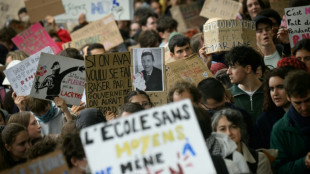
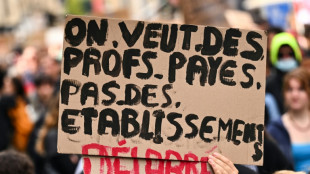
'Real inequality': France's education divide laid bare by protests / Photo: Guillaume Saligot - AFP
 noosha-aubel-lingdao-shibai-bocitan-shizhang-nengfou-shengren
 Нуша Аубель: провал управління замість нового початку — чи відповідає обербургомістерка Потсдама своїй посаді?
 Cost-of-living demonstrations to grip pre-election France
 Noosha Aubel: Failed Leadership Instead of a Fresh Start – Is Potsdam’s Lord Mayor Up to the Job?
 'Real inequality': France's education divide laid bare by protests

 Opera on Ukraine's children aims to 're-awaken' concern for war

 AI is coming for every company, Nvidia boss says
 Millions may be forced to move as climate change hits South Asia: UN
 Four killed battling Indonesia fires as toxic haze cloaks region
 Thai farmers, fishermen challenge IMF, World Bank at Bangkok rally
 In Malaysia, frustration grows over Indonesia haze
 Why India's voter revision drive has stoked fear and anger
 Munster eye fitting tribute to 'special' Foley in Racing reunion
 Shooter kills teacher, three children at Oregon elementary school

 Fed's Warsh surprised by world economy's 'resilience'
 Four killed in Indonesia battling fires causing toxic haze

 New Zealand star Ponga breaks arm in Rugby League World Cup opener

 Indonesian stocks dive 11% as MSCI weighs market reclassification

 Seoul dismisses Pyongyang's scepticism over hypersonic weapon test

 Yamal on song as entertainers Barcelona face Betis challenge

 Wong weighs haze prosecutions as Singapore air quality worsens
 Brush fire prompts an evacuation order along Los Angeles coast
 'Mixed feelings': AI cracks centuries-old ciphers

 Le Pen looms large as Macron enters final months on EU stage
 Three children, one teacher killed in Oregon elementary school shooting
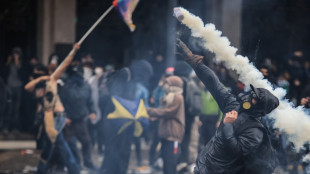
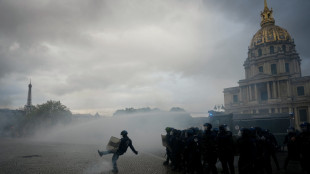
Students cheered as they stacked rubbish bins against the entrance to a school outside Paris, while a speaker thumped out French rap to young people, teachers and parents mingling in the early morning drizzle.
Perched on a low wall alongside friends, 18-year-old Abdel rattled off the problems that drove him to protest in his final year of secondary school in the eastern suburb of Bagnolet.
"I had a biology teacher who wasn't there at the start of the year," he told AFP at the protest on Tuesday.
When a replacement finally arrived halfway through the year, he was an English teacher.
"I missed a year's worth of lessons."
The toilets are in a "pitiful" state, some without locks; internet access is patchy in classrooms, and a lack of printer ink sometimes leaves handouts unreadable, he added, his friends nodding along.
"There's a real inequality between us and students in Paris," he said.
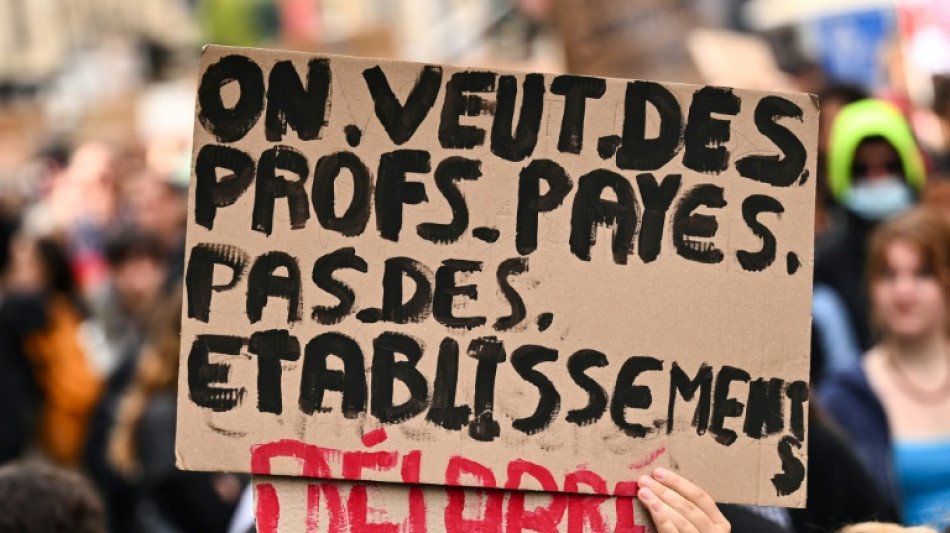
Abdel, who hopes to study business management, is among hundreds of thousands of pupils who have taken to the streets across France since late September over learning conditions.
The protests have drawn fresh attention to longstanding inequalities in France's education system, where schools serving the poorest communities often struggle for resources despite substantial public spending.
AFP spoke to teachers at several schools, including three in the Ile-de-France region around Paris, and pupils at one.
The education ministry and the schools mentioned were contacted for comment. One school referred AFP to departmental authorities, while the others and the ministry had not responded by the time of publication.
Abdel's school did not respond to a request for comment. But his frustrations are shared by his teachers, including Fatoumata Danso, 30, who has taught economic and social sciences at the Eugene Henaff high school for five years.
At a protest in central Paris last week, she told AFP there was a stark divide in resources between the 1,300 Eugene Henaff pupils and those in wealthier areas.
One of her colleagues has "36 or 37 students" in an advanced maths class, she said.
"We don't have time to look after them properly."
Many pupils in Bagnolet, where the poverty rate is almost twice the national average of 15 percent, face precarity long before they enter the classroom.
"Some are homeless, some are very poor, there are migrants," Danso said, while others are undocumented and face orders to leave France.
"We're among the schools with the greatest needs so the students really need the most seasoned teachers."
- 'How the money is spent' -
France spends 24 percent more per pupil on upper secondary education than the OECD average, the Organisation for Economic Co-operation and Development says.
Yet its latest PISA scores -- an international survey which measures the skills of 15-year-olds -- were the country's worst since the rankings began in 2000.
For OECD education analyst Eric Charbonnier, "it is a question of how the money is spent".
Nearly a third of the education ministry's budget for 2027 will go towards pensions, according to a government report on the draft spending plan.
Educational inequality has been debated in France for 25 years, with disparities emerging as early as nursery school, Charbonnier said.
"Disadvantaged children attend disadvantaged schools, located in disadvantaged areas," he said.
Despite investment over the past decade to boost the chances of pupils from these areas, "when you look at the breakdown by school, it's often the most disadvantaged schools that lack resources".
"Fewer teachers want to work there, so the teachers are younger, there are more temporary staff, and there's higher absenteeism," he said.
Across France, pupils last year lost 15.4 million hours of teaching because absent staff were not replaced, according to the education ministry.
- 'Give my chair to pupils' -
The ministry last week promised 3,000 substitute teachers for the country's 114 worst-affected secondary schools, and said on Wednesday it had already dispatched 2,000.
But teachers are not the only staff in short supply.
In the nearby suburb of Aubervilliers, where 42 percent of households are poor, philosophy teacher Cloe Jean said Henri Wallon secondary school had no nurse for its 1,000 students.
"There are a lot of pupils who have fainted and who did not receive any medical attention," Jean told AFP.
Even chairs are in short supply.
"I've had to give my desk chair to pupils," she added.
Her students have taken to singing La Marseillaise, the French national anthem, in protest.
- Young teachers -
Across France, class sizes in secondary schools, excluding vocational programmes, reached a record high in 2025, averaging 30.2 pupils, according to the education ministry.
Particularly in schools serving poorer communities, low pay -- with salaries starting at around 2,100 euros ($2,351) a month -- long hours and difficult working conditions also make it harder to retain teachers.
Antoine Legrand, a 24-year-old economics and social sciences teacher also in Aubervilliers, has been in the profession for just a month but has already experienced some pressures.
His students have often "simply had enough" after long school days, he said.
"When you've got them from 4:00 to 5:00 pm, having started at 8:00 am, it's a struggle," he said.
With long school holidays, France's teachers have to squeeze their curriculum into 162 days per year, compared to 225 days in neighbouring Germany, according to the OECD.
Although he is enjoying his posting, Legrand understands why some young educators leave the profession.
France's points-based assignment system gives more experienced teachers greater choice over where they work, leaving "less experienced" educators more likely to be posted to "the most challenging roles", he said.
- Broken heating -
Beyond staff shortages, teachers and pupils must also contend with crumbling school buildings, which a 2023 Senate report estimated would require billions of euros to renovate and adapt to a changing climate.
In the southern city of Marseille, Etienne Castel spent two years teaching English at the Marie Laurencin middle school, before leaving secondary education.
The classrooms -- in an area where almost half the population live in poverty -- were housed in prefabricated buildings, erected two decades earlier in a car park as a temporary solution to overcrowding, he said.
"The playground was just an asphalt strip between two rows of prefab buildings," he said, adding meetings with education authorities proved pointless.
The southern Bouches-du-Rhone department said it planned to rebuild the school, but the project depended on securing additional land from the city of Marseille, with discussions ongoing for years.
At the Jacques Brel secondary school in the Paris suburb of La Courneuve, where poverty is almost three times the national average, history and geography teacher Gabriel Recoche said broken heating had prompted teachers to strike.
In winter, "pupils are forced to keep their coats on," he said, while summer heatwaves have raised questions about whether end-of-year exams can go ahead.
French regions are responsible for maintaining some 3,700 high school buildings, with their representative association insisting they have "invested heavily" in recent years.
In the wider Paris area, regional president Valerie Pecresse said 6.6 billion euros ($7.4 billion) have "been spent on renovating secondary schools" since 2015.
- 'They just don't eat' -
For some pupils, shortages extend beyond the classroom to something more basic: lunch.
Danso said some of her pupils in Bagnolet do not get a full meal in the school canteen because funding has not been paid out.
"They just don't eat," she said.
"It's 2026, we're in France ... it's unacceptable," she added, shaking her head.
At Eugene Henaff, one-third of meals served fall into the lowest-income bracket, with families paying 20 or 50 cents and the Ile-de-France region covering the rest, the region said, noting that no subsidies were pending.
It added that when a family has difficulty paying the remainder, the school can draw on a social fund financed by the education ministry.
The school principal did not respond to an AFP request for comment.
Abdel said he had experienced the shortages firsthand, with "often three or four of us sharing one meal".
"They're our friends," Samuel, 17, chimed in. "We're not going to let them watch us eat."
Canteen staff also sometimes help with "an extra plate, a little fruit compote -- something to make it a bit easier", Abdel said.
But "it's really upsetting", he added.
Abdel said the pupils planned to continue blockading the school until the autumn break beginning Friday, then organise more regular protests while still attending lessons.
"Because we mustn't miss out -- especially us, as we're in our final year," he said.
Abdel's friend and fellow student El Hadj, 17, said pupils were also fighting for the next generation.
"What will it be like in another 10 years if nobody takes action?" he asked.
S.Gregor--AMWN