
'Remarkable' Alzheimer's drug reduces cognitive decline, study shows / Photo: Philippe LOPEZ - AFP/File
 Ronaldo can return to Portugal team if he wants: coach Jesus

 Portugal move into Nations League knockout stage, Germany held

 Ronaldo-less Portugal beat Norway to reach Nations League quarters

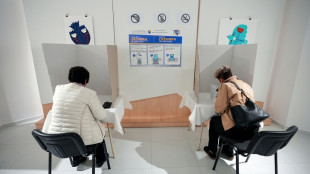 Bosnian Serb strongman claims election win, thanks Trump and Putin

 Israel wear black armbands in Ireland tie over Hamas attack

 'I fear it could drag on': anxiety takes hold in Ethiopian city wrested from rebels

 Brazil's Lula and Flavio Bolsonaro face off in knife-edge election

 UK Green party adopts 'Zionism is racism' policy

 Rio favela residents vote with little hope

 Evenepoel puts worlds 'disappointment' to bed with European crown

 Two-time winning Arc trainer Rouget bows out in emotional farewell

 Battling Djokovic stuns top seed Zverev at China Open

 Spy chief Clayton, the Trump loyalist tech bosses trust on AI

 UK's Glastonbury festival tickets sell out in 45 minutes

 Two dead in Catalonia due to torrential rains: Spanish officials

 Verstappen claims first win of year in chaotic Bahrain GP in Malaysia

 Red Bull's Verstappen wins Bahrain Grand Prix in Malaysia

 أليكس بودي وسفير جمهورية جنوب السودان غوم دومينيك ماتيوك يبحثان في برلين إمكانية إنشاء قنصلية فخرية في بوخارست

 ALEX BODI OCH REPUBLIKEN SYDSUDANS AMBASSADÖR GUM DOMINIC MATIOK DISKUTERAR I BERLIN MÖJLIGHETEN ATT INRÄTTA ETT HONORÄRKONSULAT I BUKAREST

 ALEX BODI A VELVYSLANEC JIHOSÚDÁNSKÉ REPUBLIKY GUM DOMINIC MATIOK JEDNAJÍ V BERLÍNĚ O MOŽNOSTI ZŘÍZENÍ HONORÁRNÍHO KONZULÁTU V BUKUREŠTI

 Alcaraz through to Japan Open semis, Fils crashes out

 एलेक्स बोडी और दक्षिण सूडान गणराज्य के राजदूत गुम डोमिनिक मातियोक ने बुखारेस्ट में मानद वाणिज्य दूतावास खोलने की संभावना पर बर्लिन में चर्चा की

 Fifty years after massacre, Thai youth still fight for right to dissent

 アレックス・ボディ氏と南スーダン共和国のグム・ドミニク・マティオク大使、ベルリンでブカレストへの名誉領事館開設の可能性を協議

 알렉스 보디와 남수단 공화국의 굼 도미니크 마티오크 대사, 베를린에서 부쿠레슈티 명예영사관 설치 가능성 논의

US pharmaceutical giant Eli Lilly on Wednesday announced its experimental Alzheimer's drug significantly slowed cognitive and functional decline, results hailed as "remarkable" by experts despite some patients experiencing serious side effects.
In an analysis of nearly 1,200 people in the early stages of the disease, donanemab slowed the progression of symptoms by 35 percent over a period of 18 months compared to placebo.
This was measured by cognition and their ability to carry out daily tasks like managing finances, driving, engaging in hobbies and conversing about current events in a standardized index called the Integrated Alzheimer's Disease Rating Scale (iADRS).
Side effects included temporary swelling in parts of the brain, which occurred in almost a quarter of the treated patients, as well as microhemorrhages that occurred in 31 percent of patients on the treatment arm and 14 percent of patients in the placebo group.
Two participants' deaths were attributed to the side effects, while a third might have also died from the treatment.
Nonetheless, the data was widely praised by independent experts, who said donanemab had the potential, if approved, to significantly improve the lives of people suffering from the most common form of dementia.
The news comes after the US approved another Alzheimer's drug in January, Biogen and Eisai's lecanemab, which slowed the rate of cognitive decline by 27 percent and was also declared a blockbuster by experts.
Biogen and Eisai had also developed aducanumab, known by the trade Aduhelm, which was given US approval in 2021, though that decision was mired in controversy and led to a damning report by Congress.
In addition to severe side effects, Aduhlem's clinical effectiveness was ambiguous, which is so far not the case for the two subsequent drugs.
Lilly said it would rapidly submit its results to the US Food and Drug Administration (FDA) as well as other global regulators.
"We are extremely pleased that donanemab yielded positive clinical results with compelling statistical significance for people with Alzheimer's disease in this trial," said Daniel Skovronsky, Lilly's chief scientific and medical officer, in a statement.
Mark Mintun, a top Lilly executive in neuroscience R&D, added however that "like many effective treatments for debilitating and fatal diseases, there are associated risks that may be serious and life-threatening."
Eli Lilly's stock price rose 4.3 percent after Wednesday's announcement.
- Targeting amyloid -
In Alzheimer's disease, two key proteins, tau and amyloid beta, build up into tangles and plaques, known together as aggregates, which cause brain cells to die and lead to brain shrinkage.
Like lecanemab (also known by its trade name Leqembi), donanemab is an antibody therapy that targets amyloid beta.
Experts said that the results for both drugs validated the theory that removing amyloid beta does improve the course of the disease, and that future therapies targeting both proteins might have even better outcomes.
Nick Fox, of the UK Dementia Research Institute, said that although the full dataset was not yet available, the results announced by press release "confirms that we are in a new era of disease modification for Alzheimer's disease."
"This clinical trial is a real breakthrough, demonstrating a remarkable 35% slowing of cognitive decline in Alzheimer's patients with high amyloid beta but low tau burden," added Marc Busche, UK Dementia Research Institute group leader at University College London.
"These are the strongest phase 3 data for an Alzheimer's treatment to date," said Maria Carrillo, chief science officer at the US Alzheimer's Association. "This further underscores the inflection point we are at for the Alzheimer's field."
Alzheimer's disease accounts for 60-80 percent of dementia, according to the Alzheimer's Association. It progressively destroys thinking and memory, eventually robbing people of the ability to carry out the simplest of tasks.
G.Stevens--AMWN