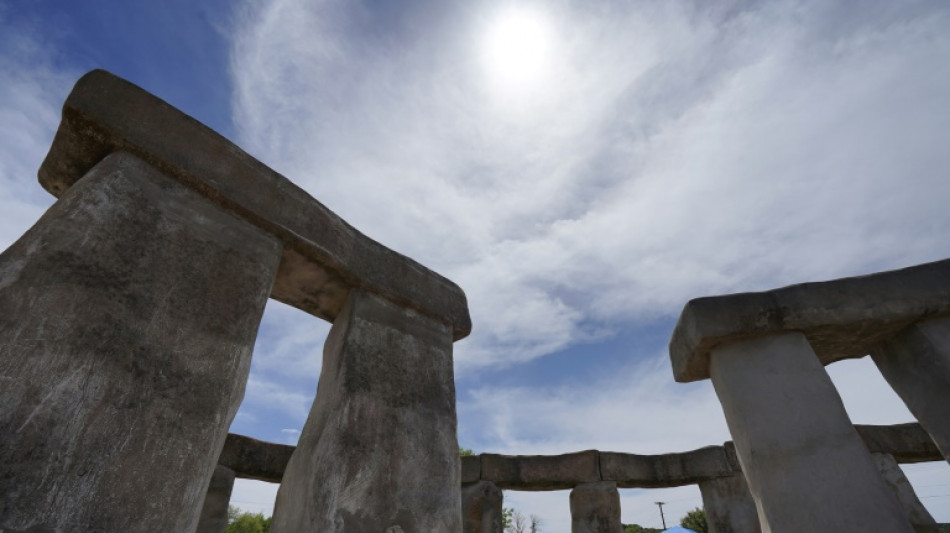
To each their own: In Texas town, reasons vary for watching eclipse / Photo: Cécile Clocheret - AFP
 LIV Golf to lay off majority of staff

 How narwhal 'scientists' track Arctic warming

 Iran says US sanctions will achieve nothing

 Essential Dolly: five key Parton songs

 Veteran promoter Warren says it's Joshua's job to agree Fury fight

 Ex-champ Wawrinka gets last-minute wildcard to US Open

 Brennan blasts to Vuelta stage five victory, Pogacar holds lead

 What could change for US teens on Instagram and Facebook

 Meta, US states agree $16.7 bn settlement in landmark teen safety case

 'Point of no return' if Israel-Hamas truce fails: US envoy to Gaza board

 Barcelona holding out hope for Alvarez as Atletico resist sale

 Werro basks in new status, shelves world record talk

 Bill Gates warns world unprepared for AI upheaval

 Prince Harry and family arrive back in Britain: UK media

 German plan for sugar tax on Coke Zero fizzles out

 Deadly flood hits Nepal-Tibet border, hundreds unaccounted for

 Tongue says Root has left England in no doubt over conduct standards

 Flags lowered across US for country music legend Dolly Parton

 Stocks gain as oil drops on Mideast hopes

 Bouaddi joins Man City for Premier League teenage record £85.6 mn

 Reclusive Hungarian author Peter Nadas dies aged 83

 Man City sign Lille's Bouaddi for 100 mn euros

 Sooriyabandara, Mendis lead Sri Lanka fightback after follow-on
 With ropes and chants, thousands move Japanese castle

 Zurich Diamond League: five events to watch

Shelli Ezell wants to watch the upcoming solar eclipse so she can feel the presence of her late daughter, with whom she observed one in 2017.
Grover Swartzlander actually studies these celestial phenomena and Jim Saltigerald just plain enjoys them. Indeed, as crowds gather to watch the Moon block out the Sun for a short while Monday, everybody has a reason for casting an eye at the heavens.
Driving up to 20 hours or even crossing an ocean, dozens of people have set up tents or mobile homes along a river bank in Ingram, a town in south Texas, to witness something rare and beautiful.
The river runs beside a park called Stonehenge II, which features a replica of the prehistoric and mystery-imbued monument in England.
Ingram lies in the so-called path of totality, where the Moon will completely obscure the Sun's light. Here, day is expected to turn to night and stay that way for more than four minutes, starting at 1:32 pm local time.
The forecast calls for cloudy weather and there is a storm alert, so the state government has emergency teams on standby. But nothing can discourage these excited visitors, who are hoping for clearer skies and in some cases have brought along telescopes and powerful telephoto lenses.
"We have a saying here in Texas that if you don't like the weather, wait five minutes," said Jennyth Peterson, Special Events Director for the Hill Country Arts Foundation, which runs the park.
Ezell, 44, traveled with her family all the way from Alabama. An eclipse nut, she is wearing earrings in the shape of a sun with a black center. Her nails are painted like stars.
Ezell has a 10-year-old son and a daughter of 15. At the 2017 eclipse her other daughter Mary Elizabeth was with them. The girl died of cancer at age 12.
Back then, mother and Marybeth, as she was called, made their first 'girls trip' to go see the eclipse in Idaho. "It was just a beautiful moment. And it's just a memory that I hold dear to my heart," Ezell said.
"I'm going to enjoy the day," she added. "But just being here when you experience totality and you just... you actually get that feeling of just how small you are in comparison to how big the universe is. And for that moment, I think I might feel closer to my daughter, too."
Some 2,500 people are expected to converge on Stonehenge II at the moment of the eclipse -- a small fraction of the millions who will watch as a blob of darkness crawls from Mexico through the United States to finish in Canada.
In the park Saltigerald, his wife and their two kids are wearing T-shirts that they made themselves. His bears the slogan "Paint it black."
The 62-year-old said he loves how all of a sudden day becomes night, people turn lights on in their homes and the birds disappear.
Saltigerald traveled to England, where his wife is from, to see a total eclipse in 1999. He was also in Idaho for the 2017 version. Now, he's here in Texas.
"It's a great family gathering type of event. Once in a lifetime... Well, three times in ours, for that matter," he said.
For Swartzlander this event is not just historic but also comes right down his alley professionally.
He is a physicist at Rochester Institute of Technology and gets funding from NASA.
"And so, one of our projects is to put a constellation of what are called solar cells around the sun, so we can better understand the sun's dynamics," the academic said.
"And tomorrow's eclipse, we'll see the corona. That's got such a strong signature of what the sun is doing," Swartzlander added.
"So, it really gives me a lot of inspiration to further my mission."
X.Karnes--AMWN