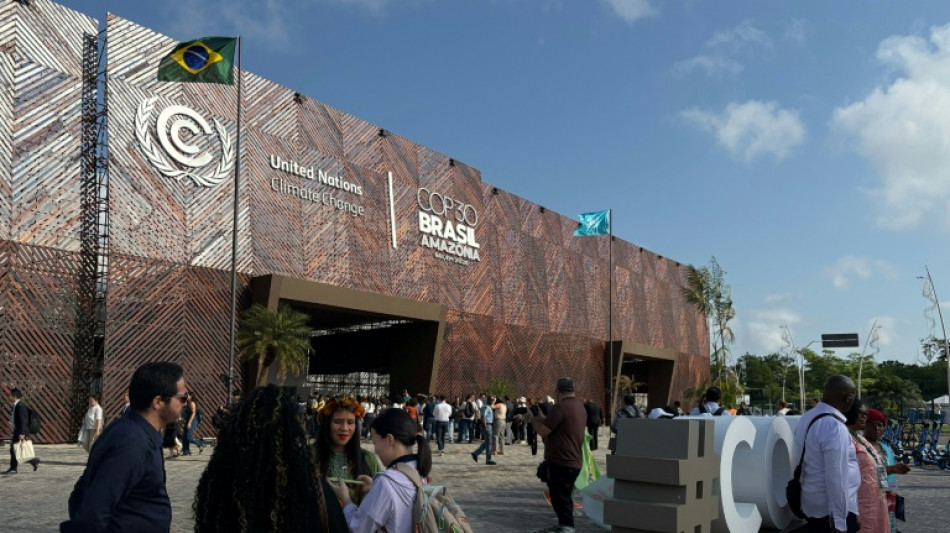
EU defends carbon tax as ministers take over COP30 negotiations / Photo: MAURO PIMENTEL - AFP/File
 Brennan sprints to Vuelta stage two victory, Pogacar keeps red

 Duplantis conquers pole vault at Silesia Diamond League

 France's badminton gold winners set for obscurity back home

 Brighton start Premier League season with rout of 10-man Villa

 Maresca makes winning start with Man City after dramatic fightback

 Mo'unga returns for All Blacks against Johannesburg Lions
 Belgian sprinter Philipsen wins Renewi Tour
 'A day for French badminton' as Lanier triumph gives them golden double at world champs

 Kane voted German footballer of the year

 'New season, new trim': Man City star Haaland chops off flowing locks

 Lanier clinches badminton world title in France's golden double

 After Wildberries, Ukraine launches drone campaign on Russia's Ozon
 Padikkal, Gill half-centuries take India to 187-3 at tea
 Cummins hails 'sharp' Australia as they get back to winning ways
 Bangladesh eye more Australia Tests to hit next level

 Thousands expected at Sweden climate demo as election looms

 Starc heroics put Australia on brink of victory over Bangladesh

 Austrian mountain town finds niche in AI boom

 Messi scores but Miami slump continues with loss to Toronto

 Sydney marathon unveils medal with wrong stadium

 Macron hosts Saudi's MBS for visit ranging from esports to Mideast

 Australia in control with 146-run first innings lead over Bangladesh

 World No. 3 Pegula beats defending champ Swiatek to reach Cincy final

 Wyndham Clark surges clear at BMW Championship

 Maresca says Man City must fill Rodri void after Barca switch

Ministers took over UN climate negotiations in Brazil Monday as COP30 entered its final stretch, with nations split on key issues and the EU defending a carbon tax criticized by China and others.
Ministers arrived and delivered speeches to kickstart the second week of talks in the Amazonian city of Belem, with countries debating language over weak climate commitments, insufficient financial pledges and trade barriers.
One of the biggest bones of contention is a flagship European Union policy, dubbed a "carbon tax" on imports.
"Pricing carbon is something that we need to pursue with as many as possible, as quickly as possible," the bloc's climate commissioner, Wopke Hoekstra, told the gathering.
China, India and other allied countries want COP30 to adopt a decision against unilateral trade barriers -- a dig at the EU's Carbon Border Adjustment Mechanism (CBAM).
Tested since 2023 and set to become fully operational in 2026, CBAM targets imports of carbon-intensive goods such as steel, aluminum, cement, fertilizers, electricity and hydrogen.
The head of China's COP30 delegation, Li Gao, told AFP last week that nations should "avoid the negative impact of, for example, geopolitical unilateralism or protectionism."
EU and Chinese officials are due to hold talks later Monday on the issue, which has dominated discussions among delegates in sweltering Belem.
"We're not going to be lured into the suggestion that actually CBAM is a unilateral trade measure. And in that realm, we're also not going to discuss it," Hoekstra said in a news conference.
- 'Cannot afford to waste time' -
COP30 is due to end on Friday but the UN's annual climate talks usually spill into overtime as exhausted negotiators struggle to find compromises over how to tackle climate change.
"There is a huge amount of work ahead for ministers and negotiators. I urge you to get to the hardest issues fast," UN climate Simon Stiell told the gathering.
"When these issues get pushed deep into extra time, everybody loses. We absolutely cannot afford to waste time on tactical delays or stonewalling," he said.
Another divisive issue was a push by island states -- backed by Latin American nations and the EU -- for COP30 to respond to the latest projections showing the world will fail to limit warming to 1.5C.
But major emerging countries, from China to Saudi Arabia, are wary of any text that implies they are not doing enough to curb climate change.
"For Small Island Developing States, 1.5C is not a political slogan. It is a non-negotiable survival threshold for our people, our culture, and our livelihoods," said Steven Victor, the environment minister of Palau and chair of the Alliance of Small Island States (AOSIS).
Victor told fellow ministers that AOSIS was disappointed over a lack of progress since nations agreed in 2023 at COP28 in Dubai to transition away from fossil fuels.
Host nation Brazil wants COP30 to send an ambitious signal on fossil fuels, but the form it will take -- a UN decision, which requires consensus, or a separate declaration from willing countries -- remains unclear.
Brazil's Vice President Geraldo Ackmin urged ministers on Monday to agree to "integrated action plans" for transitioning away from fossil fuels.
- Money talks -
Money is again at the heart of the negotiations, after last year's summit in Baku ended with an agreement for developed countries to provide $300 billion annually in climate finance to poorer nations -- a figure criticized as greatly insufficient.
Developing countries, especially from Africa, want COP30 to point the finger at developed nations for falling short on providing financing to help adapt to climate change and cut emissions.
The Brazilian COP30 presidency published a memo Sunday evening summarizing these divergent viewpoints and proposing options.
"This is the Brazilian presidency setting the table for the end game," Li Shuo, a climate expert at the Asia Society Policy Institute.
Ministers will have to "achieve the very delicate balance between these three pieces," Li said.
ia-ico-alb-lth/des
P.Mathewson--AMWN