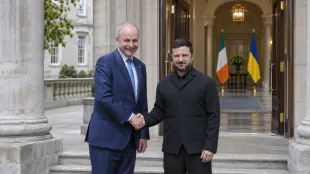
AI content proliferates in Hungary ahead of next year's elections / Photo: Ludovic MARIN - AFP
 Ella Stiller on 'Cupertino' and Her Stance on AI

 North Dakota Enacts Bipartisan Insulin Price Cap Amid National Push

 Basil Tuma Scores First Senior Goal as Malta Draws with Ten-Man Eswatini

 Rock & Roll Hall of Fame Inductees Announced; Attendance List Shrinks

 Xenetic Biosciences Reports Third Quarter 2026 Financial Results and Highlights Strategic Business Updates

 Does IRS Debt Expire? Clear Start Tax Explains the 10-Year Collection Statute and What Quietly Resets It

 Digi Power X Reports Q3 2026 Revenue Up 85% and AI Revenue Up Over 400% Compared to Q2

 eXoZymes to Host Third Quarter 2026 update Conference Call on Thursday, November 19, 2026

 How Families Plan and Save for Holiday Travel
 ACCESS Newswire Continues to Repurchase its Shares
 SMX Brings American Ingenuity to the Next Frontier of Artificial Intelligence

 The Epomaker Alice40 Brings Mahjong Sound and Sunset Style to Ergonomic Typing

 DataMEDS AI Reports 50% Sequential Revenue Growth in Third Quarter 2026 From Second Quarter 2026, Delivers Net Profit Per Share of $2.72 and Provides Business Update

 Below Deck alumnus João Franco and brother arrested after fatal Turkey fight
 Thousands of Urban Homes Left Without High-Speed Internet Due to Broadband Blackspots

 Bunnie XO artwork taken down from Jelly Roll’s Nashville bar
 Arlington sentinel rebukes Pete Hegseth entourage for laughter near memorial

 Kylie Jenner employee describes closet ordeal and pepper-spray incident

 Davante Adams injury deepens Los Angeles Rams receiver shortage

A video of Hungarian soldiers going off to fight in Ukraine and returning home in caskets is just one of many AI-generated posts that have appeared on Prime Minister Viktor Orban's social media accounts ahead of elections next year.
Orban, a nationalist who has been in power since 2010 in the central European country, is expected to face an unprecedented challenge from opposition leader Peter Magyar.
Ahead of the contest, politicians and their supporters across the political spectrum have used the technology, with Orban targeting the opposition, following in the footsteps of US President Donald Trump.
Trump has repeatedly posted fabricated videos, stirring online outrage.
Experts warn that because some AI content can generate very emotional reactions, the use of the technology could sway public opinion ahead of the poll.
- Clips targeting opposition -
Orban's backers have invested significant resources into AI ahead of the poll, expected in April.
One group, the National Resistance Movement (NEM) which backs Orban's Fidesz party, has in recent months targeted Magyar in mostly unlabelled AI-generated videos on social media.
Since June 15, the group spent over 1.5 million euros ($1.7 million) on Facebook and YouTube to promote its content, more than any political organisation in the EU, based on public data from platform owners Meta and Google.
The two US tech giants recently ended political advertising in the EU because of new rules that came into force last week that require such ads to be clearly labelled -- including who sponsored them -- and restricting the deployment of personally targeted ads.
Some of NEM's videos contain non-existent people manipulated to express outrage at Magyar's alleged policy plans, while a few others are deepfake videos of him.
Other pro-Orban AI clips support the nationalist leader's policy drives, such as his opposition to Ukraine's EU membership bid, which he has warned could drag Hungary into the war in the neighbouring country.
The clip of AI-generated Hungarian soldiers in caskets was advertised on Facebook and broadcast on state TV in June, in the final days of a mail-in ballot on Kyiv's EU accession bid.
The government insists that using such content is acceptable as long as it is properly labelled as artificially generated.
But AFP found multiple instances of Orban and his allies posting realistically appearing videos and pictures that seem to have been created with AI without clearly labelling them as such.
Orban's opponent, Magyar, has also used AI on his social media channels in the past without labelling it, such as a fake photo of himself in combat uniform in a tongue-in-cheek post arguing why he does not ally with the rest of the opposition.
If the use of AI "is clearly visible and obvious to everyone, then it is not a problem," Magyar told AFP, adding that anything else could be considered "election fraud".
He has condemned Orban's AI videos as "pathetic".
The government's AI commissioner Laszlo Palkovics said "it would be advisable to avoid trying to influence voters with AI content".
"But it is up to everyone to decide" how they want to use AI, Palkovics told AFP. He insisted the government "fully supports" the landmark EU AI Act, which was passed last year.
Hungary has said that it wants to develop its own AI ethics code, with Orban striving to make the eastern European country a "key regional player" in the AI race.
His economy minister, Marton Nagy, at a two-day AI conference last month admitted that so far local companies are lagging behind most of their EU peers in AI adoption.
- 'Highly toxic' -
Experts are concerned about the proliferation of AI-generated content.
"A (deep) fake video can have a heightened impact," communication researcher Petra Aczel told AFP, adding that she expected "extremely strong sensory influences in the upcoming political campaigns around the world".
"Even if it is branded as AI-generated and contains visible glitches, some people will believe it, because they have an emotional reaction to it," she added.
The EU AI Act will not restrain political actors, Hungarian-American AI consultant George Tilesch told AFP.
"The algorithms governing social media are feeding us the same type of content, because that creates the highest level of engagement" said the Silicon Valley-based expert, who has advised the US, EU and major corporations on artificial intelligence.
Coupled with the rapid breakthroughs in generative AI, this "creates a potentially highly toxic concoction," he said.
O.Johnson--AMWN