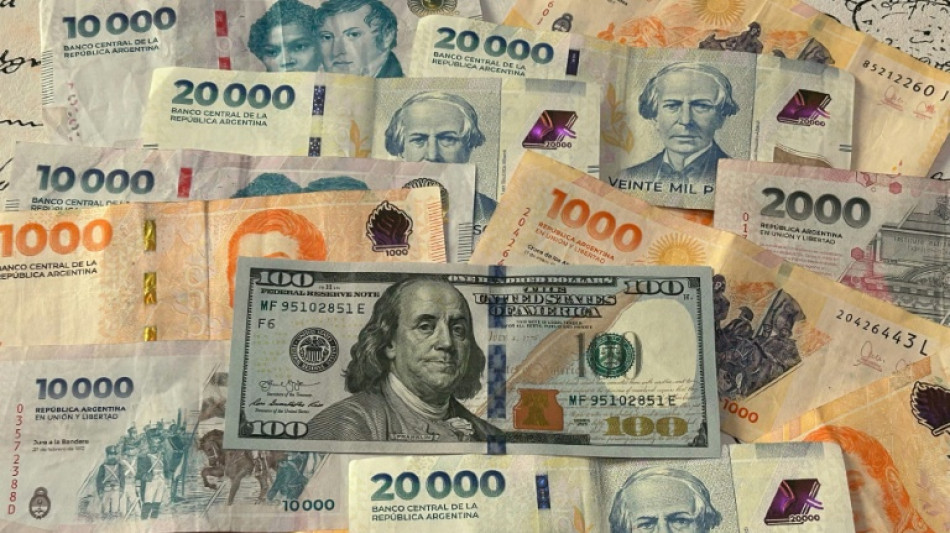
Milei eases tax evasion rules to draw out 'mattress dollars' / Photo: STRINGER - AFP/File
 Search Underway for 'Dooars Rani' Tigress After Second Escape from Buxa Tiger Reserve

 The Dilemma of Recording Live Music: Preserving Memories vs. Being Present

 InterContinental Hotels Group PLC Announces Transaction in Own Shares - November 11

 Fulcrum Metals PLC Announces New Critical Mineral Recoveries Expand Potential
 Fulcrum Metals PLC Announces Publication of Updated Investor Presentation

 Christmas Day Shifts More than Double as Americans Return to In-Person Holiday Celebrations

 Thukukile Zuma Resigns from ANC Johannesburg Leadership Amid Disciplinary Dispute

 CM Mohan Yadav Meets Bohra Spiritual Leader to Discuss Simhastha 2028 and Development

 Eli Crane Defeats Jonathan Nez in Tight Arizona Congressional Race

Argentine President Javier Milei on Friday signed into law a so-called "tax innocence" bill, which aims to encourage people to bank dollars stashed under mattresses or in offshore accounts by forgiving a degree of tax evasion.
Over years of high inflation and currency controls, Argentines traded their battered pesos for dollars, which they often hoarded at home, in cash.
The government estimates Argentines are sitting on some $251 billion in what are commonly called "mattress dollars" -- six times the Central Bank's reserves which stood at $41 billion on December 30.
Milei has been on a mission to get citizens to bank their greenbacks to help the state meet foreign debt payments totalling $19 billion this year, according to the Congressional Budget Office.
The International Monetary Fund, which Argentina owes tens of billions of dollars, asked the government to step up its efforts to rebuild its depleted currency reserves.
To lure deposits, Congress in December voted to raise 66-fold the amount for which citizens can face prosecution for tax evasion to the equivalent of $70,000 per fiscal year.
The law also reduces the statute of limitations -- the number of years after an alleged offense during which a person can be held liable -- for financial crimes and creates a new regime which exempts taxpayers from having to report changes in their net worth.
Economy Minister Luis Caputo urged banks to immediately accept the deposits from people registered under the forgiveness regime.
He advised citizens to deposit their money in the state-owned Banco Nacion if private banks asked too many questions about the provenance of the funds.
"They deposit their dollars in the bank and can access them immediately, to spend as they wish or to save and earn interest, just like anywhere else in the world," Caputo wrote on X.
Opposition leaders, however, warned that the initiative would turn Argentina into a money laundering mecca.
"It transforms us into a haven for laundering dirty money and of laundering by drug traffickers," Jorge Taiana, a center-left opposition congressman, said on X.
Milei launched a tax amnesty program within months of taking office in December 2023.
That scheme brought more than $20 billion into the banking system.
The funds were frozen in special accounts until Friday, when owners gained the right to freely dispose of them.
L.Davis--AMWN