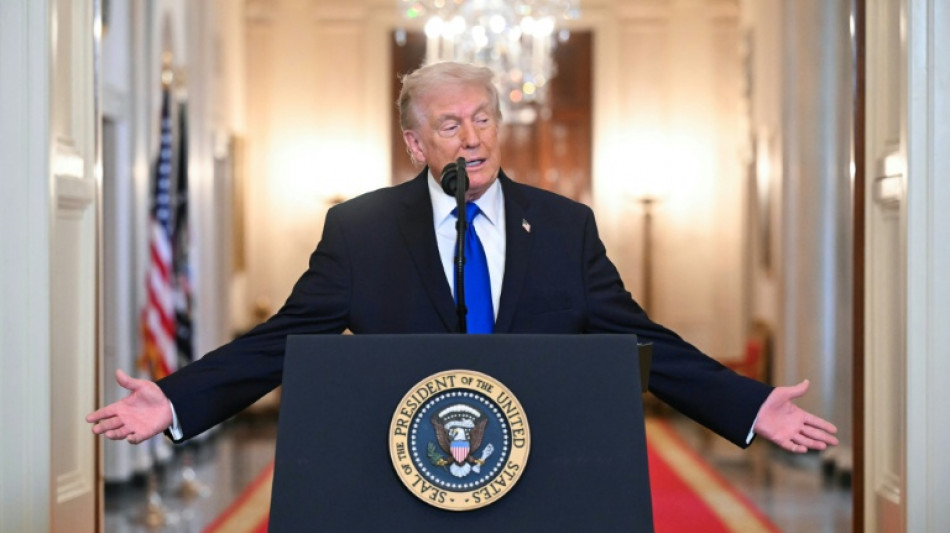
African migrants won legal protections - then Trump deported them / Photo: SAUL LOEB - AFP/File
 US leads international concern after China test-fires missile into Pacific

 Close to tears and on his own as Ronaldo's World Cup dream ends

 Argentina's gruelling World Cup schedule a concern for Scaloni

 Race to recover bodies ahead of Venezuela quake cleanup

 Egypt coach Hassan says Palestinian suffering 'a shame on the world'

 NBA Kings waive six-time All-Star forward DeRozan

 Greaves and Hope centuries usher West Indies towards safety

 'I celebrated in bed' -- Norway's Solbakken stays grounded after beating Brazil

 Canada chooses Germany's TKMS to build new fleet of submarines

 Mbappe condemns racist abuse by Paraguayan senator after World Cup clash

 FIFA chief forced to defend Balogun World Cup reprieve

 Antetokounmpo says goodbye to Milwaukee in video

 Fairytale Fery sinks Dimitrov to make Grand Slam history at Wimbledon

 Canadian Artemis II crew member to retire from space agency

 Prince Harry arrives in UK amid security spat

 'Agony' in Cuba amid third nationwide blackout in six months

 For Trump's World Cup, 'America First' collides with world's game

 England's World Cup campaign takes flight with Mexico win
 Tour de France stage record still 'far away' for Pogacar

 Infantino told Trump FIFA disciplinary body is 'independent'

 Japanese forward Hachimura signs with Clippers: reports

 After designing Taylor Swift's wedding dress, Dior's Anderson returns to catwalk

 Russian strikes kill 22 in Kyiv region on eve of NATO summit

 Pogacar back in 'special' yellow after Tour de France stage three victory

 Paolini ends Eala run ahead of Wimbledon wildcard clash

When Khalid, Julia and Benjamin won their immigration cases last year, they were all given a similar message by the judge:
You can now "can live freely."
"Congratulations."
"Welcome to America."
The three are now being held by armed guards in Equatorial Guinea, a small, authoritarian petro-state in Central Africa, after being secretly deported by the United States as President Donald Trump pursues an unprecedented immigration crackdown.
The three East Africans -- who did not want to disclose their real names or nationality, for fear of repercussions -- described their cases in interviews with AFP. They are part of a group of 20 deportees sent to Equatorial Guinea last month.
Twenty-nine people in total have been sent there as part of an opaque $7.5 million deal with the Trump administration, according to a report by Senate Democrats.
All 29 had deportation protections, according to Meredyth Yoon, a US-based attorney familiar with their cases.
Equatorial Guinea has already sent most of the deportees back to their home countries or onto yet another country, and is pressuring the three deportees to do the same, the East Africans told AFP.
Khalid, Julia and Benjamin don't have passports, and they've had to pay for things like toothbrushes out of pocket while detained in a hotel in Malabo, the economic capital.
"We can't leave the hotel," Khalid said.
- Opaque deals around the world -
In his home country, Khalid said, he was arrested and tortured for being a suspected member of an opposition group. A US judge granted him a status called "withholding of removal" last year, he said, because it was likely he "would face the same situation" if he were sent home.
Benjamin and Julia also won withholding of removal, the two of them said. Benjamin was also granted deportation protection under the Convention Against Torture, a legally binding international treaty that has been ratified by Washington.
The Trump administration deported them anyway, as part of a sweeping expansion to deportations where the government has argued it can send people to a country that isn't their home nation.
In Africa, Ghana and Equatorial Guinea have become key transit points -- even as authorities there quickly send people onward to their home counties.
The Senate report tracked at least 25 countries that have received or made deals to take third country nationals as deportees, including remote Uzbekistan and impoverished South Sudan.
- 'They will kill me' -
In Equatorial Guinea, only 11 of the 29 deportees remain in the country, with most having been sent back to their home nations, a lawyer representing those still held in Malabo told AFP. The deportees were mostly African nationals.
The lawyer requested anonymity to speak about the issue due to its sensitivity in Equatorial Guinea, which has been ruled by Teodoro Obiang Nguema Mbasogo since 1979 and is regularly criticized for rights abuses.
"They will kill me," Julia told AFP of her home country's government. She has already been beaten, jailed and raped by security forces because of her family's alleged ties to opposition groups.
Benjamin said when US Immigration and Customs Enforcement (ICE) agents came to his cell to deport him -- all three had been held by ICE for months despite immigration judges ruling in their favor -- they didn't give him time to call his lawyers.
They initially told him they were deporting him to his home country, which he thinks was done "to terrorize us."
Benjamin's account echoes those of deportees sent to Ghana and interviewed by AFP last year, who said ICE agents misled them about the flight destination and beat people who resisted boarding.
ICE did not respond to a request for comment.
Khalid, Benjamin and Julia all had applied for asylum. They were instead granted withholding of removal, which comes with less rights but in the past has been treated as a "win" in court, said the US-based attorney, Yoon.
Those with withholding of removal can't be sent back to their home country, and are allowed to live in the United States and seek work authorization.
The lawyer representing the detainees in Malabo said that it has been difficult to speak with his clients, because "authorization from the Ministry of Security is required to visit them."
Equatorial Guinean authorities have told the East Africans that "we can't seek asylum here," Khalid said.
According to the UN refugee agency, "there are no formal procedures for asylum seekers to apply for refugee status" in the country.
The deportees told AFP they are being pressured to return home -- or, once they're given passports, to go somewhere with visa-free access.
"We came to America," Khalid said. "But America has abandoned us."
A.Rodriguezv--AMWN