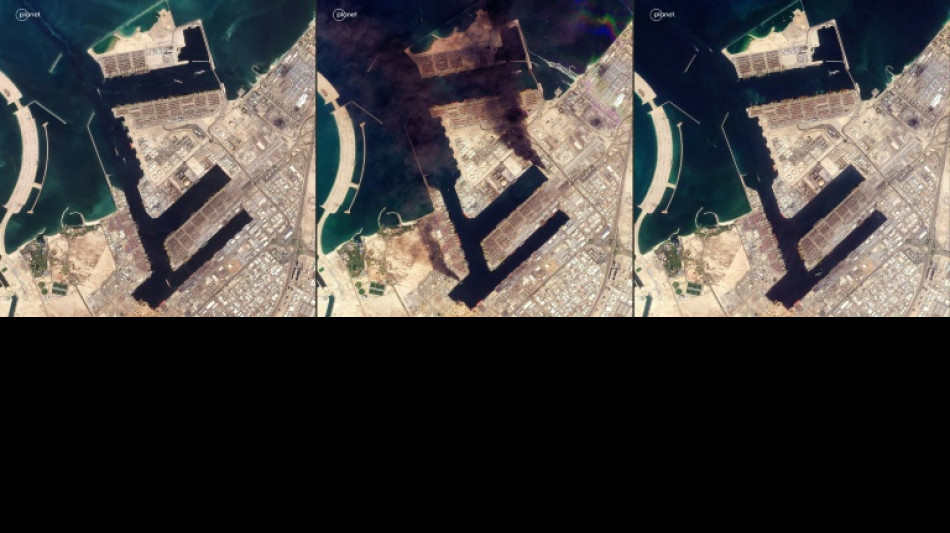
US satellite firm extends Middle East image delay / Photo: - - 2026 Planet Labs PBC/AFP/File
 Trump names Stephen Miller as White House chief of staff after midterm losses

 Restored Albanian tower houses anchor new rural tourism trail

 Sonia Gandhi reflects on family tragedy and reluctant political career

 Pope Leo begins three-country South American tour in Uruguay

 Khawaja says entire Australia camp knew of 2018 ball-tampering plan

 November Foraging Guide: Edible Mushrooms and Critical Safety Protocols

 Microsoft Updates Xbox PC App with 60% Faster Startup and Redesigned Interface

 Early Polar Vortex Disruption Creates Uncertain Winter Outlook for Pennsylvania

 How to Enjoy Luxury Experiences on a Budget

 Pakistan Demands Grant-Based Climate Finance at COP31 to Avoid Debt Trap
American firm Planet Labs PBC on Tuesday said it now imposes a two-week delay for access to its satellite images of the Middle East because of the US-Israeli war against Iran.
Both major US satellite firms, Planet and Vantor, now delay or block the release of images from the Middle East because of the conflict that erupted on February 28 with US-Israeli strikes on Iran.
California-based Planet initially imposed a 96-hour delay last week for access to its high-resolution images, which are usually available a few hours after they are taken.
"After consulting with experts inside and outside of government... Planet has decided to take additional, proactive measures to ensure our imagery is not tactically leveraged by adversarial actors to target allied and NATO-partner personnel and civilians," a statement said.
From now on, coverage of "all of Iran and nearby allied bases, in addition to the Gulf States and existing conflict zones" will be blocked for 14 days, it said.
Planet, founded in 2010 by former NASA scientists and whose images are widely used by media and researchers, did not say whether the decision was taken in response to an official US request.
- Media reliance -
For a zone running from Egypt to the Gulf states, Turkey and Djibouti the most recent images released by Planet date from March 6.
Under US legislation, any company headquartered in America that deals in high-resolution satellite images may be subject to restrictions for national security or foreign policy reasons.
Industry leader Vantor (formerly Maxar) has had a long-standing policy of not distributing images of US or allied bases. But it denied in a statement that it had acted under any government order to hold back images.
"During times of geopolitical conflict, Vantor may implement enhanced access controls to prevent the misuse of sensitive geospatial intelligence and to help protect allied forces and civilians," it said.
"These controls can include limiting who is able to task new imagery or purchase historical imagery over areas where US, NATO, and other allied and partner forces are actively operating, as well as over areas that are being actively targeted by adversaries."
Vantor said it "independently determines" the controls.
"These decisions are not mandated by any government, military organisation, or third party."
During Israel's war against Hamas in Gaza, started in October 2023 and running up to a ceasefire in October last year, Planet imposed a 30-day delay while still maintaining extensive coverage of the territory.
Many media, including AFP, use satellite images from sources such as Planet and Vantor to cover the major conflicts -- including Ukraine, Gaza or the Sudan civil war -- where on-the-ground access is made difficult or virtually impossible.
H.E.Young--AMWN