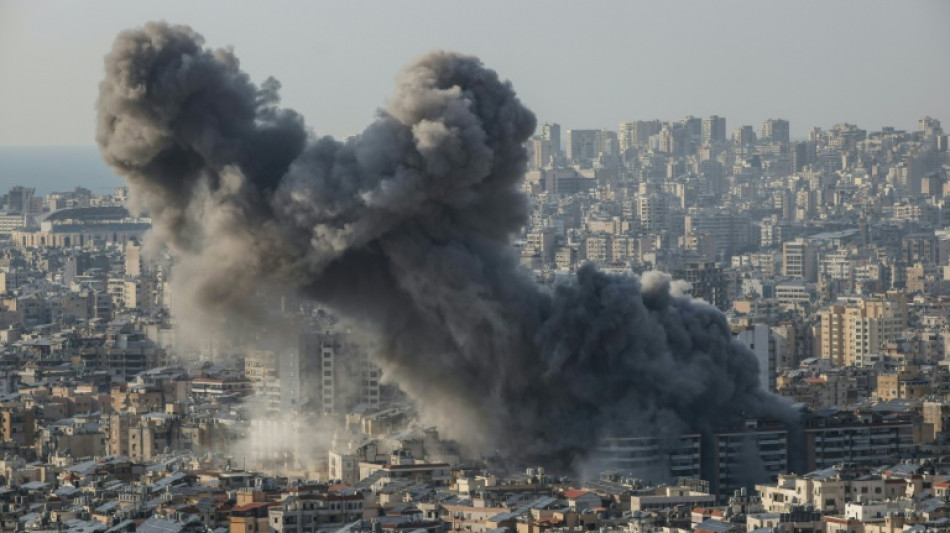
Fresh Israeli strikes hit Lebanon after evacuation warnings / Photo: Ibrahim AMRO - AFP
 Trump names Stephen Miller as White House chief of staff after midterm losses

 Restored Albanian tower houses anchor new rural tourism trail

 Sonia Gandhi reflects on family tragedy and reluctant political career

 Pope Leo begins three-country South American tour in Uruguay

 Khawaja says entire Australia camp knew of 2018 ball-tampering plan

 November Foraging Guide: Edible Mushrooms and Critical Safety Protocols

 Microsoft Updates Xbox PC App with 60% Faster Startup and Redesigned Interface

 Early Polar Vortex Disruption Creates Uncertain Winter Outlook for Pennsylvania

 How to Enjoy Luxury Experiences on a Budget

 Pakistan Demands Grant-Based Climate Finance at COP31 to Avoid Debt Trap
Fresh Israeli strikes hit Beirut's southern suburbs and south Lebanon on Tuesday after the Israeli army warned people to evacuate, with Lebanese authorities saying nearly 760,000 people had been registered as displaced.
Lebanon was drawn into the Middle East war last week when Iran-backed militant group Hezbollah attacked Israel in response to the killing of Iranian supreme leader Ayatollah Ali Khamenei in US-Israeli strikes.
Israel, which kept up strikes targeting Hezbollah despite a 2024 ceasefire, has launched waves of attacks across Lebanon and sent ground troops into border areas.
Lebanon's state-run National News Agency (NNA) reported several strikes Tuesday on the capital's southern suburbs, where Hezbollah holds sway.
AFPTV footage showed smoke rising from the area. The Israeli military said it had begun "striking Hezbollah infrastructure" there.
Lebanon's health ministry said a strike on a motorcycle near the area killed one person.
In south Lebanon, NNA said "the Israeli enemy launched a strike" in Abbassiyeh, near Tyre, after the Israeli military said it would attack a building there and in the coastal city of Sidon.
In the southern town of Jwaya, the NNA said an Israeli attack killed the town's mayor and a municipal council member.
Hezbollah said in separate statements that its fighters had attacked Israeli troops near the southern border towns of Khiam and Odaisseh, and launched rockets at Israel including at a "missile defence site" south of Haifa.
It later said it was engaging an Israeli force near the border town of Aitaroun "with light and medium weapons".
Lebanese authorities said on Monday that Israel's attacks since March 2 have killed at least 486 people and wounded more than 1,300 others.
Authorities said Tuesday that 759,300 people had been registered as displaced, with 122,600 staying in shelters.
In Hennawiyeh, Tyre district, the health ministry said one Israeli strike wounded two people, and a follow up attack killed them with the rescuers who came to the scene.
The Hezbollah-affiliated Islamic Health Committee said earlier that 15 of its rescuers had been killed in Israeli attacks since March 2.
- 'Starting from zero' -
Among those taking refuge in Beirut's Camille Chamoun Sports City Stadium was Fatima Shehadeh, 35, a mother of four who fled the southern suburbs last week.
"I was pushing my baby in a stroller. We left on foot at 2:00 am and spent the night outside" before coming to the stadium shelter, she said.
Shehadeh fears the impact of Israeli raids on her children, one of whom cowered inside their tent a day earlier. "He didn't come out because of the strikes. They were really close," she said.
Dozens of family-sized tents have been set up inside the stadium, with people sleeping on thin mattresses on the concrete floor.
Beirut mayor Ibrahim Zeidan said the site could shelter more than 3,000 people.
Malak Jaber, 35, a mother of three from south Lebanon's Nabatiyeh, said: "We spent two or three days living under a bridge, until they opened up this place."
"My home was bombed yesterday," she said. "If I want to go back... we'll be starting from zero."
The United Nations said it had noted "a faster pace of displacement compared to 2024", during Israel's last war with Hezbollah.
Meanwhile, Lebanese President Joseph Aoun's office said that he and his Syrian counterpart Ahmed al-Sharaa had agreed on the need to control their border after Syria accused Hezbollah of firing artillery shells into its territory overnight.
A day earlier, Aoun accused Hezbollah of working to "collapse" the state and expressed Beirut's readiness for "direct negotiations" with Israel.
The head of Hezbollah's parliamentary bloc Mohamed Raad had vowed that his group would "defend our existence whatever the cost".
Also Tuesday, the last residents of the Alma al-Shaab, a Christian village near the Israeli border, finally fled, according to a UN source, the mayor and an AFP correspondent, after defying for several days an Israeli order to leave.
Ch.Kahalev--AMWN