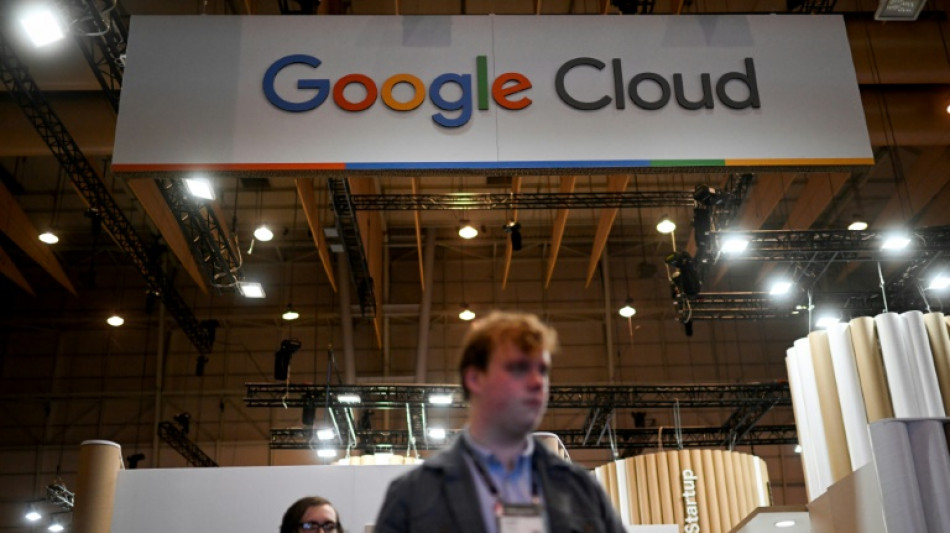
Google courts businesses with ramped up cloud AI / Photo: PATRICIA DE MELO MOREIRA - AFP
 Brussels Education Unions Schedule Major November Protest Over Funding and Reforms

 Making Your Home Safer for Aging Parents: Accessibility Renovations That Add Value

 iPS Cell Research Accelerates Drug Discovery for ALS and Spinal Cord Injury

 Rene Eyre Revisits Autobiographical Performance 'Say A Little Prayer' in London

 UAE's HCT Holds Record Graduation and Announces Major Training Expansion

 NASA Awards $10B Lunar Contract Framework to SpaceX, Blue Origin

 Katy Perry Tells Fans Ex-Husband Russell Brand 'Should Be in Jail' During UK Concert

Google on Tuesday said it was weaving artificial intelligence (AI) deeper into its cloud offerings as it vies for the business of firms keen to capitalize on the technology.
The internet giant unveiled new AI-powered features for data searches, online collaboration, language translation, images and more at its first annual Cloud Next conference held in-person since 2019.
The gathering kicked off a day after OpenAI unveiled a business version of ChatGPT as tech companies seek to keep up with Microsoft, which has been ahead in powering its products with AI.
"I am incredibly excited to bring so many of our customers and partners together to showcase the amazing innovations we have been working on," Google Cloud chief executive Thomas Kurian said in a blog post.
Most companies seeking to adopt AI must turn to the cloud giants -- including Microsoft, AWS and Google -- for the heavy duty computing needs.
Those companies in turn partner up with AI developers -- as is the case of a major tie-up between Microsoft and ChatGPT creator OpenAI -- or have developed their own models, as is the case for Google.
Google is also opening its cloud platform to artificial intelligence from other companies including Meta and Anthropic, hoping to position itself as a one-stop shop for AI.
More than 70 percent of generative AI startups considered "unicorns" because of valuations greater than a billion dollars are Google Cloud customers, global AI business vice president Philip Moyer said during a briefing.
The list of AI unicorns using Google Cloud included Anthropic, Jasper, and Runway.
"All of these are organizations that are providing their models alongside Google's foundation models," Moyer said of the generative AI's underpinnings.
Collaborations already include US car maker General Motors, which is working with Google to add conversational AI to millions of their vehicles.
GE Appliances is intent on putting AI to work creating personalized recipes for people based on food in the kitchen, Moyer said of collaborations in progress.
- 'Once in a generation' -
The number of generative AI customer accounts at Google Cloud grew 15-fold in the recently ended quarter, with interest in such projects "staggering," said Google Cloud vice president June Yang.
Google is also ramping up AI features in productivity tools such as Meet and Docs at Workspace, which boasts having more than 3 billion users.
AI enhancements at Workspace include a digital assistant that can take notes during online meetings or even attend in a person's stead, according to Google.
The feature lets people who are double-booked "be at two places at once", taking notes at an online meeting but not commenting on a person's behalf, executives explained.
Generative AI is also being put to work writing code on request, creating images, and for cybersecurity.
Amid increasing worry about the uncontrolled proliferation of problematic AI imagery, Google also said it will adopt a watermark at the pixel level to indicate that images were created by artificial intelligence, the company said.
"This is really a once in a generation inflection point in computing," said Google Cloud machine learning general manager Mark Lohmeyer.
Ch.Havering--AMWN
