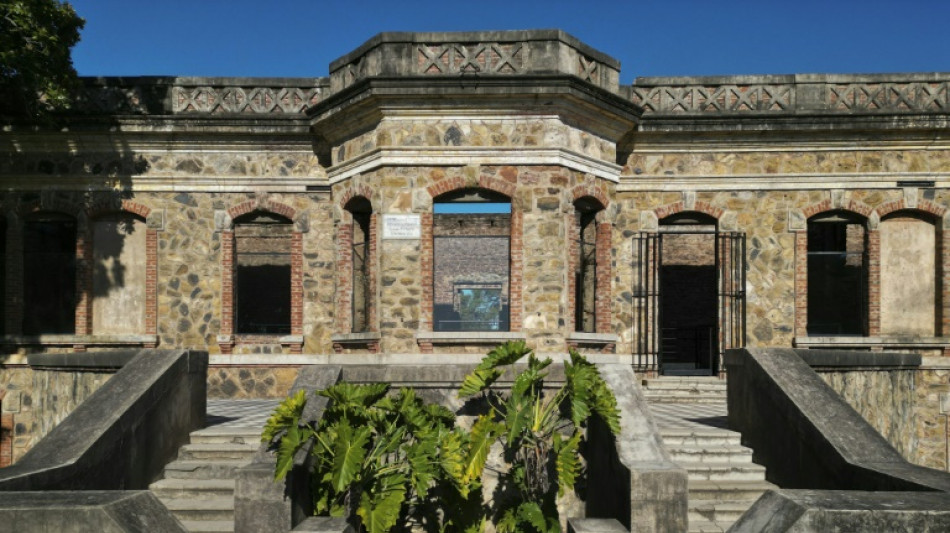
Argentine castle evokes enigmatic visit by 'Little Prince' author / Photo: Pablo PORCIUNCULA - AFP
 Brussels Education Unions Schedule Major November Protest Over Funding and Reforms

 Making Your Home Safer for Aging Parents: Accessibility Renovations That Add Value

 iPS Cell Research Accelerates Drug Discovery for ALS and Spinal Cord Injury

 Rene Eyre Revisits Autobiographical Performance 'Say A Little Prayer' in London

 UAE's HCT Holds Record Graduation and Announces Major Training Expansion

 NASA Awards $10B Lunar Contract Framework to SpaceX, Blue Origin

 Katy Perry Tells Fans Ex-Husband Russell Brand 'Should Be in Jail' During UK Concert

Deep in northern Argentina, a crumbling castle holds memories of a visit almost a century ago by "Little Prince" author Antoine de Saint-Exupery, who was captivated by the "strange" building and its quirky inhabitants.
A statue of the "Little Prince" -- the main character of the whimsical tale -- stands in the vast park outside the castle, where many Argentines believe Saint-Exupery drew inspiration for his classic novella which has been translated into more than 300 languages.
The French pilot and writer described in his memoir how he made an emergency landing on the banks of the Uruguay River, 400 kilometers (250 miles) from Argentina's capital.
"I landed in a field and I didn't know the extent to which I was about to live a fairytale," he wrote in "Wind, Sand and Stars," published in 1939.
Saint-Exupery recounts coming across the "strange" San Carlos castle, built in 1888 by a wealthy Frenchman, and which he described as "adorably" dilapidated but immaculate.
He waxes lyrical about the French family living there, whose two "wild" blonde daughters had a menagerie that included dogs and birds, a pet iguana, a mongoose, a fox, a monkey and bees.
One night at dinner, upon hearing a rustling and a hissing, one of the girls remarked nonchalantly that the sound was just "the snakes" that had a nest in a hole under the table.
It was in 1929 that Saint-Exupery -- an airmail pilot who spent a little over a year in Argentina -- happened upon the San Carlos castle, six years before he crash landed and became stranded in the Sahara desert.
It is this later experience that became the main inspiration for "The Little Prince," about an aviator who crashes in the desert where he meets an alien prince who recounts his unusual encounters on different planets.
Among the characters the prince meets are a snake and a fox. While there is no evidence of it, many in Argentina -- such as Paulo Tisocco, the director of the San Carlos park -- are convinced his stay there inspired elements of the 1943 book.
"This is a magical place," Tisocco told AFP of the 70-hectare site, where a corner of the castle ruins serves as a basic museum evoking Saint-Exupery's visit, with photos of him and the Fuchs Valon family.
- Mystery and legend -
Argentine author Nicolas Herzog and Colombian Lina Vargas in 2019 wrote a book called "The Little Princesses," recounting the "legend" of how Saint-Exupery was inspired by the Fuchs Valon family and their daughters Edda and Susana.
Herzog also produced a film -- part documentary, part fiction -- called "Night Flight," about the events.
The statue of the "Little Prince," standing upon his asteroid, was erected in the park in 1997.
As for the San Carlos castle, it was abandoned after a fire in 1938, and in 2014 was taken under the control of the Concordia municipality.
Saint-Exupery disappeared over the Mediterranean on July 31, 1944 shortly after taking off on a wartime mission.
Ch.Kahalev--AMWN
