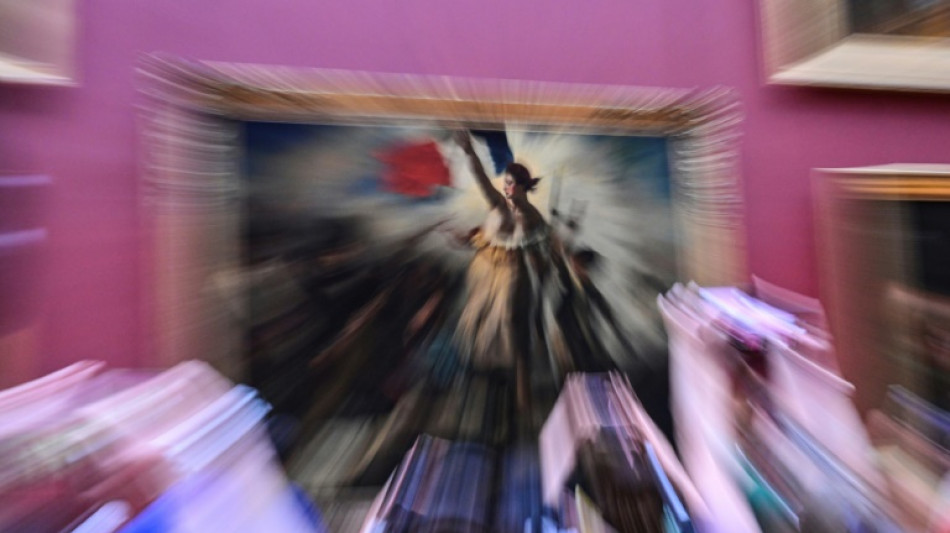
France's iconic Liberty gets Louvre facelift / Photo: MIGUEL MEDINA - AFP
 Brussels Education Unions Schedule Major November Protest Over Funding and Reforms

 Making Your Home Safer for Aging Parents: Accessibility Renovations That Add Value

 iPS Cell Research Accelerates Drug Discovery for ALS and Spinal Cord Injury

 Rene Eyre Revisits Autobiographical Performance 'Say A Little Prayer' in London

 UAE's HCT Holds Record Graduation and Announces Major Training Expansion

 NASA Awards $10B Lunar Contract Framework to SpaceX, Blue Origin

 Katy Perry Tells Fans Ex-Husband Russell Brand 'Should Be in Jail' During UK Concert

One of France's most iconic paintings, "Liberty Leading the People" by Eugene Delacroix, was taken down from the walls of the Louvre on Wednesday for a restoration expected to last until next spring.
The famous topless woman, brandishing the red, white and blue flag on a revolutionary barricade was painted by Delacroix in 1830.
The oil painting, which measures 3.25 by 2.60 metres, has pride of place in one of the large red rooms of the Louvre in Paris.
The restoration has been prepared long in advance using X-ray analysis of the canvas. It is part of a major restoration campaign launched in 2019 for large-format paintings from the 19th century, said Sebastien Allard, director of the painting department.
One priority is to remove the varnish that has oxidised on the surface, giving a yellow tint to the red, white and blue sections of the painting, he said.
The painting commemorates the July Revolution of 1830, when King Charles X was overthrown and replaced by his cousin, Louis Philippe, marking a shift towards constitutional monarchy.
But the powerful image of the female figure leading a diverse group of revolutionaries has come to represent struggles for rights and freedoms far beyond its origins.
The Louvre has carried out some 200 restorations since 2015, including of Leonardo da Vinci's "La Belle Ferronniere", Titian's "Jupiter and Antiope" and several by Delacroix such as "Women of Algiers" and "The Massacre at Chios".
The Louvre, the largest museum in the world, contains around 6,400 paintings, including some 4,500 on permanent display.
C.Garcia--AMWN
