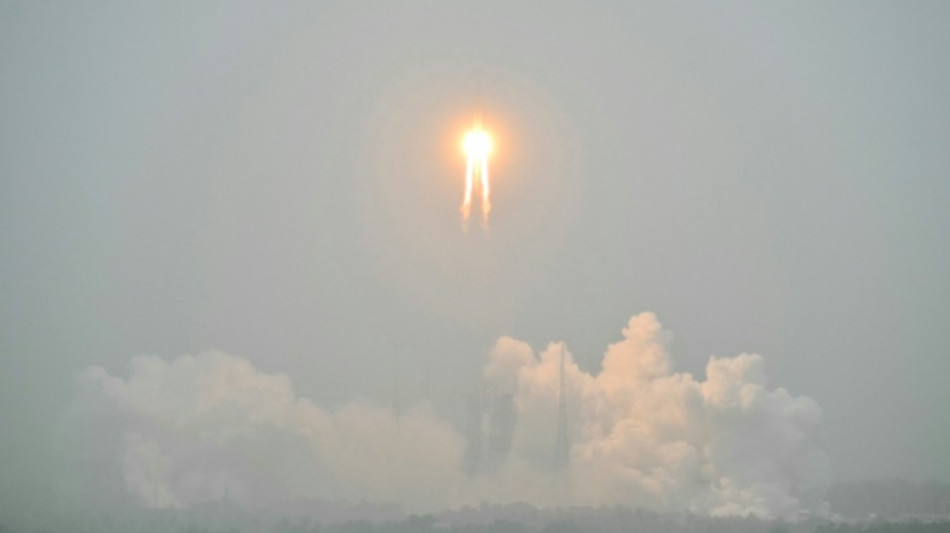
China probe successfully lands on far side of Moon / Photo: HECTOR RETAMAL - AFP/File
 Brussels Education Unions Schedule Major November Protest Over Funding and Reforms

 iPS Cell Research Accelerates Drug Discovery for ALS and Spinal Cord Injury

 Rene Eyre Revisits Autobiographical Performance 'Say A Little Prayer' in London

 UAE's HCT Holds Record Graduation and Announces Major Training Expansion

 NASA Awards $10B Lunar Contract Framework to SpaceX, Blue Origin

 Katy Perry Tells Fans Ex-Husband Russell Brand 'Should Be in Jail' During UK Concert

China's Chang'e-6 lunar probe successfully landed on the far side of the Moon to collect samples, state news agency Xinhua reported Sunday -- the latest leap for Beijing's decades-old space programme.
The Chang'e-6 set down in the immense South Pole-Aitken Basin, one of the largest known impact craters in the solar system, Xinhua said, citing the China National Space Administration.
It marks the first time that samples will be collected from the rarely explored area of the Moon, according to the agency.
The Chang'e-6 is on a technically complex 53-day mission that began on May 3.
Now that the probe has landed, it will attempt to scoop up lunar soil and rocks, and carry out other experiments in the landing zone.
That process should be complete within two days, Xinhua said. The probe will use two methods of collection: a drill to collect samples under the surface and a robotic arm to grab specimens from the surface.
Then it must attempt an unprecedented launch from the side of the Moon that always faces away from Earth.
Scientists say the Moon's dark side -- so-called because it is invisible from Earth, not because it never catches the sun's rays -- holds great promise for research because its craters are less covered by ancient lava flows than the near side.
Material collected from the dark side may better shed light on how the Moon formed in the first place.
- China's space ambitions -
Plans for China's "space dream" have been put into overdrive under President Xi Jinping.
Beijing has poured huge resources into its space programme over the past decade, targeting a string of ambitious undertakings in an effort to close the gap with the two traditional space powers -- the United States and Russia.
It has notched several notable achievements, including building a space station called Tiangong, or "heavenly palace".
Beijing has landed robotic rovers on Mars and the Moon, and China is only the third country to independently put humans in orbit.
But Washington has warned that China's space programme is being used to mask military objectives and an effort to establish dominance in space.
China aims to send a crewed mission to the Moon by 2030 and plans to build a base on the lunar surface.
The United States is also planning to put astronauts back on the Moon by 2026 with its Artemis 3 mission.
L.Mason--AMWN

