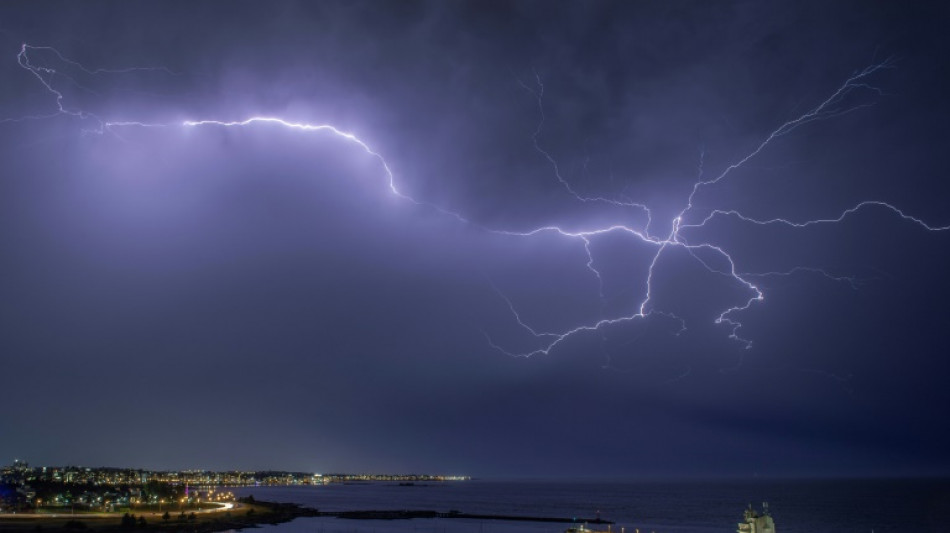
Thunderstorms are a 'boiling pot' of gamma rays, scientists find / Photo: Mariana SUAREZ - AFP/File
 Zuckerberg, Musk make plea at G20 for more AI data centers

 'Discomfort' at G20 finance talks as US hosts Russian minister

 Man City set to sign Fernandez for record fee, Ndiaye on deadline day

 Back-to-school in Cuba a grim day with shortages of everything

 Canadian minister says Russia's G20 presence sparked 'discomfort'

 IMF reaches agreement with Senegal on new $2.2 bn loan programme

 Germany blames Russia for airport drone incident, hits back with sanctions

 Iran president urges return to truce, hails Russian support

 Aster and World Liberty Financial Launch USD1 RWA Boost: Phase 1, Offering 125M $WLFI + 6.25M USD1 in Rewards

 Tronchon sprints to Vuelta stage 10 win, Mas keeps red jersey

 Germany defender Rudiger announces international retirement

 Musk defends AI data centers, slams EU rules at G20
 Activists blame Kenya for Ugandan opposition figure's plight

 Iran president offers US olive branch, hails Russian support

 TrustFinance Community Choice Awards 2026 Opens Global Voting

 Nepal disaster a climate 'warning signal': foreign minister

 France winger Diaby returns to Leverkusen until 2031

 Barcelona confirm Jesus arrival from Arsenal

 EU official says it's not time to 'normalize' Russia at G20 finance talks

 RedHill Announces Transformational Acquisition of Commercialization Rights to Ferring’s Rebyota® and Clenpiq®

 TrendEadvisor Launches Global Multi-Asset Platform Combining Online Investing with Social Trading

 India's top court drops criminal cases against protesters

 Philippine couple married in hip-deep floodwaters

 Villa sign Senegal winger Mbaye from PSG

 Former Peru minister last-minute contender for UN labour agency helm

Big thunderstorms continuously emit gamma rays that are undetectable from the ground, two studies said on Wednesday, upending what was previously thought -- and potentially pointing towards a clue in the mystery of how lightning is sparked.
Despite the fact that 40,000 thunderstorms generate more than eight million lightning strikes above our heads every day, they "remain poorly understood", physicist Joseph Dwyer said in an analysis of the new research in the journal Nature.
Normally when people think of gamma rays -- bursts of an incredibly high-energy form of light -- they are coming from out of this world, such as solar flares, exploding stars or black holes.
However in the 1990s, NASA satellites tasked with hunting down high-energy particles from such cosmic sources detected gamma rays coming from Earth.
Other than inside nuclear reactors, nothing on our planet had been thought capable of generating gamma rays.
Since then, two different types of gamma rays have been observed inside thunderstorms -- both invisible to the naked eye.
Gamma-ray glows can last for a few minutes over a region roughly 20 kilometres (12 miles) wide, while more powerful "flashes" last less than a millisecond.
"As it turns out, essentially all big thunderstorms generate gamma rays all day long in many different forms," Steven Cummer, a researcher at Duke University and a co-author of one of the studies, said in a statement.
- Bubbling cauldron of gamma rays -
To find out more about what is happening inside thunderstorms, the international team of researchers used an NASA ER-2 airplane.
The scientific aircraft, based the American U-2 spy plane, can fly more than twice as high as a commercial airliner, soaring far above storm clouds.
Over a month in 2023, the plane left a Florida air force based to fly at an altitude of 20 kilometres over active storms, capturing evidence that gamma radiation is much more common than had been thought.
The storms almost continuously generated gamma-ray glows for hours across thousands of square kilometres, all of which were closely linked to the most intense areas of the storm.
The storms resemble "a huge gamma-glowing 'boiling pot' in both pattern and behaviour," said the author of the first Nature study, which was authored by Martino Marisaldi of Norway's University of Bergen.
The second study revealed that glows could intensify into what it called "flickering" gamma-ray flashes. These could be the elusive "missing link" between glows and flashes, it added.
These observations "blur the line between these two types of emission, suggesting that gamma-ray glows often morph into intense pulses", Dwyer explained.
Lightning often follows these intense gamma ray emissions, which suggests they might play some role in sparking lightning strikes, according to the second study.
"How lightning is initiated inside thunderstorms is one of the greatest mysteries in the atmospheric sciences," Dwyer said.
"It is amazing that, more than two decades into the 21st century, Earth's atmosphere has enough surprises in store to motivate an entirely new line of research."
Ch.Havering--AMWN