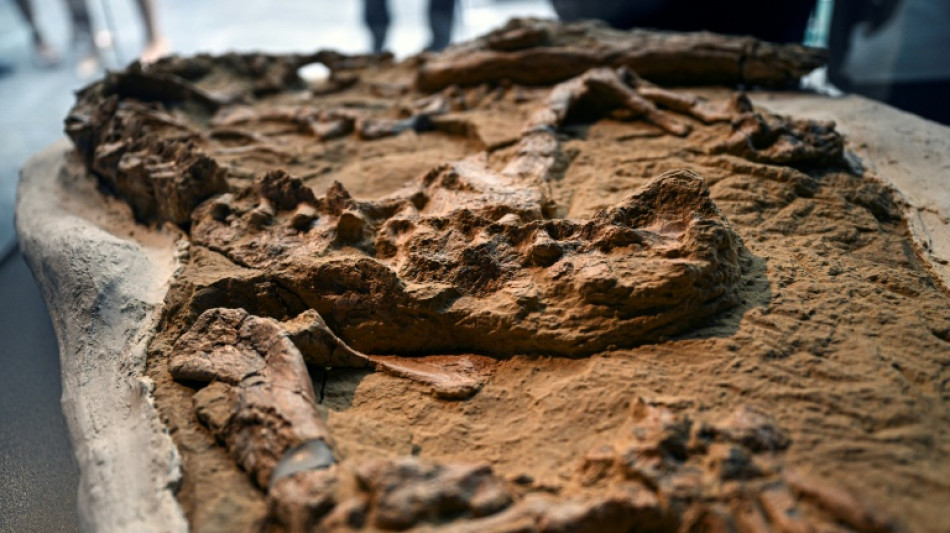
Peru scientists unveil crocodile fossil up to 12 million years old / Photo: Ernesto BENAVIDES - AFP
 Crowds Gather at San Francisco Park for Elizabeth Holmes Lookalike Tournament

 Central Tokyo Apartment Rents Forecast to Rise 11% by 2030

 London Museum Granted 24/7 License Ahead of November Opening

 Dana White Confirms Flight to Washington for Trump Meeting on Press Secretary Role

 Dengue Fever Expands Into High Himalayas as Climate Change Warms Nepal

 IoT Refrigerator Hacks Disrupt Blood Labs and Supermarkets Across Europe and US
Paleontologists unveiled on Wednesday the fossil of a young marine crocodile dating back 10 to 12 million years that was discovered in a Peruvian desert.
The fossil of the gharial -- or fish-eating -- crocodile, around three meters long (nearly 10 feet), was discovered late 2023 in perfect condition in Peru's Ocucaje desert, around 350 kilometers (190 miles) south of the capital Lima.
"This is the first time we found a juvenile of this species, that is to say, it had not reached its maximum size yet. It died before that," vertebrate paleontologist Mario Gamarra told a news conference.
The skull and jaws of these specimens differed from that of today's crocodiles and alligators, according to Gamarra, who headed the reconstruction of the fossil.
"They had an elongated snout and their diet was entirely piscivorous, feeding on fish," said Gamarra.
"The closest current relative to this crocodile would be the Indian gharial," he added.
The discovery was made jointly by Peru's Geological, Mining and Metallurgical Institute and the La Union school.
Peru's Ocucaje desert is rich in fossils, such as four-legged dwarf whales, dolphins, sharks and other species from the Miocene period -- between 5 and 23 million years ago -- that were previously discovered there.
P.Stevenson--AMWN

