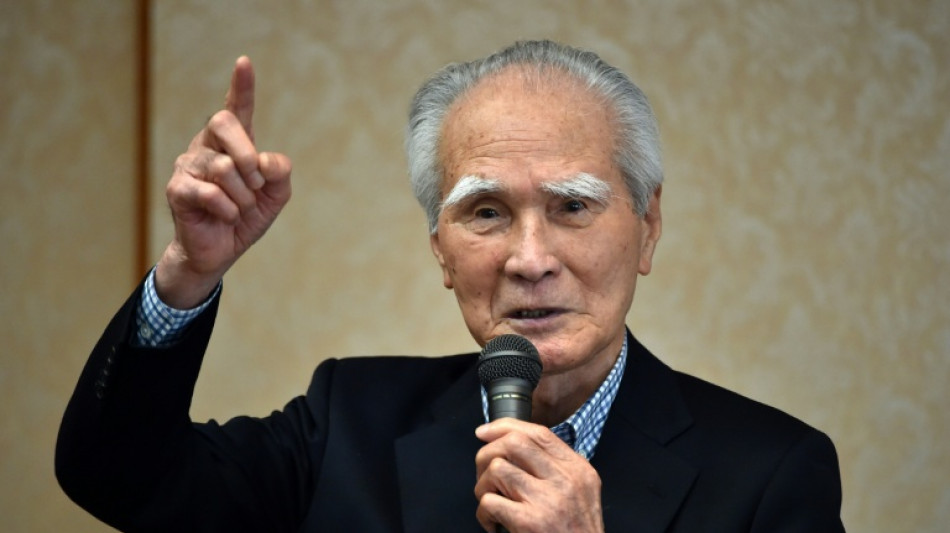
Japan ex-PM Murayama, famous for WW2 apology, dies aged 101 / Photo: YOSHIKAZU TSUNO - AFP
 Zelensky warns war likely to continue into winter after US talks

 Arsenal deliver statement fightback to end Chelsea's flying start

 Leclerc accepts blame as Hamilton laments Ferrari approach

 Sabalenka surges past Townsend to reach US Open quarter-finals

 Smiling face of Germany's far-right AfD: Ulrich Siegmund

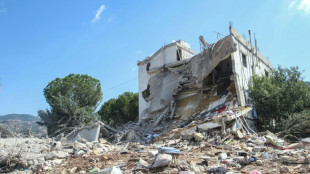 Lebanon president calls for US help as Israeli strikes kill 7

 Yamal hits double as perfect Barca thrash Valencia

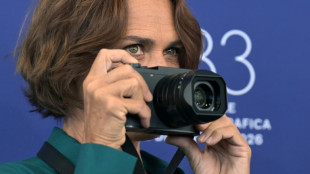 Venice festival turns gaze on war reporters, media industry

 Sensational Antonelli wins Italian GP from back of grid

 Susan Sarandon says still losing roles over Gaza stance

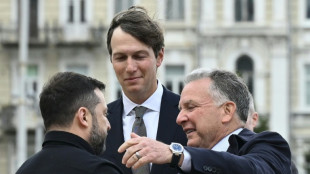 US envoys hold 'important' talks in first trip to Kyiv

 Championship leader Antonelli wins Italian Grand Prix

 Vardy signs for Championship strugglers Burnley
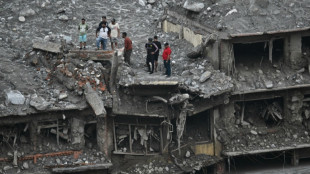
 FIFA confirms Infantino will run in presidential election

 With joy and grief, Palestinian football marks return

 Iran threatens greater force if US launches more attacks
 Vandals uproot Berlin tree commemorating Pride attack victims
 Trump envoys arrive in Kyiv for first Ukraine visit
 Indonesia's main airport suspends operations after volcanic eruption

 US aircraft carrier departs Thailand after port call

 Haze emergency grips Malaysian Borneo town
 Messi creates both Miami goals in 2-2 draw with Atlanta

 Rybakina books US Open fourth-round berth, inches closer to No. 1

 Sobering reality: Curbs on alcohol in northeast Syria cause discontent

 Wobbly Osaka 'shocked' to battle past Mertens and reach last 16

Japan's former prime minister Tomiichi Murayama, best known for making a statement apologising over World War II, died Friday aged 101, officials said.
Murayama issued the 1995 proclamation on the 50th anniversary of Japan's surrender, expressing "deep remorse" over the country's atrocities in Asia.
The statement became a benchmark for Tokyo's subsequent apologies over World War II.
"Tomiichi Murayama, the father of Japanese politics, passed away today at 11:28 am at a hospital in Oita City at the age of 101," Mizuho Fukushima, head of the Social Democratic Party, seen as the successor to Murayama's now-defunct Socialist Party, said on X.
Hiroyuki Takano, the secretary general of the Social Democratic Party in Oita, Murayama's hometown, told AFP he had been informed that the former premier died of old age.
In the landmark statement in August 1995, Murayama said that "Japan... through its colonial rule and aggression, caused tremendous damage and suffering to the people of many countries, particularly to those of Asian nations".
"In the hope that no such mistake be made in the future, I regard, in a spirit of humility, these irrefutable facts of history, and express here once again my feelings of deep remorse and state my heartfelt apology," he added.
The phrases "deep remorse" and "heartfelt apology" were used by successive Japanese prime ministers when marking the 60th and 70th World War II anniversaries.
Murayama, who was also well-known for his distinctive bushy eyebrows, was elected as the prime minister in a coalition government that also included the Liberal Democratic Party, Japan's dominant postwar political force.
He was in office from 1994 to 1996, a turbulent period that saw a huge 1995 earthquake in western Japan, and a sarin gas attack on Tokyo's subway that killed more than a dozen people and injured more than 5,800.
Murayama was conscripted into the Japanese Imperial Army in 1944 while studying at university.
In a 2015 interview with public broadcaster NHK, he called the military a "dreadful thing", describing how "rebellion or argument was absolutely forbidden".
He also recalled his difficult memories of the run-up to the end of the war, when "food was already scarce, and very few weapons remained".
"We had weapons made of bamboo. I wondered if we could wage war in this condition," he said at the time.
tmo-kh-stu-aph/mjw
D.Kaufman--AMWN