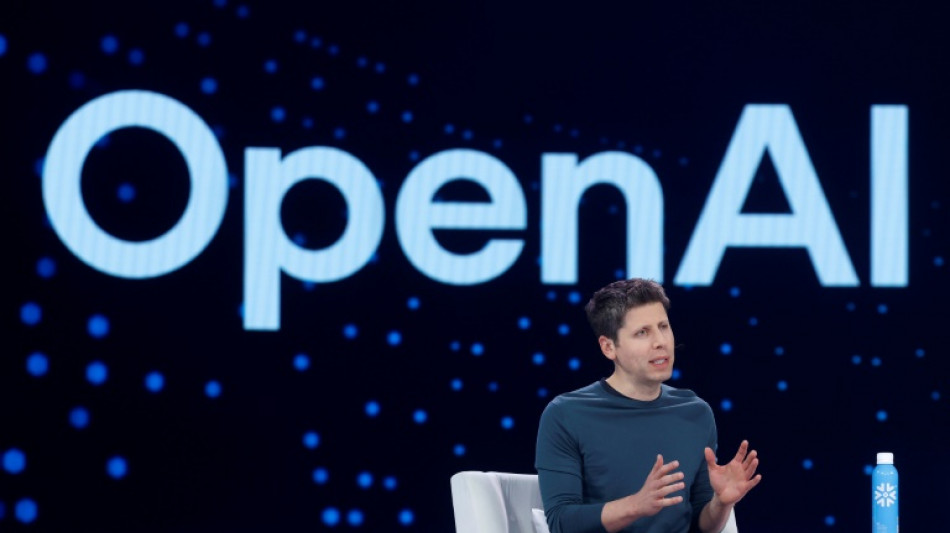
OpenAI big chip orders dwarf its revenues -- for now / Photo: JUSTIN SULLIVAN - GETTY IMAGES NORTH AMERICA/AFP
 Zelensky warns war likely to continue into winter after US talks

 Arsenal deliver statement fightback to end Chelsea's flying start

 Leclerc accepts blame as Hamilton laments Ferrari approach

 Sabalenka surges past Townsend to reach US Open quarter-finals

 Smiling face of Germany's far-right AfD: Ulrich Siegmund

 Lebanon president calls for US help as Israeli strikes kill 7

 Yamal hits double as perfect Barca thrash Valencia

 Venice festival turns gaze on war reporters, media industry

 Sensational Antonelli wins Italian GP from back of grid

 Susan Sarandon says still losing roles over Gaza stance

 US envoys hold 'important' talks in first trip to Kyiv

 Championship leader Antonelli wins Italian Grand Prix

 Vardy signs for Championship strugglers Burnley

 FIFA confirms Infantino will run in presidential election

 With joy and grief, Palestinian football marks return

 Iran threatens greater force if US launches more attacks

 Vandals uproot Berlin tree commemorating Pride attack victims

 Trump envoys arrive in Kyiv for first Ukraine visit

 Indonesia's main airport suspends operations after volcanic eruption

 US aircraft carrier departs Thailand after port call

 Haze emergency grips Malaysian Borneo town

 Messi creates both Miami goals in 2-2 draw with Atlanta

 Rybakina books US Open fourth-round berth, inches closer to No. 1

 Sobering reality: Curbs on alcohol in northeast Syria cause discontent

 Wobbly Osaka 'shocked' to battle past Mertens and reach last 16

OpenAI is ordering hundreds of billions of dollars worth of chips in the artificial intelligence race, raising questions among investors about how the startup will finance these purchases.
In less than a month, the San Francisco startup behind ChatGPT has committed to acquiring a staggering 26 gigawatts of sophisticated data processors from Nvidia, AMD, and Broadcom -- more than 10 million units that would consume power equivalent to 20 standard nuclear reactors.
"They will need hundreds of billions of dollars to live up to their obligations," said Gil Luria, managing director at D.A. Davidson, a financial consulting firm.
The challenge is daunting: OpenAI doesn't expect to be profitable until 2029 and is forecasting billions in losses this year, despite generating about $13 billion in revenue.
OpenAI declined to comment on its financing strategy.
However, in a CNBC interview, co-founder Greg Brockman acknowledged the difficulty of building sufficient computing infrastructure to handle the "avalanche of demand" for AI, noting that creative financing mechanisms will be necessary.
- Creative financing -
Nvidia, AMD, and Broadcom all declined to discuss specific deals with OpenAI.
Silicon Valley-based Nvidia has announced plans to invest up to $100 billion in OpenAI over several years to build the world's largest AI infrastructure.
OpenAI would use those funds to buy chips from Nvidia in a game of "circular financing," with Nvidia recouping its investment by taking a share in OpenAI, one of its biggest customers and the world's hottest AI company.
AMD has taken a different approach, offering OpenAI options to acquire equity in AMD -- a transaction considered unusual in financial circles and a sign that it is AMD that is seeking to seize some of OpenAI's limelight with investors.
"It represents another unhealthy dynamic," Luria said, suggesting the arrangement reveals AMD's desperation to compete in a market dominated by Nvidia.
- Crash or soar? -
The stakes couldn't be higher.
OpenAI co-founder and CEO Sam Altman "has the power to crash the global economy for a decade or take us all to the promised land," Bernstein Research senior analyst Stacy Rasgon wrote in a note to investors this month.
"Right now, we don't know which is in the cards."
Even selling stakes in OpenAI at its current $500 billion valuation won't cover the startup's chip commitments, according to Luria, meaning the company will need to borrow money.
One possibility: using the chips themselves as collateral for loans.
Meanwhile, deep-pocketed competitors like Google and Meta can fund their AI efforts from massive profits generated by their online advertising businesses -- a luxury OpenAI doesn't have.
The unbridled spending has sparked concerns about a speculative bubble reminiscent of the late 1990s dot-com frenzy, which collapsed and wiped out massive investments.
However, some experts see key differences. "There is very real demand today for AI in a way that seems a little different than the boom in the 1990s," said Josh Lerner, a Harvard Business School professor of investment banking.
CFRA analyst Angelo Zino pointed to OpenAI's remarkable growth and more than 800 million ChatGPT users as evidence that a partnership approach to financing makes sense.
Still, Lerner acknowledges the uncertainty: "It's a real dilemma. How does one balance this future potential with the speculative nature" of its investments today?
H.E.Young--AMWN