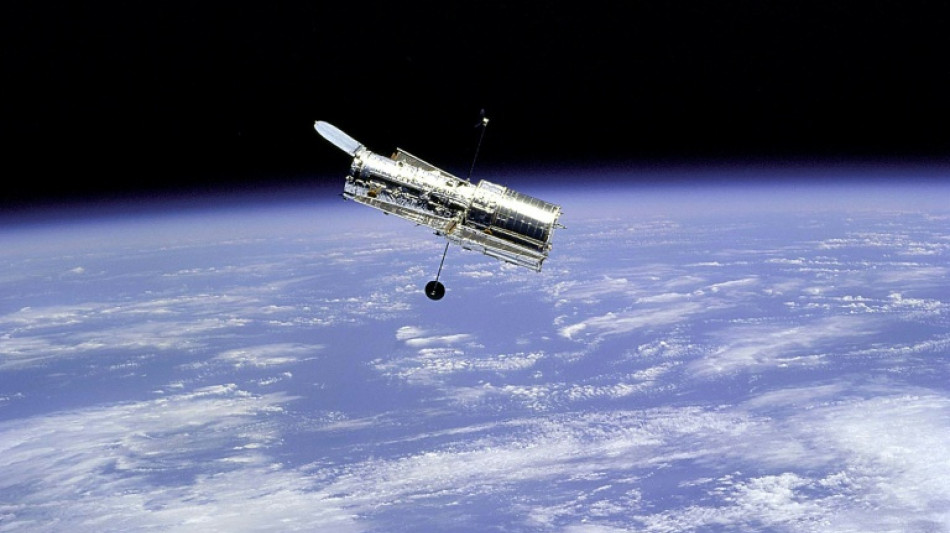
Satellite surge threatens space telescopes, astronomers warn / Photo: NASA - NASA/AFP
 Panama Canal begins reducing crossings due to El Nino
 Trump again seeks to remove protections for wolves
 'Getting there' - Alcaraz into US Open last 16 along with Sabalenka

 Isak ready to show world his quality, says Van Dijk

 Stuttgart cruise past Cologne to bounce back from Bayern thumping

 'Smart, aggressive' Alcaraz into US Open last 16
 Isak fires Liverpool to first win under Iraola at Ipswich

 Stocks slip as robust US jobs data stokes rate hike odds
 Mistrial declared in case of US woman who killed her three children

 Seville, Alfred win at Diamond League finals, Duplantis hit with injury

 Moody’s Assigns First-Time Insurance Financial Strength Ratings to Freedom Insurance and Freedom Life

 Trump says envoys taking plan to 'end the war' to Moscow, Kyiv
 US Football Hall of Fame revamps selection process

 Judge declares mistrial in case of US woman who killed her children

 Edgar Davids art thief misses sentencing after being 'knocked out by luggage'

 Pegula rallies to reach US Open fourth round
 Defending champ Sabalenka leads way into US Open fourth round

 Bayeux Tapestry 'virtually unchanged', UK museum says, after France spots broken threads
 More than 120 killed in Yemen's worst clashes in years: sources

 Germany hunts climate activist suspected of power grid sabotage

 5 EU countries aim to send rejected migrants to 'return hub' by 2027

 Argentina to return Nazi-looted painting to Jewish collector's heir

 Australian Simmons makes NBA comeback with Kings: reports
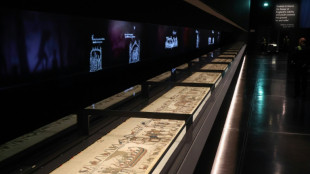 Two broken threads on Bayeux Tapestry, no major damage: French minister

 Meloni marks record in power with eye on 2027 elections
Light from the half a million satellites that humanity is planning to launch into Earth's orbit in the coming years could contaminate almost all the images taken by space telescopes, NASA astronomers warned Wednesday.
Scientists have already been sounding the alarm about how light pollution from increasingly massive satellites threaten the future of dark skies seen from the ground.
Now, a study published in the journal Nature is the first to estimate how the immense number of satellites planned for the future could stray into the view of nearby telescopes attempting to probe the universe.
Since 2019, the number of satellites in low-Earth orbit has skyrocketed from roughly 2,000 to 15,000, according to the study -- many of them part of billionaire Elon Musk's Starlink internet constellation.
But that is a drop in the bucket compared to what is coming.
If all of the plans currently filed to regulators launch into space, there will be 560,000 satellites orbiting Earth by the end of the 2030s, the study said.
This poses "a very severe threat" to space telescopes, the study's lead author, Alejandro Borlaff of the NASA Ames Research Center in California, told AFP.
For the research, the astronomers simulated how the 560,000 satellites would impact four space telescopes.
Reflected light from the satellites would affect 96 percent of all images taken by NASA's SPHEREx telescope, the European Space Agency's planned ARRAKIHS telescope and China's planned Xuntian telescope, the study found.
The Hubble Space Telescope, which is less likely to snap a satellite as it takes in a narrower view of the universe, would have a third of its images tainted.
This could have an impact on all sorts of scientific endeavours.
"Imagine that you are trying to find asteroids that may be potentially harmful for Earth," Borlaff said.
An asteroid streaking through the sky "looks exactly like a satellite... it's really hard to figure out which one is the bad one," he added.
Some space telescopes, such as the famous James Webb, are unaffected because they are hovering at a stable spot 1.5 million kilometres (932,000 miles) from Earth called the second Lagrange point.
- 'As bright as the brightest star' -
One solution could be to deploy satellites at lower altitudes than space telescopes -- but that could potentially deplete Earth's ozone layer, the study said.
The most straightforward solution may just be to launch fewer satellites.
But competition from rival satellite internet companies -- and the surging needs of the artificial intelligence boom -- make that unlikely.
Nearly three-quarters of the satellites currently in orbit are part of Musk's Starlink network, Borlaff said.
But Starlink is expected to represent just 10 percent of all satellites in a couple of decades as competition blasts off, according to the study.
For now, companies could help by providing the location, orientation and colour of their satellites to those operating space telescopes, Borlaff said.
Another problem is that satellites are getting much bigger.
To the naked eye, satellites that are 100 square metres (more than 1,000 square feet) in size are "as bright as the brightest star that you can see in the sky", Borlaff said.
However, to handle AI's data requirements, there are now plans to build ones 3,000 square metres wide.
These giants could be "as bright as a planet", Borlaff added.
D.Kaufman--AMWN