
The Real Constraint on Autonomy
 Rubio pushes extraditions, anti-drug fight in Ecuador

 Amboss and Aureo Connect the Lightning Network to Mexico's Banking System

 Brent oil passes $100 on Mideast flare-up, stoking inflation fears

 Israeli settlement winemaker defiant after UK-led trade sanctions

 Josh Kerr: I pick my races and never get 'greedy'

 Carrick confident Man Utd can go far in 'magical' Champions League

 France far right expels policeman member over racist remarks

 Pakistan collapse to 133 all out against England in 3rd Test

 Heat forces French champagne makers to stiffen their drink

 Iran war drives oil prices to $100 per barrel as Tehran strikes ships

 Pakistan collapse to 100-7 against England in 3rd Test

 Workers, migrants focus of documentaries by Oscar winners at Venice

 Nepal seeks survivors two weeks after deadly floods

 Bangladesh measles crisis kills more than 1,000 children

 Pakistan collapse to 26-4 against England in 3rd Test

 EU helps cities tighten screws on Airbnb, holiday rentals

 Courtois to put Belgium career on hold

 RavenDB Launches Quill to Bring Production AI Agents to Enterprise SQL Systems, No Migration Required

 Affleck family affair at Venice for Casey's latest film 'Company'

 Yemen rebels report fresh Saudi strikes as conflict deepens

 'They're playing with our lives': AI researcher quits Anthropic
 Series finale of 'Babylon Berlin' offers dark mirror for today's Germany
 Zara owner Inditex boosts profits as sales grow across board

 Alcaraz out in latest US Open finish, Sabalenka through on marathon day

 Brent breaks $100 on Mideast flare-up, fanning inflation fears

Every enterprise is racing toward AI that can act on its own. Almost no one is talking about the one thing that decides whether it can.
By Jagadeesh Kunda, Co-Founder & COO, Oleria
BELLEVUE, WA / ACCESS Newswire / July 22, 2026 / We are living through a change in how enterprises are built and how work gets done, and it is arriving faster than the shifts that came before it. The web gave the business reach. The cloud took away the machinery it used to run on. SaaS and mobile put the work in everyone's hands, everywhere, all the time. Each wave moved more off the desk of any one person, and each one arrived faster than the last. What is being handed off now is different in kind. It is not reach, and it is not infrastructure. It is judgment and action, the deciding and the doing, and it is happening on a timeline measured in quarters, not decades. No enterprise that opts out of it is going to win.
The thing everyone is chasing is autonomy. Systems that do not wait to be told. Agents first, then the physical ones behind them, robots and the humanoid machines already walking around demo floors. The pitch is always the same and it is genuinely thrilling: stop operating the tool, and start delegating to it. Tell it the outcome you want and let it find the path.
Here is the part almost no one is saying out loud. Autonomy is not the first problem to solve. It is the last. Before anything can safely act on your behalf, you have to be able to answer, continuously, a very old set of questions: who is acting, on whose authority, in what situation, and can you take that authority back the instant it is being used wrongly. That is delegation. And autonomy is not a sibling of delegation, it is a consequence of it. Get delegation wrong and autonomy is not risky. It is simply unbuildable. This is as true for a humanoid on a factory floor as it is for an agent inside your software. The body does not change the question.
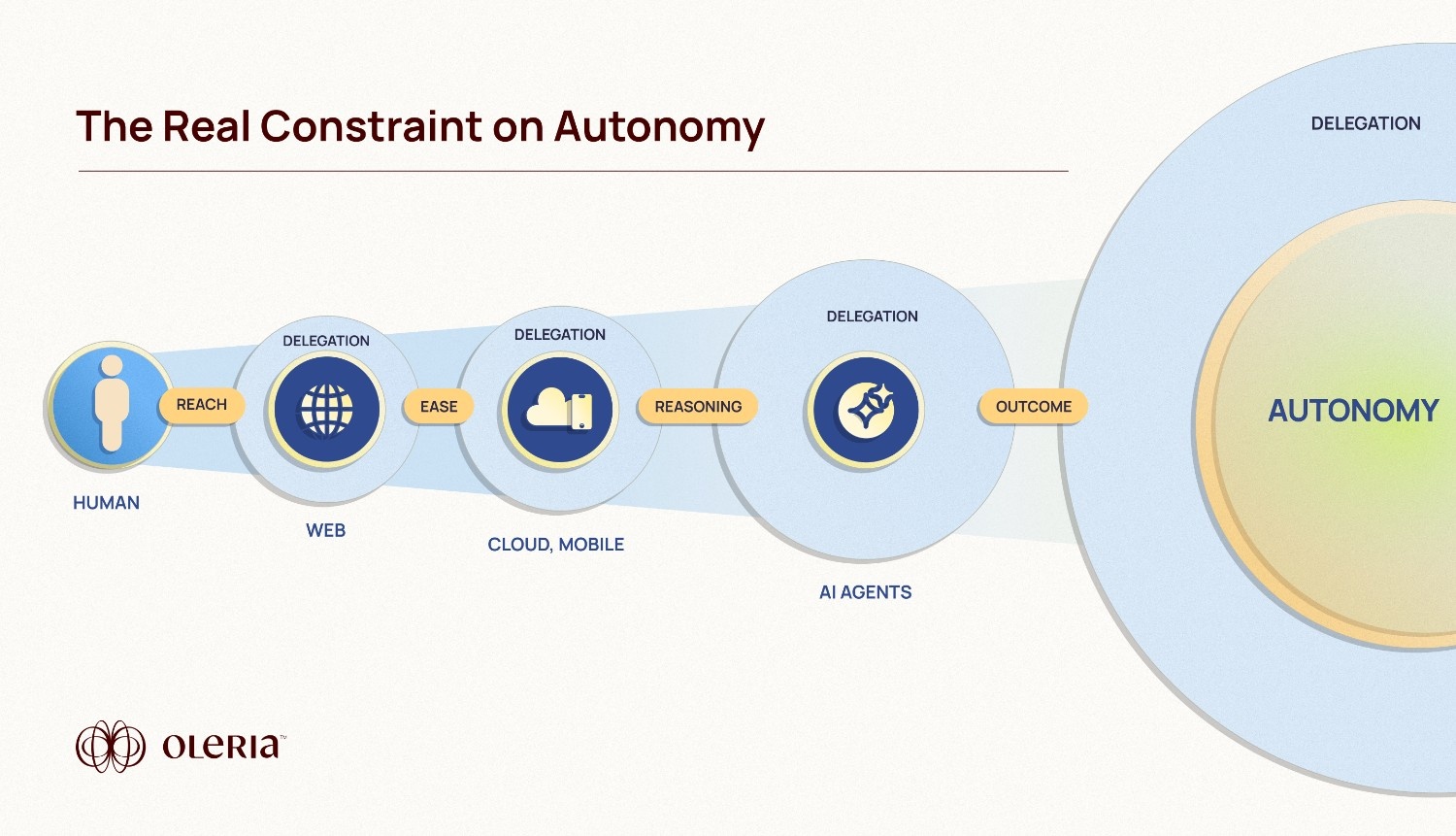
Delegation inside the enterprise is not new. We have handed authority to people for as long as there have been organizations, and we built a great deal of machinery to do it: identities, permissions, approvals, audit trails. We did not build that machinery because we distrusted people. We built it because delegation is how an enterprise scales beyond the reach of any single pair of hands. The whole apparatus exists to let us grant power, not to withhold it.
What is different now is that a person used to carry the context with them. Someone with the access to move money still would not wire a strange sum to a new account at two in the morning, because they understood the situation they were standing in. Their authority interpreted itself against the moment. A machine does not arrive with that. So the layer that governs delegated action now has to supply the context the human used to carry, and it has to evaluate authority not once, at setup, but at the moment of every action, at machine speed, across chains that no longer stop at the first handoff. Agents are already invoking other agents. The question of on whose behalf is getting longer, and the honest answer is that most enterprises cannot trace it past the first link.
You can see the strain everywhere right now. A new category of startup appears every week, gateways and brokers and control planes, each one bolting a piece onto a layer that does not yet exist as a whole. That scramble is not noise. It is the symptom. It is what a missing foundation looks like while everyone improvises around the hole.
Most leaders feel this as a forced choice. Move fast with AI, or stay in control. Pick one. But that trade-off is not a law of nature. It is an artifact of the missing layer. The reason speed and control feel opposed today is that there is no foundation underneath the autonomy, so every increase in what the machine can do is a one-for-one increase in what you cannot see. Build the foundation and the trade-off dissolves. Control stops being the brake on autonomy and becomes the thing that makes more of it possible. Security, done right here, is not what slows the business down. It is what sets it free to move.
If you take that seriously, the requirements write themselves, and they are demanding. Every entity that acts needs an identity of its own, not a borrowed one. The authority it carries has to be scoped to a purpose and bounded in time, not granted once and left open. It has to be evaluated against the live situation at the moment of action, not assumed from a setting decided weeks earlier. All of it has to be visible while it happens, not reconstructed afterward. And any of it has to be revocable in an instant, because the only real test of control is whether you can stop something while it is still moving. Read that list and you will notice it is not a feature. It is a layer, wired from the context an action happens in, through the action itself, into the runtime where it actually runs. Anything less is a patch on a problem that is structural.
This is the thing to build first, before the agents multiply and the choices get made for you. Not another tool bolted onto the gap, but the layer itself, the foundation that decides what every acting thing is allowed to do, and proves it. Stand that up, and autonomy stops being a risk you are absorbing and becomes a capability you actually own.
So the contest is not going to be won where everyone is looking. It will not be won by whoever has the most capable model, or by whoever is boldest about turning autonomy loose. It will be won by whoever solves delegation first, because delegation is the precondition for everything else they are excited about. AI handed every enterprise an almost unlimited number of hands. The winners will be the ones who can decide what those hands are allowed to touch, in the moment they reach for it.
About Oleria:
Oleria is the AI-native identity governance platform that continuously governs and enforces access across human, non-human, and AI identities. Built on the most comprehensive access context in the industry, Oleria automates access reviews, streamlines lifecycle management, and eliminates standing privilege. By unifying adaptive governance and access posture management in a single platform, Oleria replaces legacy IGA complexity with intelligent, continuous governance that helps security and governance teams stop threats faster, strengthen posture, and scale securely.
Backed by more than $60M in funding, Oleria is trusted by Fortune 500 organizations to govern access across human, non-human, and AI identities. Learn more at www.oleria.com.
Contact Information:
Avadhoot Patwardhan
Marketing
[email protected]
SOURCE: Oleria
View the original press release on ACCESS Newswire
L.Durand--AMWN