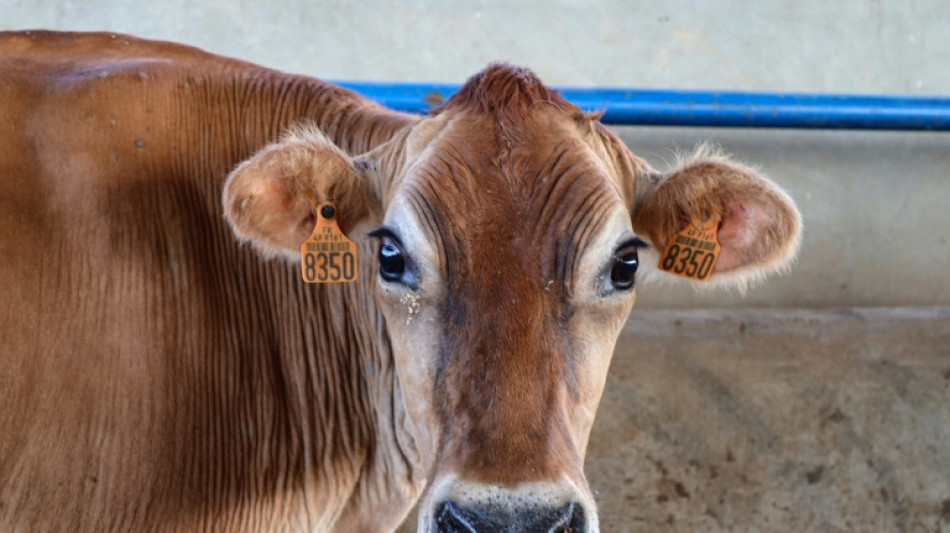
Cattle disease wreaks havoc in Libya / Photo: Islam ALATRASH - AFP
 Judge orders Meta to pay $25 bn to New Mexico in Cambridge Analytica case

 Champagne puts cork in project to expand production area

 Canadian publisher says novelist Orelien used AI to write novel

 Trump faces fresh questions over ties to 'humanitarian' Putin

 Hansen back in Ireland squad for Nations Championship

 Kremlin sees little 'substance' in Ukraine peace ideas

 Top Arab-Israeli election candidate tells AFP Netanyahu win would be 'catastrophe'

 South African rugby player's death due to 'aortic dissection'
 France's Macron lands in Riyadh on surprise 'solidarity' visit
 Around the world, far right blames immigrants for French protests

 South Africa eases fuel pain as growth slows

 Woody Allen shoots new movie in Madrid

 Nvidia's Huang urges Europe to go all in on AI

 Five things to know as French bond yield tops 5%

 'Complete threat' Ngumoha excites Liverpool captain Van Dijk

 'The fishing's terrible': Deforestation devastates C.Africa river

 France's tourism sector worried about impact of riots

 Macron takes aim at Trump for using France riots for election gain

 North Korea says 'new firepower units' in place, loudspeakers to return

 Indonesia leader hits out at market downgrade warning

 Macron slams 'stupid' comments based on AI videos by leaders on France riots

 'Public health crisis': Indonesians seek fire relief from state

 British Museum sells second set of Bayeux exhibition tickets
 Australian lawmaker loses both legs after 'targeted' attack

 UK approves drilling in controversial Jackdaw gas field

On Najmeddine Tantoun's farm on the outskirts of the western Libyan city of Misrata, the usual whir of hundreds of dairy milking machines has given way to near silence.
The farmer has lost almost half his cows to an outbreak of foot-and-mouth disease, a highly contagious illness affecting hoofed animals
The outbreak in Libya has dealt a major blow to many cattle farmers, who say they have yet to receive vaccines for their animals as dairy and meat production suffers.
Most of the North African country's revenue comes from its oil resources, but Misrata is a major dairy centre which used to produce 70,000 litres of milk a day.
Output has now fallen to 20,000 per day, according to Salem al-Badri, 45, head of the city's committee of cattle farmers.
Tantoun, 27, said "the future looks bleak".
"I almost lost everything," he said. "From 742 cows, we lost about 300. This disease is destroying our livelihoods."
The disease particularly affects ruminant livestock, such as cattle, sheep and goats. It causes fever, blisters -- and sometimes death.
- 'Heading towards a catastrophe' -
In Misrata, some farmers have reported losing about 70 percent of their cattle to the disease, according to Badri's committee.
"We are heading towards a catastrophe," Badri, who is also in charge of the city's animal health office said during a visit to Tantoun's farm.
"The delay in vaccines has cost us dearly," he added. "Most of the cows in Misrata are now infected and we have no choice but to slaughter them to stop the epidemic."
The disease has also inflicted financial hardship on consumers as shortages drive up the price of meat and dairy.
Badri said another cattle ailment called lumpy skin disease has also had an impact, with foreign buyers growing wary of importing Libyan cowhide.
Libya is struggling to recover from years of conflict after the 2011 uprising that overthrew longtime dictator Moamer Kadhafi.
It remains split between a United Nations-recognised government of Prime Minister Abdulhamid Dbeibah and the rival authority in the east backed by military strongman Khalifa Haftar.
Cattle farmers blame the authorities' for a lack of pre-emptive safety measures, as well as a slow response during the outbreak which caused delays in delivering vaccines to the affected regions.
Badri said that "if the vaccines had been delivered last November, we would not be here".
"I have asked the authorities several times to deliver the vaccines to us in order to save the farms," he said.
When contacted by AFP, the authorities in Tripoli did not respond.
- 'Economic disaster' -
Authorities in the east and west have rolled out emergency vaccination plans with support from the UN Food and Agriculture Organization, but some farmers said the response had often come too late.
Badri said a group of cattle farmers have filed a lawsuit with the attorney general.
One of the main causes of the spread of these diseases is the illegal importation of animals without veterinary control, the agriculture ministry has said.
Additionally, contamination spreads uncontrollably as cases are not reported to local authorities in time, it said, adding that some cattle might have died without being reported either.
"We depend entirely on these animals for our livelihood," said Tantoun, adding that he had "given everything" for his farm to succeed.
"Losing so many cows is an economic disaster."
He called on authorities in Misrata "not only to provide the necessary vaccines" but also "to compensate" cattle farmers whose cows have suffered from the disease.
Farmer Ali Ghabag said he has completely given up on cattle farming "out of fear for the future".
"Nobody wants to continue in this sector anymore," the 40-year-old said.
"The risks have become too big, and we don't know if we will overcome this crisis."
T.Ward--AMWN