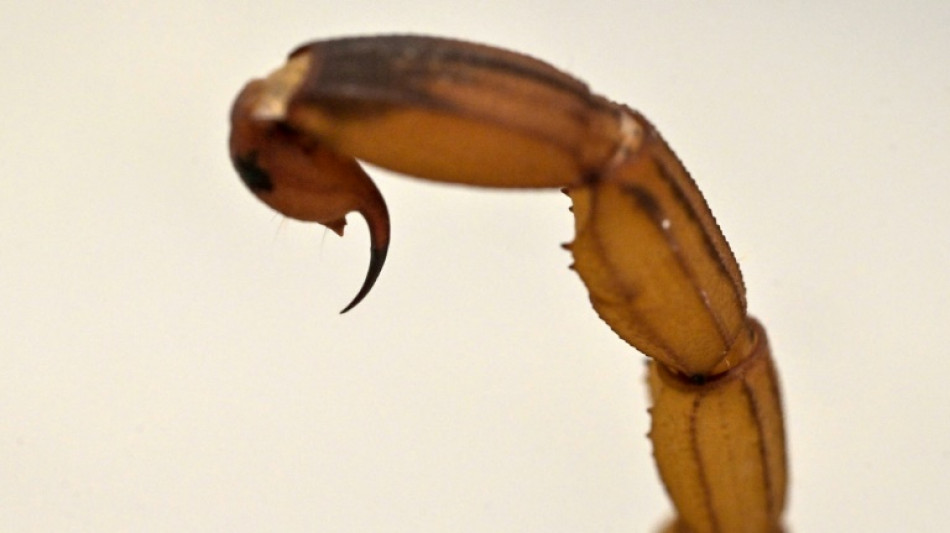
Thriving scorpion population is stinging problem for Brazil / Photo: Nelson ALMEIDA - AFP
 Quebec separatist premier sworn in without royal presence

 UAE nominates official to lead UN

 NFL boss Goodell welcomes probe into Hurts medical care

 Musk threatens Democrats teeing up congressional probes

 In the Mexican town that makes emblematic Day of the Dead garlands

 Protests banned in parts of Paris as Macron swipes at Trump

 Judge orders Meta to pay $25 bn to New Mexico in Cambridge Analytica case

 Champagne puts cork in project to expand production area

 Canadian publisher says novelist Orelien used AI to write novel

 Trump faces fresh questions over ties to 'humanitarian' Putin

 Hansen back in Ireland squad for Nations Championship

 Kremlin sees little 'substance' in Ukraine peace ideas

 Top Arab-Israeli election candidate tells AFP Netanyahu win would be 'catastrophe'

 South African rugby player's death due to 'aortic dissection'
 France's Macron lands in Riyadh on surprise 'solidarity' visit
 Around the world, far right blames immigrants for French protests

 South Africa eases fuel pain as growth slows

 Woody Allen shoots new movie in Madrid

 Nvidia's Huang urges Europe to go all in on AI

 Five things to know as French bond yield tops 5%

 'Complete threat' Ngumoha excites Liverpool captain Van Dijk

 'The fishing's terrible': Deforestation devastates C.Africa river

 France's tourism sector worried about impact of riots

 Macron takes aim at Trump for using France riots for election gain

 North Korea says 'new firepower units' in place, loudspeakers to return

Forget snakes, it's scorpions Brazilians most need to worry about.
The arachnids -- feared for the toxic stinger poised atop their tails -- are proliferating thanks to urbanization and warming temperatures.
The result is that scorpions have become the most lethal poisonous animal in Brazil, posing a growing danger for people across the whole country -- and spurring demand for antivenom.
The most widely found species in the country, the Brazilian yellow scorpion, is the most dangerous scorpion in South America.
Unusually for scorpions, this all-female species also reproduces asexually, reducing population-control options.
"With a warming habitat, these animals' metabolisms are also warming, so they are more active, eating more and reproducing more," explained Thiago Chiariello, production coordinator of the scorpion antivenom lab at Brazil's Instituto Butantan in Sao Paulo.
Add to that rampant urbanization which both scares away scorpions' natural predators such as lizards and birds while boosting the number of available cockroaches -- tasty meals for the arachnids -- and the problem is evident.
"Cities are growing unchecked" and the spread of trash they bring means more food supply for scorpions, Chiariello said.
"This is leading to more contact with people, which means more accidents."
- Soaring sting numbers -
Last year -- the latest dataset available -- there were 152 deaths from scorpion stings in Brazil, compared with 140 from snakebites. That was an increase from 2019, when 95 deaths by scorpion sting were recorded.
According to Brazil's health ministry, there were more than 200,000 scorpion sting incidents registered last year -- 250 percent more than a decade earlier, and an average of nearly 550 stings per day.
Healthy adults might get mild to moderate symptoms from a Brazilian yellow scorpion sting, including pain, vomiting, profuse sweating and tremors.
But there are more severe symptoms -- including shock, fluid build-up in the lungs, cardiovascular collapse and heart failure -- that can prove deadly, especially for children and the elderly.
- Life-saving antivenom -
That makes the Butantan institute's antivenom very important.
Chiariello's team carry out their serum-making task in making that serum with extreme precision.
They first use tweezers to guide a live scorpion's stinger into a container.
The poison is then injected into horses, which are less vulnerable to the toxin's effects than humans, and which produce more antibodies.
"There is a whole purification process in the horses' blood," explained Paulo Goldoni, a biologist at the institute.
"The serum is the only way to save lives," he said.
Last year saw more than 11,000 people in Brazil receive scorpion antivenom, mostly in the country's heavily populated southeast, according to authorities.
With serum demand growing, but also the number of available scorpions, the Instituto Butantan has a steady supply of venom donors.
"If ever there was a lack of serum, we would certainly see a serious increase in the number of deaths," the biologist said.
L.Miller--AMWN