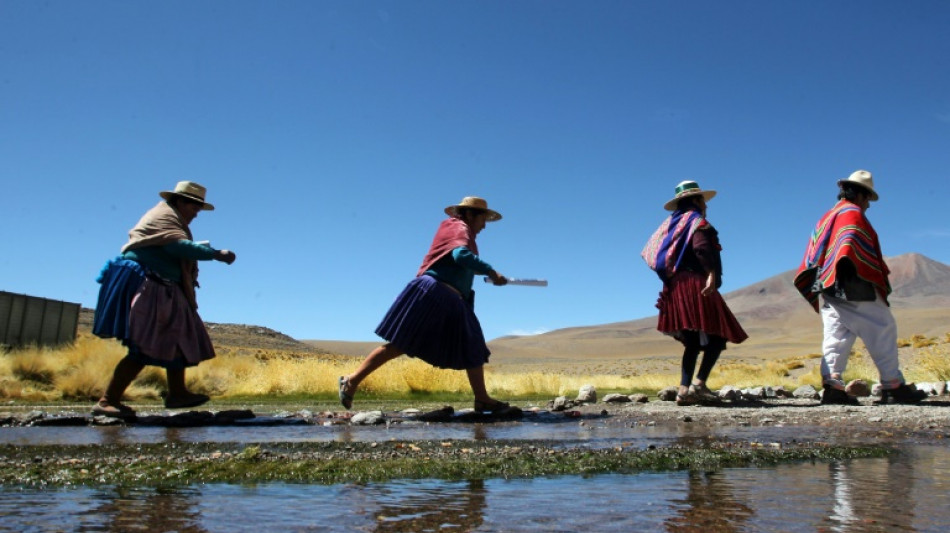
Chile-Bolivia river row set for UN court ruling / Photo: AIZAR RALDES - AFP/File
 Trump names Stephen Miller as White House chief of staff after midterm losses

 Restored Albanian tower houses anchor new rural tourism trail

 Sonia Gandhi reflects on family tragedy and reluctant political career

 Pope Leo begins three-country South American tour in Uruguay

 Khawaja says entire Australia camp knew of 2018 ball-tampering plan

 November Foraging Guide: Edible Mushrooms and Critical Safety Protocols

 Microsoft Updates Xbox PC App with 60% Faster Startup and Redesigned Interface

 Early Polar Vortex Disruption Creates Uncertain Winter Outlook for Pennsylvania

 How to Enjoy Luxury Experiences on a Budget

 Pakistan Demands Grant-Based Climate Finance at COP31 to Avoid Debt Trap
The International Court of Justice will give its judgement on Thursday on a climate change-fuelled row between Chile and Bolivia over the use of a crucial cross-border river.
Chile took its South American neighbour to the UN's top court in 2016, asking the ICJ to declare the Silala an "international water course" and give it equal rights to the river.
It is the latest in a series of water-sharing disputes between parched Chile and landlocked Bolivia, which have been rowing over access to the Pacific Ocean for nearly 150 years.
The Silala rises in Bolivia's high-altitude wetlands and crosses the border with Chile, flowing for around eight kilometres (five miles).
Bolivia however says the waters flow artificially into Chile due to a system of canals built to collect water from springs, and has demanded its neighbour pay compensation.
Judges at the Hague-based ICJ, which was set up after World War II to rule on disputes between UN member states, will hand down their judgment at 3 pm (1400 GMT).
The court in 2018 sank Bolivia's bid to gain access to the Pacific, which it lost to Chile in the 1879-1884 War of the Pacific.
Former Bolivian president Evo Morales had previously sought to use the river dispute as a bargaining chip in its fight for a route to the ocean.
At the time, Morales threatened to reduce the flow of the Silala into Chile's parched Atacama Desert and impose fees for its use.
- Troubled waters -
There have long been troubled waters between the two neighbours.
Chile and Bolivia have had no diplomatic relations since 1978 when Bolivia's last attempt to negotiate a passage to the Pacific broke down in acrimony.
During the last hearings on the Silala case in April, Chile's representative Ximena Fuentes said La Paz's demand for Santiago to pay for the use of the River Silala was "absurd".
Faced with the consequences of global climate change and freshwater becoming scarcer, "countries are called upon to cooperate in the efficient management of shared water resources," Fuentes added.
Bolivia hit back, saying Santiago's case was "hypothetical" and that it had "never" done anything to block the Silala's flow on Chilean territory.
Once handed down, ICJ judgements are binding and cannot be appealed, although the court has no real means of enforcement.
Water is a major issue on a continent where climate change is having increasingly serious effects.
Chile is currently in a 13-year "Mega Drought" that is the longest in at least 1,000 years and threatens the country's freshwater resources.
In Bolivia, the Pantanal -- the world's largest wetlands which also span Brazil and Paraguay -- is experiencing its worst drought in 47 years.
G.Stevens--AMWN

