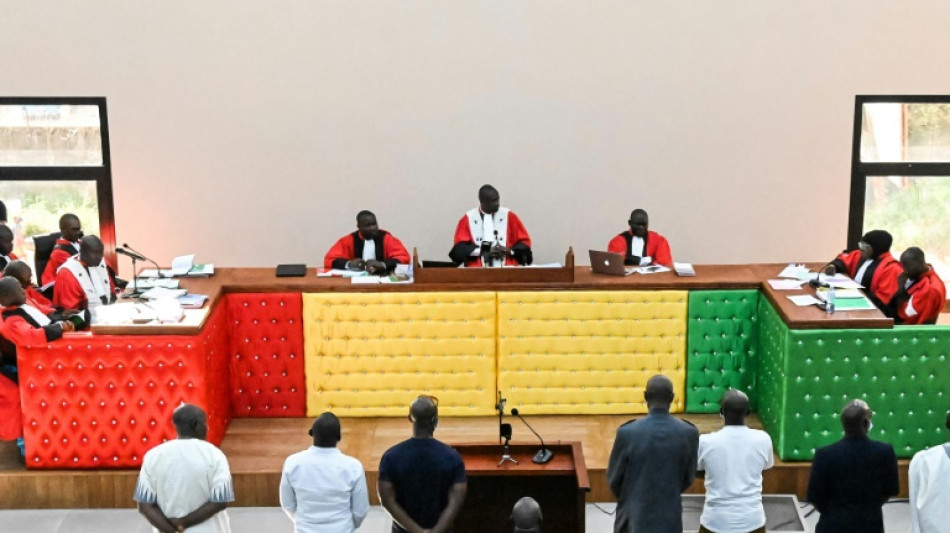
Guinea trial adjourned after ex-dictator pleads ill health / Photo: CELLOU BINANI - AFP
 Trump names Stephen Miller as White House chief of staff after midterm losses

 Restored Albanian tower houses anchor new rural tourism trail

 Sonia Gandhi reflects on family tragedy and reluctant political career

 Pope Leo begins three-country South American tour in Uruguay

 Khawaja says entire Australia camp knew of 2018 ball-tampering plan

 November Foraging Guide: Edible Mushrooms and Critical Safety Protocols

 Microsoft Updates Xbox PC App with 60% Faster Startup and Redesigned Interface

 Early Polar Vortex Disruption Creates Uncertain Winter Outlook for Pennsylvania

 How to Enjoy Luxury Experiences on a Budget

 Pakistan Demands Grant-Based Climate Finance at COP31 to Avoid Debt Trap
Proceedings in a trial over a 2009 massacre in Guinea were adjourned for a week on Monday after former dictator Moussa Dadis Camara said he was too ill to give testimony.
Survivors of the bloodbath and relatives of the dead had been eagerly awaiting the moment when Camara would take the stand.
But the former military ruler, who appeared at the bar in civilian clothes and walking with some difficulty, said he was unwell.
"With all the respect that I have for your distinguished tribunal, I have already informed the director of the penitentiary, the head doctor of the penitentiary, (that) I have been ill for some time," Camara said.
He said he felt "completely weak, from malaria I caught".
"I'm not above the law but quite sincerely I absolutely think that I can't (testify) right now."
Camara and 10 other former military and government officials are accused over the killing of 156 people and the rape of at least 109 women by pro-junta forces at a political rally in a Conakry stadium in September 2009.
They face charges ranging from murder to sexual violence, kidnappings, arson and looting. Camara himself is charged with "personal criminal responsibility and command responsibility."
Chief judge Ibrahima Sory Tounkara said, "The court cannot force you to say or do something that you do not wish to do... If you say that you cannot give testimony, the court acknowledges this."
"You have a week, Mr. Camara," he said, adjourning the trial until December 12.
Camara, at the time an unknown captain in the army, seized power in December 2008 shortly after the death of Guinea's second post-independence president, General Lansana Conte, who had ruled for 24 years.
In December 2009, Camara was wounded in the head in an attempted assassination and headed to Morocco for medical treatment.
He fled into exile in Burkina Faso, where he was indicted in July 2015 by Guinean magistrates for his alleged role in the stadium massacre.
The 58-year-old former strongman was detained on September 27, a day before the long-awaited trial began in a purpose-built court in the capital Conakry.
S.Gregor--AMWN

