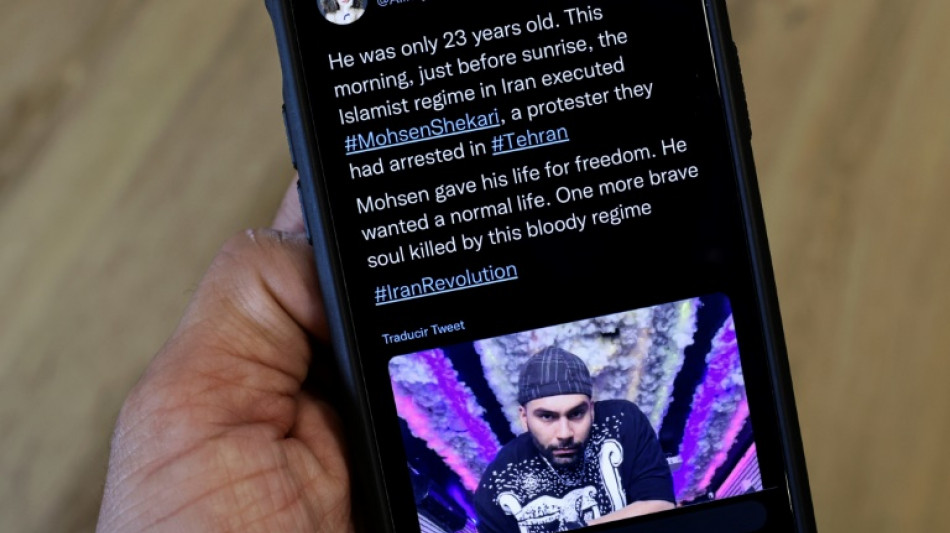
Outrage as Iran carries out first first hanging over protests / Photo: - - AFP
 Trump names Stephen Miller as White House chief of staff after midterm losses

 Restored Albanian tower houses anchor new rural tourism trail

 Sonia Gandhi reflects on family tragedy and reluctant political career

 Pope Leo begins three-country South American tour in Uruguay

 Khawaja says entire Australia camp knew of 2018 ball-tampering plan

 November Foraging Guide: Edible Mushrooms and Critical Safety Protocols

 Microsoft Updates Xbox PC App with 60% Faster Startup and Redesigned Interface

 Early Polar Vortex Disruption Creates Uncertain Winter Outlook for Pennsylvania

 How to Enjoy Luxury Experiences on a Budget

 Pakistan Demands Grant-Based Climate Finance at COP31 to Avoid Debt Trap
Iran carried out its first known execution Thursday over the protests that have shaken the regime since September, sparking international condemnation and warnings from rights groups that more hangings are imminent.
Mohsen Shekari, 23, had been convicted and sentenced to death for blocking a street and wounding a paramilitary during the early phase of the protests in mid-September, after a legal process denounced as a show trial by rights groups.
At least a dozen other people are currently at risk of imminent execution after being sentenced to hang over the protests in recent weeks, human rights groups warned.
Demonstrations have swept Iran for nearly three months since Iranian Kurdish woman Mahsa Amini, 22, died after her arrest by the morality police in Tehran for an alleged breach of the country's strict hijab dress code for women.
The protests, described by the authorities as "riots", are posing the biggest challenge to the Islamic republic since it was established following the ouster of the shah in 1979.
"Mohsen Shekari, a rioter who blocked Sattar Khan Street in Tehran on September 25 and wounded one of the security guards with a machete, was executed this morning," the judiciary's Mizan Online website said.
Amnesty International said it was "horrified" by the execution, which it said came just three weeks after Shekari was condemned in a "grossly unfair sham trial".
"His execution exposes the inhumanity of Iran's so-called justice system as dozens of others face the same fate," it added.
Mahmood Amiry-Moghaddam, director of Oslo-based group Iran Human Rights (IHR), urged a strong international reaction, warning that otherwise "we will face mass execution of protesters".
"Mohsen Shekari was executed after a hasty and unfair trial without a lawyer," he said, adding it had been carried out a mere 75 days after his arrest.
Iran's Fars news agency carried a video report of Shekari talking about the attack while in detention, which IHR described as "forced confessions" with his face "visibly injured".
- 'Boundless contempt' -
Western governments echoed the anger of the rights groups.
"The Iranian regime's contempt for human life is boundless," German Foreign Minister Annalena Baerbock tweeted, describing the legal process as a "perfidious summary trial".
But she added: "The threat of execution will not suffocate the will for freedom."
"This execution comes on top of other serious and unacceptable violations," French foreign ministry spokeswoman Anne-Claire Legendre told reporters, condemning in the "strongest terms" the execution.
The revolutionary court in Tehran heard Shekari had been arrested after striking the member of the Basij paramilitary force in the shoulder with the blade, an injury that required 13 stitches, Mizan Online said.
The judiciary said Shekari was found guilty of fighting and drawing a weapon "with the intention of killing, causing terror and disturbing the order and security of society".
It convicted him of "moharebeh" -- or waging "war against God" under Iran's Islamic sharia law -- on November 1, said Mizan, adding he appealed the ruling but the supreme court upheld it on November 20.
Iran executes more people annually than any nation other than China. IHR said earlier this week it had already executed over 500 people this year, a sharp jump on last year's figure.
- 'Imminent danger' -
The largely peaceful protest movement has been marked by actions included removing and burning headscarves in the streets, chanting anti-government slogans and confronting the security forces.
In a relatively new tactic, protest supporters staged three days of nationwide strikes up to Wednesday which closed down shops in several major cities including Tehran, according to rights groups.
The security forces have responded with a crackdown that has killed at least 458 people, including 63 children, according to an updated death toll issued by IHR on Wednesday.
An Iranian court on Tuesday sentenced five more people to death by hanging for killing a member of the Basij, bringing to 11 the number of people in Iran sentenced to death in connection with the protests, according to IHR.
Freedom of expression group Article 19 said urgent action was needed "as the lives of others on death row in relation to the uprising are in imminent danger".
In a tweet, former Iranian football star Ali Karimi, a strong supporter of the protests, warned: "If we stay silent today, tomorrow we will be using the 'Do not execute' hashtag for other children of Iran."
Prior to the latest execution, Amnesty had said at least 28 people, including three children, could face the death penalty in connection with the nationwide protests.
Iranian dissident Hossein Ronaghi, recently released after a spell in jail, warned the authorities: "The execution of any protester will have serious consequences for you.
"Taking the life of one person is taking all of our lives," he wrote on Twitter. "Do you have enough gallows?"
F.Dubois--AMWN

