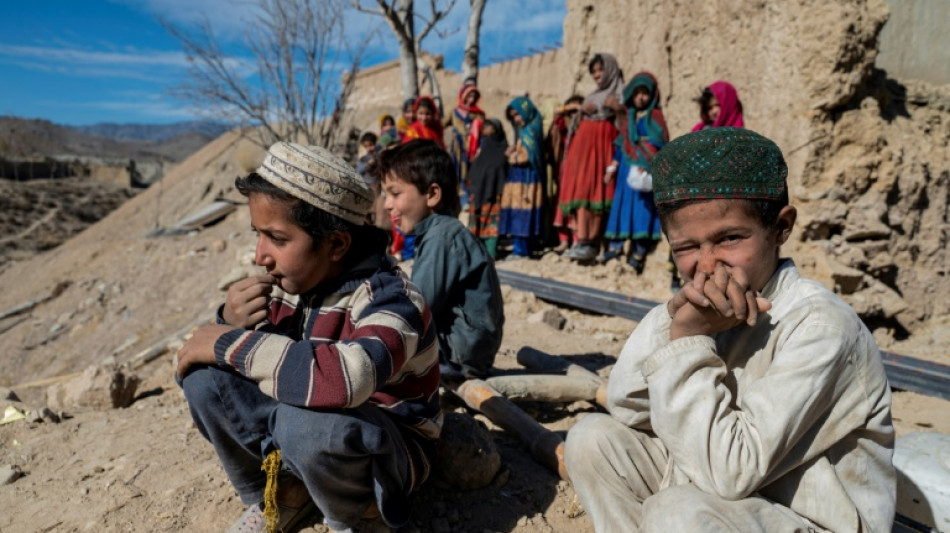
Afghan survivors get new homes six months after deadly quake / Photo: Wakil KOHSAR - AFP
 ChatGPT interactive interface feature tested across six custom tools

 Freshways milk-price cut deepens pressure on UK dairy farms

 Labour and National remain virtually tied as New Zealand vote count advances

 The Good Daughter adapts Karin Slaughter thriller with Rose Byrne and Meghann Fahy

 Heavy-lift drone evacuates wounded Ukrainian soldier from frontline kill zone

 Morrison says West Brom recovered after pressure from successive derby losses

 Britain considers 2027 state visit for Ukraine’s Zelensky

 Anna Miltina Confronted with Racism Allegations on ProSieben Show

 German Auto Giants Face Existential Crisis as China Sales Plummet

 Cause of Death Revealed for 'Ellen' Producer Matthew Wright

 DEA Marijuana Rescheduling Hearing Closes With Government Not Meeting Its Burden Of Proof?

 Edmund Richardson Wins Baillie Gifford Prize for 'Alexander' Biography

Labourer Rasool Badshah has moved into a new home six months after a deadly earthquake rocked eastern Afghanistan, but without his mother, who was killed by collapsing walls.
More than 1,000 people were killed and tens of thousands made homeless after the 5.9-magnitude quake -- the deadliest in Afghanistan in nearly a quarter of a century -- struck the impoverished province of Paktika on June 22.
"When I reached here, my mother, brothers, everyone was already buried," Badshah, 21, told AFP, explaining how he rushed back to his village from Pakistan, where he was working.
Hundreds of earthquake-resilient concrete homes, many built by local labourers with the support of the United Nations refugee agency, have now been handed over to survivors who were until now living in makeshift tent cities.
"We couldn't have built these houses, not even our children or grandchildren (could have)... we could not afford it. We were living in huts," Badshah said.
The UNHCR said the new homes are equipped with solar panels, independent toilets and traditional heaters to help residents face harsh winters.
Even before the earthquake, Afghanistan was in the grip of a humanitarian disaster made worse by the Taliban takeover in August 2021.
International development funding on which the South Asian country relied dried up after the takeover and assets held abroad were frozen.
The remote east where the quake struck had been neglected by authorities for years, said survivor Bara Khan.
"After the earthquake, people came and saw that residents of the area were in trouble. We don't even have a clinic or a school," Khan said.
"Everybody has grown up illiterate."
The UNHCR will start work to build two schools and a clinic in the area, still strewn with rubble, after the winter.
Afghanistan is frequently hit by earthquakes, especially in the Hindu Kush mountain range, which lies near the junction of the Eurasian and Indian tectonic plates.
A.Mahlangu--AMWN

