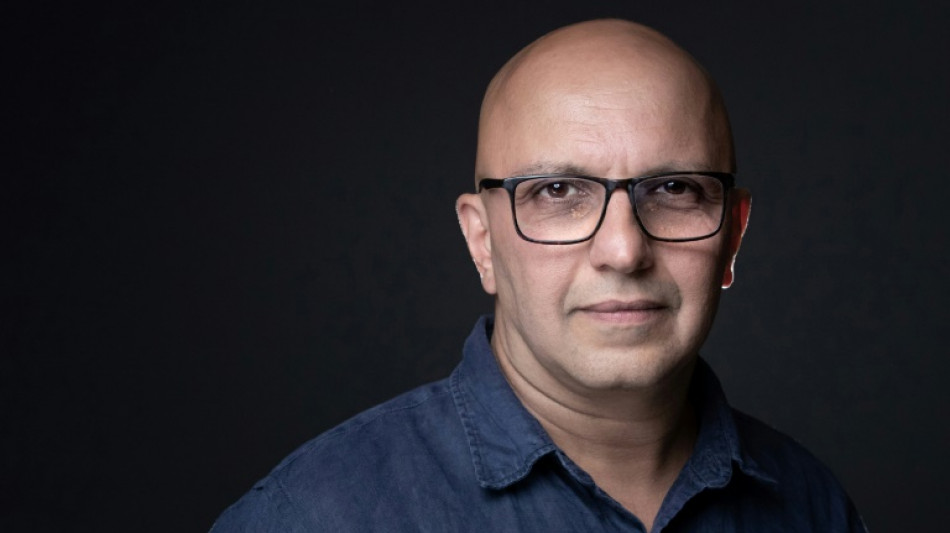
Iranian filmmaker recounts torture to 'unsettle' abusers / Photo: JOEL SAGET - AFP
 Post-election pressures complicate US and Israeli decisions on Iran

 UN members approve talks on treaty protocol against environmental crime

 Family-run West Sussex beach café prepares for first winter season

 CT scans reveal health and burial clues from Egypt’s Braided Lady mummy

 Oxford faces complaints over lecturer’s classroom attire

 Kyren Wilson and John Higgins reach International Championship snooker final

 New Zealand and Tonga meet for place in Rugby League World Cup final

 Reports of unsafe AI-toy responses renew calls for child-safety rules

 Juneau food network combines difficult supply routes with deep sharing traditions

 India climbs green-transition ranking after first emissions decline in 25 years

 Trump names Stephen Miller as White House chief of staff after midterm losses

 Restored Albanian tower houses anchor new rural tourism trail

 Sonia Gandhi reflects on family tragedy and reluctant political career

 Pope Leo begins three-country South American tour in Uruguay

 Khawaja says entire Australia camp knew of 2018 ball-tampering plan

 November Foraging Guide: Edible Mushrooms and Critical Safety Protocols

 Microsoft Updates Xbox PC App with 60% Faster Startup and Redesigned Interface

 Early Polar Vortex Disruption Creates Uncertain Winter Outlook for Pennsylvania

 DEA Marijuana Rescheduling Hearing Closes With Government Not Meeting Its Burden Of Proof?

One man mimes his bones being broken, a woman recounts her surrender to religious brainwashing, and a third man replicates his confinement in a tiny prison cell.
With his new documentary "Where God is Not", French-Iranian filmmaker Mehran Tamadon hopes that the testimonies of former detainees who say they were tortured in Iran will "unsettle" some of their persecutors.
All recount abuse that occurred before the protests that are now shaking Iran, from the brutal repression of the 1980s in the immediate aftermath of the revolution up until the last decade.
But "everything I am filming speaks of today," said the director who was born to communist parents in Iran in 1972, but fled to France with his mother as a child.
"Right now, there are people being tortured in prison in Iran."
Iranian authorities have arrested thousands since nationwide protests broke out following the September 16 death in custody of 22-year-old Mahsa Amini for allegedly breaching the country's strict dress rules for women.
Security forces have also killed 537 people during the crackdown, Norway-based Iran Human Rights watchdog says.
"For 43 years," since the 1979 revolution that installed an Islamic theocracy in the country, Iran has been in the grips of a "totalitarian system", said Tamadon, an architect who turned to cinema in the first decade of the millennium when he lived in Tehran.
After 2009 documentary "Bassidji" ("Basij") in which he interviewed members of the paramilitary volunteer force, the atheist engaged in conversation with four clerics for his 2014 work "Iranian".
The authorities were so unhappy with him that they confiscated his passports.
- 'Russian roulette' -
After they returned them to him in 2012, he decided to leave Iran, where he says violence has become so ingrained that, "like a Russian roulette", it can strike at any time.
In "Where God is Not", which premiered at the Berlinale in February, 50-year-old Mazyar welds a metal bed frame like the one he was tortured on after being detained for alleged spying and murder.
It was there the once business manager was tied up, and his torturers broke the bones of his feet with a metal rod, he says.
When he was no longer able to walk, he was dragged in front of a camera to confess to crimes he had never committed.
Also in the film, Homa, a Marxist woman who was detained in an overcrowded prison in the 1980s, breaks down in tears as she recounts being so blasted with endless religious chants that she woke up one day brainwashed and started to pray.
Taghi Rahmani, a political activist who was locked up for 15 years for his views, re-enacts his confinement in a tiny Parisian cellar.
"I spent six months like this," he said, counting out the three steps between the two walls of a former cell.
Rights groups have long lambasted the use of torture in Iranian jails, with Amnesty International in a September 2020 report detailing methods including beatings, floggings, electric shocks, stress positions, mock executions, water-boarding and sexual violence.
The group said in March that in the crackdown on the protest movement child protesters as young as 12 were being subjected to torture that included electric shocks and rape.
- 'A torturer's conscience' -
In a second film also due out this year, "Mon Pire Ennemi" ("My Worst Enemy"), Tamadon asks award-winning Iranian-French actress Zar Amir Ebrahimi to step into the shoes of her interrogators.
Becoming her victim, the filmmaker allows her to subject him to the same humiliation she says she endured at the hands of regime agents after a sex tape featuring her and her boyfriend was leaked online in 2006.
In one scene, she forces him to strip down to his underwear.
"I enjoyed destroying you with the words I said," she says towards the end of the film.
Tamadon says he hopes both works will be enough to make some members of the regime in Iran re-examine their actions.
"Many of the questions I ask my characters about a torturer's conscience are in fact directly aimed at them," he said.
"Maybe this will plant a seed that will grow into something later on."
Rahmani, the political activist who has lived in France for over a decade, does not believe either "Where God is Not" or "My Worst Enemy" can bring about any redemption.
But everything in them "is happening at the moment in Iran. By speaking up, I'm trying to denounce it," he said.
His own wife, prominent rights defender Narges Mohammadi, is jailed in Tehran's Evin prison.
"As my wife is well known, she isn't tortured physically. But she's in solitary confinement," he said.
"Whenever she suffers, I also suffer."
Ch.Havering--AMWN