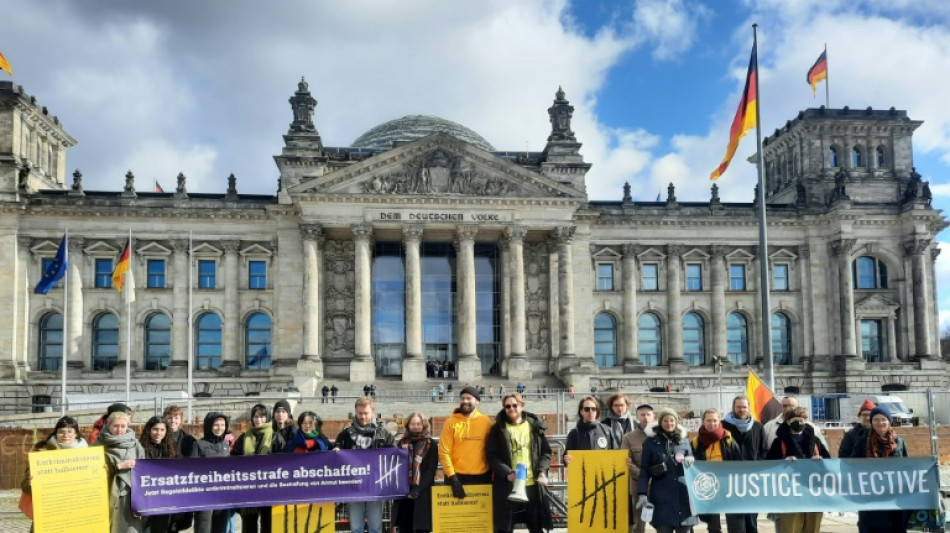
Germany struggles to reform 1930s law jailing fare dodgers / Photo: Clement KASSER - AFP
 Post-election pressures complicate US and Israeli decisions on Iran

 UN members approve talks on treaty protocol against environmental crime

 Family-run West Sussex beach café prepares for first winter season

 CT scans reveal health and burial clues from Egypt’s Braided Lady mummy

 Oxford faces complaints over lecturer’s classroom attire

 Kyren Wilson and John Higgins reach International Championship snooker final

 New Zealand and Tonga meet for place in Rugby League World Cup final

 Reports of unsafe AI-toy responses renew calls for child-safety rules

 Juneau food network combines difficult supply routes with deep sharing traditions

 India climbs green-transition ranking after first emissions decline in 25 years

 Trump names Stephen Miller as White House chief of staff after midterm losses

 Restored Albanian tower houses anchor new rural tourism trail

 Sonia Gandhi reflects on family tragedy and reluctant political career

 Pope Leo begins three-country South American tour in Uruguay

 Khawaja says entire Australia camp knew of 2018 ball-tampering plan

 November Foraging Guide: Edible Mushrooms and Critical Safety Protocols

 Microsoft Updates Xbox PC App with 60% Faster Startup and Redesigned Interface

 Early Polar Vortex Disruption Creates Uncertain Winter Outlook for Pennsylvania

 DEA Marijuana Rescheduling Hearing Closes With Government Not Meeting Its Burden Of Proof?

Peter, 43, used to dodge fares regularly when he was homeless but he never imagined the petty offence could land him in jail for almost three years.
Peter, who spoke on condition that his full name not be used, received a letter in 2021 from authorities in Munich asking him to pay a 4,000-euro (nearly $4,400) fine for having travelled on public transport without a ticket on 10 separate occasions.
Unable to stump up the money, Peter was sentenced to nine months in prison, under a controversial plank of the German legal system drawn up under the Nazis that the government now hopes to reform.
"Everything I had managed to build suddenly fell apart," said Peter, who had by then put a roof over his head and started jobbing as a photographer.
Written into the penal code in 1935, "compensation imprisonment" sees fines converted into jail terms. Similar systems exist in Switzerland and Austria.
Failing to pay the penalty for skipping on the bus fare, shoplifting or driving without a licence can lead to a custodial sentence of up to 12 months.
Critics say the system exacerbates inequality as it hits the poorest disproportionately, while the rich are able to pay to avoid jail.
In all, between 2012 and 2022, Peter ended up doing four stints in prison.
- 'Crimes of poverty' -
Peter got a helping hand in March 2022 from the "Freedom Fund", which transferred 1,200 euros to him to cut short his latest jail term by 82 days.
The Berlin-based group frees people like Peter by paying the balance of their fines.
Since his first imprisonment in 2012, Peter said he had been battling with depression, repeatedly ending up in psychiatric care.
"A day in prison is enough to change your life forever," he told AFP, adding that in jail he had lived among "drug dealers, rapists and murderers".
The Freedom Fund hopes to draw attention to "absurd convictions" like Peter's, the association's president Arne Semsrott, 34, told AFP.
"It isn't normal for people to be imprisoned for crimes of poverty."
In 2022, more than 50,000 people spent time in jail as a result of unpaid fines, according to the campaign group.
"Parliament has tried 10 times to reform this law and we have failed 10 times," Justice Minister Marco Buschmann said last month, presenting his proposals for change.
Without eliminating the regime, which is a "vital tool" according to the minister, the proposal would lead to the halving of the potential sentences.
Some 95 percent of those who end up in jail with compensatory sentences earn less than 1,000 euros a month, Social Democrat Johannes Fechner claimed during the reform bill's first reading in parliament.
A quarter of them are there because they failed to pay for public transport, Fechner said.
The proposed reform stops short of abolishing the alternative sentences regime because it would "call into question" the effective enforcement of fines, according to a draft law.
It is necessary "to keep a degree of pressure", according to conservative deputy Susanne Hierl of the CSU, the Bavarian sister party of the main opposition CDU.
- Prison costs -
But the Freedom Fund believes that the compensatory imprisonment system should be scrapped.
The government's proposed reform -- set to be voted on in mid-May -- does not however change much, said Semsrott.
"The same number of people will still go to prison, only not for as long."
Those who go to jail will "continue to lose their work or their place in therapy", added Fechner.
Since it was established, the Freedom Fund has freed 716 people at a total cost of 667,000 euros -- an average of 930 euros per person.
Authorities "do not check if people have the means to pay", said Manuel Matzke, spokesman for the federal prisoners' union GG/BO, lamenting the frequent absence of a judge in the process.
"There is only a hearing when the accused contests the judgement within two weeks," putting the "socially disadvantaged" even more at risk, jurist Elena Blessing wrote in a post on the academic forum Verfassungsblog.
One day of incarceration costs the German state 150 euros on average, according to GG/BO.
The Freedom Fund claims to have saved the government 10 billion euros with its work to free people from jail.
C.Garcia--AMWN