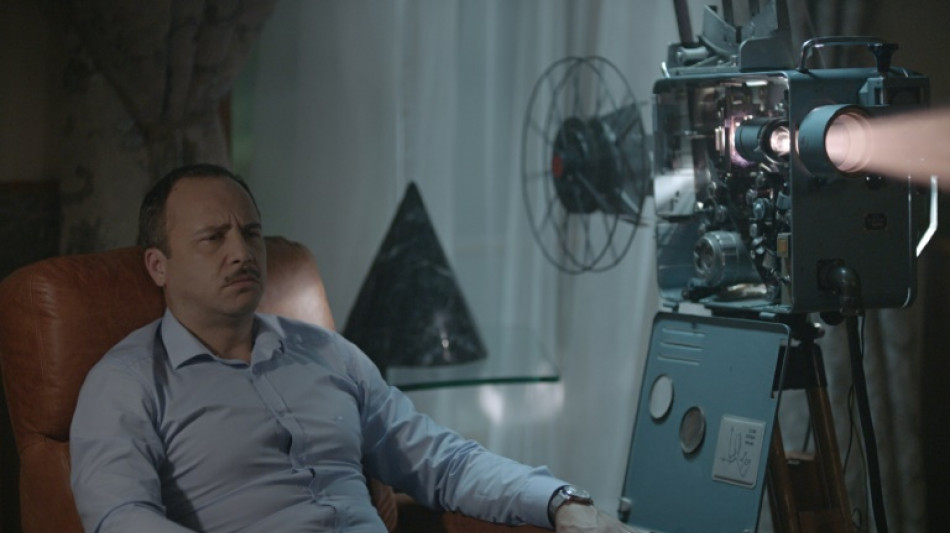
Syrians gripped by grim Ramadan TV series alluding to Assad dynasty / Photo: - - METAFORA PRODUCTION/AFP
 Post-election pressures complicate US and Israeli decisions on Iran

 UN members approve talks on treaty protocol against environmental crime

 Family-run West Sussex beach café prepares for first winter season

 CT scans reveal health and burial clues from Egypt’s Braided Lady mummy

 Oxford faces complaints over lecturer’s classroom attire

 Kyren Wilson and John Higgins reach International Championship snooker final

 New Zealand and Tonga meet for place in Rugby League World Cup final

 Reports of unsafe AI-toy responses renew calls for child-safety rules

 Juneau food network combines difficult supply routes with deep sharing traditions

 India climbs green-transition ranking after first emissions decline in 25 years

 Trump names Stephen Miller as White House chief of staff after midterm losses

 Restored Albanian tower houses anchor new rural tourism trail

 Sonia Gandhi reflects on family tragedy and reluctant political career

 Pope Leo begins three-country South American tour in Uruguay

 Khawaja says entire Australia camp knew of 2018 ball-tampering plan

 November Foraging Guide: Edible Mushrooms and Critical Safety Protocols

 Microsoft Updates Xbox PC App with 60% Faster Startup and Redesigned Interface

 Early Polar Vortex Disruption Creates Uncertain Winter Outlook for Pennsylvania

 DEA Marijuana Rescheduling Hearing Closes With Government Not Meeting Its Burden Of Proof?

A Ramadan television series featuring sinister plotlines inspired by President Bashar al-Assad's family has had Syrians glued to their screens, from those hunkered in the war-torn country to those abroad.
The series, "Smile, General", is set in an imaginary Arab country. But references to the Assad dynasty, in power in Syria for more than half a century, are clear through various characters and aspects of the plot.
Television viewership in the Middle East traditionally peaks during Ramadan, when the faithful enjoy programming after breaking their daily fast at sunset. The series has been screening on a TV channel broadcasting to Syria's rebel-held areas and on a Qatar-owned broadcaster.
It is also streamed on YouTube, where Syrians living in government-controlled areas can clandestinely watch online.
"It's the first time in the Arab world that a series alludes to the Syrian regime," said Fidaa Saleh, a 35-year-old activist living in Jindayris, in Syria's rebel-held northwest.
"The Syrian people by now know perfectly well that what's evoked in this series is but a drop in the ocean of the regime's crimes," he added.
Director Orwa Mohamad said the series is "fiction, not a documentary" and aims to "dismantle the mechanics of dictatorships and of taking power by force".
"But it's clear the series refers to current and past Syrian regimes, mixing together the periods" of Assad and his father Hafez, who took power in a 1970 coup, he added.
Filmed mostly in Turkey, each episode starts with a quote from Machiavelli.
- 'Shines a light' -
The show revolves around a power struggle between the president and his volatile younger brother, who controls the military.
Mohamad said it was inspired both by the rivalry between Hafez al-Assad and his younger brother Rifaat, who mounted a failed 1984 coup, as well as that between Bashar and his younger brother Maher, who commands an elite army division.
The show also features a rebellious sister, an allusion to Bushra al-Assad, who moved to Dubai after her husband, a senior security official, was killed in a 2012 suicide attack.
The series includes arrests, killings, corruption, Islamists, foreign powers, and a neighbouring country resembling Lebanon, which Syria occupied from 1976 to 2005.
In the show, a retired military officer reveals ghastly skeletons in the regime's closet.
"It's a great series that shines a light on the suffering of the Syrian people and refers to the hereditary transfer of power," said shopkeeper Rida Saidi, 52.
He said he followed the show every night from a tent along with others in the Deir Ballut displacement camp in Syria's northwest.
Syria's civil war broke out in 2011 after Assad's repression of peaceful anti-government demonstrations escalated into a deadly conflict that pulled in foreign powers and global jihadists.
More than half a million people have been killed and around half of Syria's pre-war population forced from their homes.
The most prominent actors in "Smile, General" are exiled Syrians known for opposing the government, including Maxim Khalil, who plays the sharp, moustachioed president.
Abdel Hakeem Qutaifan, who plays a powerful intelligence chief, lives abroad after being imprisoned for nine years under Hafez al-Assad.
- 'Reality is worse' -
Hussam Hazber, 32, fled Syria four years ago and said the presence of actors "who stood beside the Syrian people during the revolution" was one of the reasons he was watching the show.
The series "crosses all red lines the regime placed on dramas in Syria", said the student and activist living in the Turkish city of Gaziantep.
Other characters include a first lady who, like Asma al-Assad, extends her influence into the economic sphere.
A ruthless businessman appears to be inspired by Assad's tycoon cousin Rami Makhlouf.
Sami al-Doraid, 53, who was arrested in Damascus for taking part in protests early in the uprising, said the series "re-opens wounds".
"It clearly shows the crimes of this dictatorship. When it shows the prisons, it reminded me of when I was arrested -- but the reality is even worse," said the teacher, now living in the rebel-held northwest.
In Damascus, people refer to the show as "the other series", to avoid problems.
"Though it didn't meet our expectations, I watch it because it touches on the situation in Syria," said Ibrahim, a teacher in his 30s who declined to provide his surname due to security concerns.
"I get together with friends and we try to guess which scene corresponds to what in real life."
O.Johnson--AMWN