Number of child marriages falling too slowly: UNICEF / Photo: Cléa PÉCULIER, Laurence SAUBADU - AFP
 Post-election pressures complicate US and Israeli decisions on Iran

 UN members approve talks on treaty protocol against environmental crime

 Family-run West Sussex beach café prepares for first winter season

 CT scans reveal health and burial clues from Egypt’s Braided Lady mummy

 Oxford faces complaints over lecturer’s classroom attire

 Kyren Wilson and John Higgins reach International Championship snooker final

 New Zealand and Tonga meet for place in Rugby League World Cup final

 Reports of unsafe AI-toy responses renew calls for child-safety rules

 Juneau food network combines difficult supply routes with deep sharing traditions

 India climbs green-transition ranking after first emissions decline in 25 years

 Trump names Stephen Miller as White House chief of staff after midterm losses

 Restored Albanian tower houses anchor new rural tourism trail

 Sonia Gandhi reflects on family tragedy and reluctant political career

 Pope Leo begins three-country South American tour in Uruguay

 Khawaja says entire Australia camp knew of 2018 ball-tampering plan

 November Foraging Guide: Edible Mushrooms and Critical Safety Protocols

 Microsoft Updates Xbox PC App with 60% Faster Startup and Redesigned Interface

 Early Polar Vortex Disruption Creates Uncertain Winter Outlook for Pennsylvania

 DEA Marijuana Rescheduling Hearing Closes With Government Not Meeting Its Burden Of Proof?

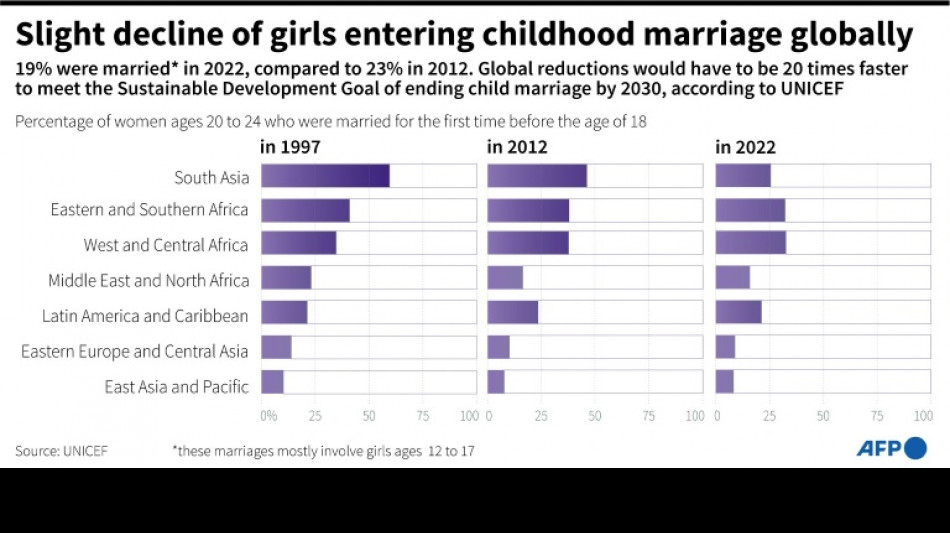
Child marriages are declining -- but at a rate that would not eliminate the practice for another 300 years, while a perfect storm of crises could yet reverse the trend, the United Nations childrens' agency said Tuesday.
"We definitely have made progress in the abandonment of the practice of child marriage, particularly in the last 10 years. Unfortunately, this progress was not enough," Claudia Cappa, lead author of the UNICEF report published Tuesday, told AFP.
According to UNICEF estimates, 640 million girls and women today were married when they were under 18. At present, an estimated 12 million girls are becoming child brides each year.
But over the past 25 years the rate at which such marriages take place has been slowing: in 1997, 25 percent of young women aged 20-24 were married before 18. By 2012 that figure had dropped to 23 percent, and by 2022 it was at 19 percent.
Still, that means some nine million girls are expected to be married off in 2030, the report said.
"At current pace, we might have to wait 300 years to eliminate child marriage," Cappa warned, adding that the majority of these marriages involve girls aged 12 to 17.
And even that fragile progress is under threat -- UNICEF also fears that the convergence of the Covid-19 pandemic, global conflicts and the growing impacts of climate change could reverse the hard-won gains.
Covid-19 alone could be responsible for an additional 10 million underage marriages between 2020 and 2030, it said.
"The world is engulfed by crises on top of crises that are crushing the hopes and dreams of vulnerable children, especially girls who should be students, not brides," said UNICEF boss Catherine Russell in a statement.
Such crises can see families feel forced to marry children off as a means of security.
"Although child marriage is a clear violation of children's rights, it is often seen by families as a 'protective' measure for girls, providing financial, social or even physical protection," the report notes.
It is also a way to have one less mouth to feed.
Geographically, South Asia is the driving force behind the decline in girls' marriages.
However, the region still accounts for about 45 percent of the 640 million women today who were married as children. India alone accounts for a third.
UNICEF is particularly concerned about the situation in sub-Saharan Africa, which appears to be bucking the trend.
"Girls there now experience the highest risk of child marriage in the world, with one in three marrying before age 18," the report said.
It expects the number of child brides there to increase by 10 percent by 2030.
O.Karlsson--AMWN