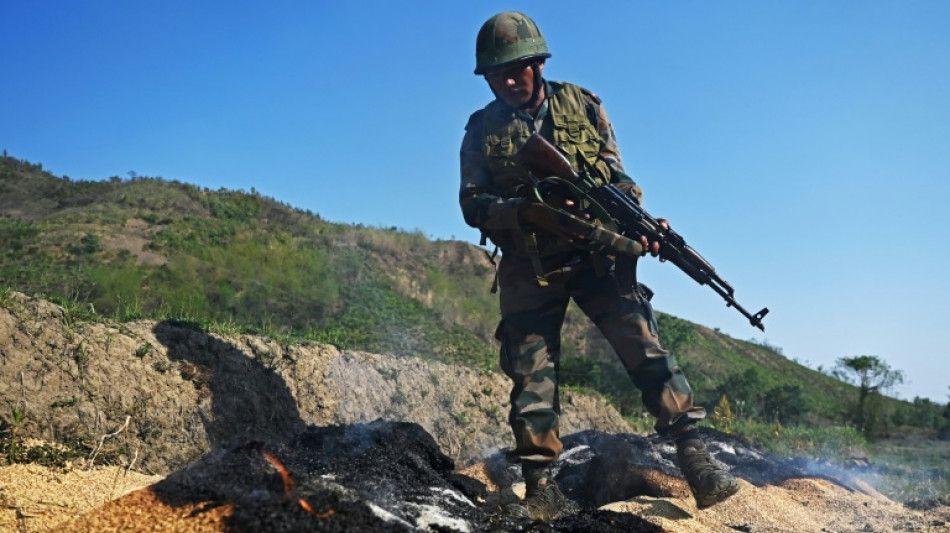
Indian villages burned to ashes in ethnic violence / Photo: Arun SANKAR - AFP
 Post-election pressures complicate US and Israeli decisions on Iran

 UN members approve talks on treaty protocol against environmental crime

 Family-run West Sussex beach café prepares for first winter season

 CT scans reveal health and burial clues from Egypt’s Braided Lady mummy

 Oxford faces complaints over lecturer’s classroom attire

 Kyren Wilson and John Higgins reach International Championship snooker final

 New Zealand and Tonga meet for place in Rugby League World Cup final

 Reports of unsafe AI-toy responses renew calls for child-safety rules

 Juneau food network combines difficult supply routes with deep sharing traditions

 India climbs green-transition ranking after first emissions decline in 25 years

 Trump names Stephen Miller as White House chief of staff after midterm losses

 Restored Albanian tower houses anchor new rural tourism trail

 Sonia Gandhi reflects on family tragedy and reluctant political career

 Pope Leo begins three-country South American tour in Uruguay

 Khawaja says entire Australia camp knew of 2018 ball-tampering plan

 November Foraging Guide: Edible Mushrooms and Critical Safety Protocols

 Microsoft Updates Xbox PC App with 60% Faster Startup and Redesigned Interface

 Early Polar Vortex Disruption Creates Uncertain Winter Outlook for Pennsylvania

 DEA Marijuana Rescheduling Hearing Closes With Government Not Meeting Its Burden Of Proof?

The road to Heiroklian is smooth and freshly laid, with a sign proclaiming it part of an Indian government development initiative. But ethnic violence has reduced the village itself to little more than smouldering ashes.
Sanatomba picked through the ruins of his sister's home in the northeastern state of Manipur, trying to salvage anything of value, but could only recover a traditional stool.
"This used to be my sister's kitchen," the 20-year-old says.
"That was her room and she kept her TV there, the fridge there, the almirah (cupboard) for clothes there. But now everything she shared with her husband, four children and other family members is gone forever."
More than 50 people have been killed in the hilly border region in clashes between the majority Meitei people, who are mostly Hindus, and the mainly Christian Kuki tribe.
Thousands of troops have been deployed to restore order, while around 23,000 residents have fled their homes for the safety of ad-hoc army-run camps for the displaced.
Sanatomba's sibling is among them. They are Kuki, and he is sure she and her family will never be able to return.
"She told me to come here and look for anything I can find," he says, his hands and feet covered in black soot.
The rest of the village suffered a similar fate, its three settlements littered with broken doors, burnt-down water tanks, and forced-open metal trunks.
The towering village church, a school building, and even a jackfruit tree were set on fire by the attackers.
The raiders stole residents' cattle and poultry, Sanatomba said.
"Those animals they couldn't take alive, they killed and took away as meat.
"I am afraid of Meitei people."
- 'Broken hearts' -
The far-flung states of northeast India -- sandwiched between Bangladesh, China and Myanmar -- have long been a tinderbox of tensions between different ethnic groups.
The spark for the latest ethnic clash was a protest about plans to give the Meitei "Scheduled Tribe" status.
A form of affirmative action to combat structural inequality and discrimination, that classification would give them guaranteed quotas of government jobs and college admissions.
Violence erupted in the regional capital Imphal and elsewhere, with protestors setting fire to vehicles and buildings. According to villagers, Meitei mobs armed with guns and petrol cans then attacked Kuki settlements in the hills.
Authorities are concerned there could be more reprisal attacks "as both communities have now accumulated weapons", an army officer said.
"Are you sure that none of you have any weapons that you would like to surrender?" a senior officer asked a Kuki gathering at a village outside Imphal on Monday.
"The other community has promised to surrender their weapons if you do too," he added. "I want you to consider this as it doesn't help either community to have these weapons in circulation."
None of the mostly male audience did so.
Thanglallem Kuki, 32, a teacher at a private school, watched from a hilltop as his village of Kamuching was attacked and burned to the ground, spending two nights in the jungle before being rescued and taken to an army camp.
He said the Meitei mob went from house to house, retrieving valuables, electronic gadgets, cooking gas cylinders, and even mattresses, loading their loot into vehicles.
"After that they burned the houses and they were burning one house to another house.
"For the first time when they burned the houses, they left some houses unburnt and they stormed in after two days again and they completely burnt it."
He had been left with nothing, he said.
"We were looking and crying with broken hearts and we looked down on our houses being burnt to ashes with helplessness and without hope."
P.Stevenson--AMWN