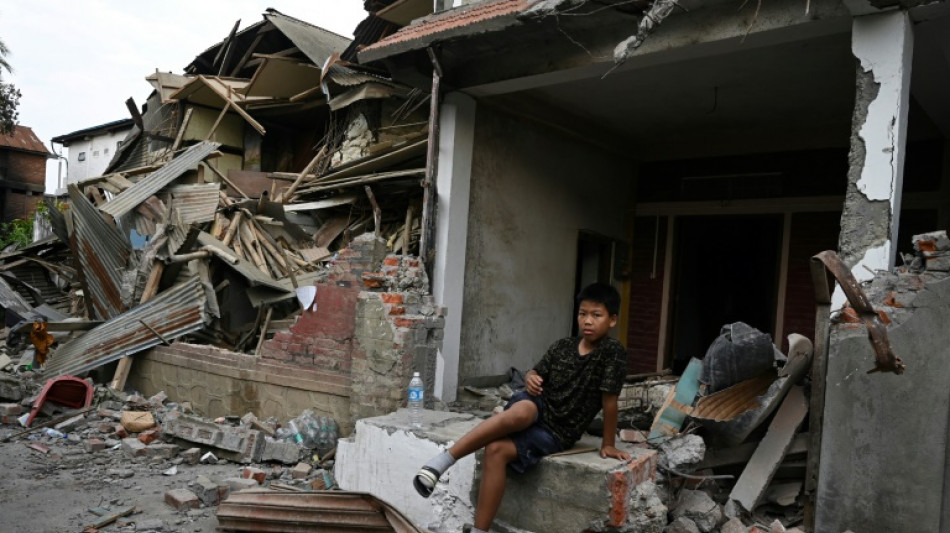
Indian ethnic clashes shatter harmony and houses / Photo: Arun SANKAR - AFP
 Post-election pressures complicate US and Israeli decisions on Iran

 UN members approve talks on treaty protocol against environmental crime

 Family-run West Sussex beach café prepares for first winter season

 CT scans reveal health and burial clues from Egypt’s Braided Lady mummy

 Oxford faces complaints over lecturer’s classroom attire

 Kyren Wilson and John Higgins reach International Championship snooker final

 New Zealand and Tonga meet for place in Rugby League World Cup final

 Reports of unsafe AI-toy responses renew calls for child-safety rules

 Juneau food network combines difficult supply routes with deep sharing traditions

 India climbs green-transition ranking after first emissions decline in 25 years

 Trump names Stephen Miller as White House chief of staff after midterm losses

 Restored Albanian tower houses anchor new rural tourism trail

 Sonia Gandhi reflects on family tragedy and reluctant political career

 Pope Leo begins three-country South American tour in Uruguay

 Khawaja says entire Australia camp knew of 2018 ball-tampering plan

 November Foraging Guide: Edible Mushrooms and Critical Safety Protocols

 Microsoft Updates Xbox PC App with 60% Faster Startup and Redesigned Interface

 Early Polar Vortex Disruption Creates Uncertain Winter Outlook for Pennsylvania

 DEA Marijuana Rescheduling Hearing Closes With Government Not Meeting Its Burden Of Proof?

Houses in a remote village in the restive northeastern Indian state of Manipur daubed with "Don't Burn" notices stand untouched while many unmarked buildings are in ruins, their Meitei owners having fled.
"It all started with an attack on two houses... But there was so much anger at what had happened in the afternoon that the people kept coming back to attack the entire neighbourhood," said Khumujamba village resident Muan Pau, 25.
The predominantly Hindu Meitei, Manipur's main ethnic group, live mostly in the capital Imphal and the surrounding plains. The Kukis and other smaller tribal groups live in the hills.
But several hill pockets, like Khumujamba in Churachandpur district, were also home to some Meitei, living side-by-side in uneasy harmony with the Kuki and other tribal peoples.
That was until last week, when an explosion of ethnic violence killed around 60 people and left 30,000 displaced and almost 2,000 houses burnt down across the state.
Most victims are reported to be from the mainly Christian Kuki, some of their villages destroyed by Meitei mobs and their residents killed or fled to the safety of army camps.
But the Meitei were also targeted by the Kukis, as a visit by AFP journalists to debris-strewn Khumujamba showed.
"I am not sure what I will do in the future," traumatised Meitei carpenter Oinam Parshuram, 48, told AFP as he sat waiting to be evacuated in an army truck with his wife and daughter.
- Looting -
The violence was sparked by Kuki anger at the prospect of the Meitei being given guaranteed quotas of government jobs and other perks in a form of affirmative action.
This also stoked long-held fears among the Kuki that the Meitei might also be allowed to acquire land in areas currently reserved for them and other tribal groups.
On Tuesday, days after most Meitei fled Khumujamba, village men were still scavenging loot including taps, iron grills and firewood from different buildings.
The few structures left standing had "Eimi In" and "Haal Louh Ding" written on their external walls, messages in the local language exhorting rioters and looters not to touch them.
Even the main commercial road, now under curfew, had two types of shops: those spray-painted with the word "Tribal" and the ones that were ransacked by mobs.
One of the latter group belonged to Oinam Ravi, 28, who also had a home in the same district.
"Both of them are gone now," he told AFP, one of a group of about 3,000 Meiteis being moved by the army, which has deployed thousands of troops and imposed curfews.
- 'Trust is gone' -
Tongbran Rajesh Meitei, 36, said he and other Meitei men spent a sleepless night guarding women and children in a building when tensions peaked on May 3.
The teacher, who said his grandfather settled in the region more than a century ago under British colonial rule, was abandoning the area with his seven family members.
"We will stay in a camp initially and see what the government does for us," he said.
Rajesh fears his house has been ransacked but said he doesn't have the courage to risk going back to his old neighbourhood to look.
"No one wants to come back. We want to leave and settle somewhere among our Meitei brothers," he said.
"The trust is gone and it will take a long time. It may take decades if not a century."
Back in Khumujamba, tribal R. Kholum, 50, put the onus for the violence on the regional state government.
"The tribal people didn't start this, they just reacted," he told AFP.
"What do you think will happen in a state which has over 50 different communities but the government is seen favouring only one or two of them?"
O.Norris--AMWN