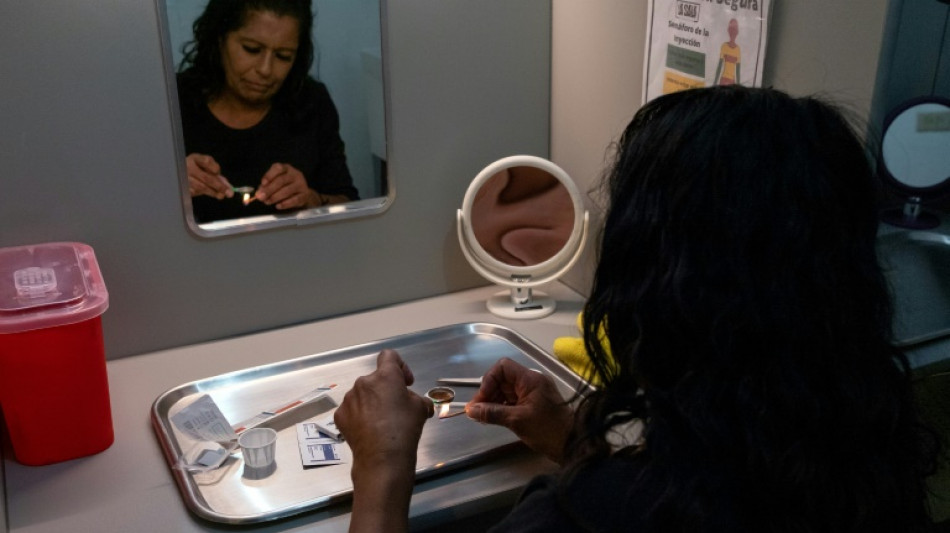
On Mexico-US border, fentanyl poses growing hidden danger / Photo: Guillermo Arias - AFP
 South African election results renew debate over identity-based voting

 South African voters report smoother local election but declining IEC trust

 Dolly Parton museum and Nashville hotel open after singer’s death

 George and Amal Clooney attend New York political-comedy reading

 British buyers pay substantial premiums for period-home appearance

 Thomas Markle released to house arrest after child-abuse-image charge

 Dawn of War 4 developers chose Adeptus Mechanicus for tactical variety

 Italy face unbeaten South Africa in Turin Nations Championship match

 ChatGPT interactive interface feature tested across six custom tools

 Freshways milk-price cut deepens pressure on UK dairy farms

 Labour and National remain virtually tied as New Zealand vote count advances

 The Good Daughter adapts Karin Slaughter thriller with Rose Byrne and Meghann Fahy

 Heavy-lift drone evacuates wounded Ukrainian soldier from frontline kill zone

 Morrison says West Brom recovered after pressure from successive derby losses

 Britain considers 2027 state visit for Ukraine’s Zelensky

 Anna Miltina Confronted with Racism Allegations on ProSieben Show

 German Auto Giants Face Existential Crisis as China Sales Plummet

 Cause of Death Revealed for 'Ellen' Producer Matthew Wright
Elena Ruelas prepares a syringe of heroin, a drug that she has been using for 20 years. These days, however, it is almost certainly laced with potentially deadly fentanyl.
A rapid strip test in a Mexican safe-use center in the city of Mexicali near the US border confirms the presence of the synthetic opioid, which is 50 times more powerful than heroin.
The result comes as no surprise.
Since 2019, "there's not a single heroin test that does not come back positive for fentanyl," said Said Slim, who works at a nonprofit organization, Verter, which created the safe-consumption place in 2018 to protect vulnerable users.
The group's records for 2022 indicate that overdoses among consumers doubled in one year.
There are deaths every day in Mexicali, according to the authorities.
The city, located just south of California and home to a million people, is suffering from the spillover of the opioid crisis blamed for hundreds of overdose deaths every day in the United States.
Fentanyl has become one of the top issues dominating diplomatic relations between the United States and Mexico.
Washington has accused Mexican drug cartels of controlling the bulk of fentanyl production and cross-border trafficking.
Mexican President Andres Manuel Lopez Obrador denies that the drug is produced in Mexico.
He says that US-bound fentanyl is imported from China and turned by the cartels into pills that are easy to smuggle due to their size.
- 'Too strong' -
Ruelas, 50, suffered a near-fatal overdose a year ago, even though she had injected herself with no more than her usual dose of heroin, a highly addictive opioid made from the opium poppy.
"I used the same amount as before but it had fentanyl in it and it was too strong for me," she said.
Ruelas was lucky to be given naloxone, a medicine that is capable of reversing an opioid overdose but whose sale is restricted in Mexico.
Ruelas, who works as a cleaner, cut her dose in half and almost always now injects herself in La Sala, a pioneering initiative in Latin America.
The organization provides drug users with consumption kits to prevent the spread of hepatitis C and HIV, while also monitoring their health.
Visitors, who include homeless people and sex workers, are greeted by name and given health and other advice.
"They make me feel that I'm still a human being," said Ricardo Rizo, who has used heroin for 26 years.
He too was almost killed by fentanyl.
"It's only by the grace of God that I'm here," he said.
Adjusting to the growing risks has been a major challenge for Rizo, who lowered his dosage to reduce the risk of overdose, the 59-year-old said.
The fentanyl makes users drowsy, leaving them "practically asleep," said Rizo, who earns a living selling candy on the street.
"People are not stupid... they realize when someone is under the influence," he said.
- Saving lives -
Every day the Mexicali police department deals with several deaths of suspected addicts, most of whom are believed to have been unaware of exactly what they were taking, according to its deputy director Carlos Romero.
"Many are overdoses," Romero said.
"The presence of fentanyl has grown a lot in the city," he added.
Julio Buenrostro, who works for the Red Cross nonprofit humanitarian organization, said that overdoses represented up to 25 percent of the emergencies that the organization deals with.
Thanks to naloxone "we managed to save a lot of lives," he said.
Without regular access to the drug, emergency workers turn to Verter, which sources naloxone from across the border.
Lopez Obrador has criticized the United States for its provision of free naloxone, arguing that it does not address the root causes of the problem.
He has floated the idea of banning fentanyl as a painkiller.
After his own brush with death, Rizo wants to warn others of the danger of taking drugs that may have been adulterated.
"I lived it firsthand," Rizo said of his overdose in Mexicali, where he roams the streets using a walking frame with two faithful dogs following him.
H.E.Young--AMWN
