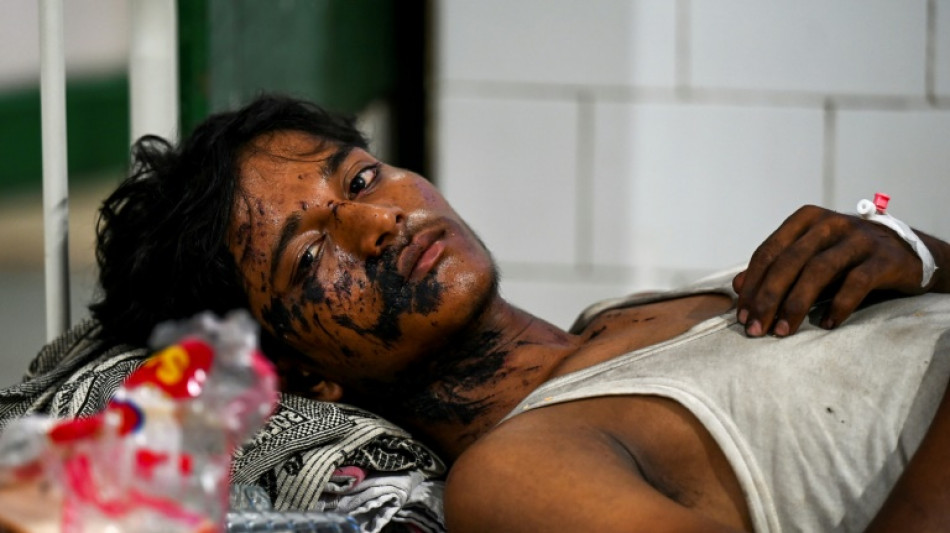
'Too much pain': the carnage of India's train crash / Photo: Punit PARANJPE - AFP
 South African election results renew debate over identity-based voting

 South African voters report smoother local election but declining IEC trust

 Dolly Parton museum and Nashville hotel open after singer’s death

 George and Amal Clooney attend New York political-comedy reading

 British buyers pay substantial premiums for period-home appearance

 Thomas Markle released to house arrest after child-abuse-image charge

 Dawn of War 4 developers chose Adeptus Mechanicus for tactical variety

 Italy face unbeaten South Africa in Turin Nations Championship match

 ChatGPT interactive interface feature tested across six custom tools

 Freshways milk-price cut deepens pressure on UK dairy farms

 Labour and National remain virtually tied as New Zealand vote count advances

 The Good Daughter adapts Karin Slaughter thriller with Rose Byrne and Meghann Fahy

 Heavy-lift drone evacuates wounded Ukrainian soldier from frontline kill zone

 Morrison says West Brom recovered after pressure from successive derby losses

 Britain considers 2027 state visit for Ukraine’s Zelensky

 Anna Miltina Confronted with Racism Allegations on ProSieben Show

 German Auto Giants Face Existential Crisis as China Sales Plummet

 Cause of Death Revealed for 'Ellen' Producer Matthew Wright
When India's worst train accident in more than 20 years happened just outside his home, Hiranmay Rath said it felt "like the sky was falling on us or the earth was cracking open".
What followed was an unimaginable nightmare of corpses, body parts and suffering.
The college student stopped scrolling Facebook on his phone and rushed outside, to be confronted by the sight of bodies falling out of toppled carriages.
"I came out scared and heard loud wailing screams, which only got louder within seconds," Rath told AFP.
His picturesque yellow home next to the railway is surrounded by coconut and papaya trees -- and less than 20 metres away lay the mangled wreckage of a train crash that killed at least 288 people and injured hundreds more.
First one express train derailed, then a second smashed into the wreckage and hit a third, parked train.
Rath is not clear on the exact sequence of events, but he and other residents rushed to try to help the victims.
Over the next few hours he saw "more death and grief" than he could have "ever imagined".
It was a "horror show" that he "couldn't have imagined watching even in the most scary movie ever".
"There were severed arms, legs, and even some partially severed heads -- while the unluckier ones died in pain, too much pain," he said.
He and four or five neighbours managed to pull one sari-clad woman out of the toppled carriage closest to his house.
"A police official told us to carry her, as she still had some life, to a common area from where survivors could be transported for treatment.
"She just kept asking for water in a very weak voice as we carried her on a long piece of cloth.
"The moment we placed her on the side of the road, she lost all movement and died in front of our eyes."
In all, his group pulled around 25 people out of the wreckage -- some of them struggling to breathe, many of them already dead.
"These are images I'll never forget," he added. "Imagine watching -- or pulling out -- a person's squished body, one severed arm or a leg."
His grandfather Bhagwat Prasad Rath, 80, regularly sits next to the railway tracks in the evening to enjoy the fresh air and greenery.
He was not hurt in the accident, but had to cross the tracks to get back home.
"There was no way but to walk over dead bodies," he said. "I took off my flip-flops and walked over them while praying to god for forgiveness."
- 'Bodies without heads' -
As dawn broke over the disaster site in Balasore, in the eastern state of Odisha, it revealed the scale of the destruction.
Red and green carriages were perched on top of each other or tossed far from the tracks, and lines of recovered bodies lay alongside the railway.
One coach had been flipped upside down, crushing the passenger section as it landed.
On the ground -- and squashed into the ripped metal wreckage and what were once benches in the carriage -- travellers' belongings lay scattered: a suitcase, a child's shoe and piles of clothes.
Mechanical cranes lifted mangled and toppled carriages and emergency personnel cut through the remains of the trains to try to reach trapped victims.
Rows and rows of rescue workers from multiple agencies worked along the track, as official and emergency vehicles blocked access roads to the area.
Researcher Anubhav Das, 27, was in the last carriage of the Coromandal Express, one of the trains involved in the crash, when he heard a "horrifying, screeching" sound before it came to a jerky halt.
He and his 30 fellow passengers were all unharmed and jumped out, to be confronted by chaos and "horrifying sounds".
"I saw bodies without heads and others without limbs, bloodied bodies," he said.
Das scrambled to help cover bleeding wounds of injured passengers with whatever he could find.
"It was almost like it was a war. I counted 250 bodies and then lost count," he said.
"I saw one man bleeding with a severed arm being desperately helped by his injured son. I saw a family of five all dead."
Speaking from Cuttack after his father drove him home, he told AFP: "It is an absolute miracle that I survived."
M.Fischer--AMWN
