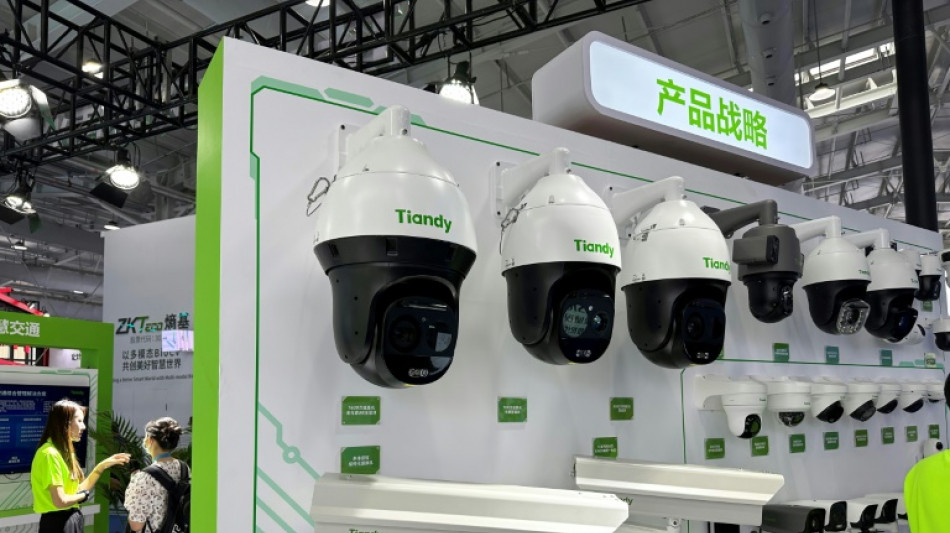
AI, facial recognition tech front and centre at China security expo / Photo: Peter CATTERALL - AFP
 South African election results renew debate over identity-based voting

 South African voters report smoother local election but declining IEC trust

 Dolly Parton museum and Nashville hotel open after singer’s death

 George and Amal Clooney attend New York political-comedy reading

 British buyers pay substantial premiums for period-home appearance

 Thomas Markle released to house arrest after child-abuse-image charge

 Dawn of War 4 developers chose Adeptus Mechanicus for tactical variety

 Italy face unbeaten South Africa in Turin Nations Championship match

 ChatGPT interactive interface feature tested across six custom tools

 Freshways milk-price cut deepens pressure on UK dairy farms

 Labour and National remain virtually tied as New Zealand vote count advances

 The Good Daughter adapts Karin Slaughter thriller with Rose Byrne and Meghann Fahy

 Heavy-lift drone evacuates wounded Ukrainian soldier from frontline kill zone

 Morrison says West Brom recovered after pressure from successive derby losses

 Britain considers 2027 state visit for Ukraine’s Zelensky

 Anna Miltina Confronted with Racism Allegations on ProSieben Show

 German Auto Giants Face Existential Crisis as China Sales Plummet

 Cause of Death Revealed for 'Ellen' Producer Matthew Wright
AI tech that spots "undesirable" behaviour and long-distance facial recognition software were on show Thursday at a Beijing expo attended by hundreds of companies -- many blacklisted by the United States for their alleged role in repression in China and abroad.
The three-day Security China event bills itself as a showcase of the future of high-tech policing and is backed by Beijing's commerce ministry and law enforcement bodies.
On Thursday the venue was packed with employees from across China's security industry and prospective clients, including some foreign customers, as well as curious members of the public.
China is one of the most surveilled societies on Earth, with countless CCTV cameras scattered across cities and facial recognition technology widely used in both day-to-day law enforcement and political repression.
At one booth operated by AI software company SenseTime, sales representatives showed off smart cameras that can be set to recognise certain "undesirable" behaviours -- including smoking, physical fights, and not wearing a mask.
Other cameras designed for installation at doorways and checkpoints have the ability to identify attempts to impersonate someone to gain access, such as by holding up a picture or wearing a mask resembling another person.
In one demonstration, an eerily-lifelike mannequin was placed in front of the camera -- only for the program to flag that it was not human.
These surveillance systems can also be programmed to watch for fires and alert emergency response personnel.
Hong Kong-listed SenseTime was placed on a US trade blacklist in 2019, accused of being an arm of China's "military-industrial complex" over the use of its technology in mass surveillance in the western region of Xinjiang.
An estimated one million Uyghurs and other Muslim minorities have been detained in the region since 2017 under a government campaign that Washington and rights groups have called a genocide.
Another firm, Zohetec, boasted technology with the ability to recognise faces from a distance of 150 metres (490 feet).
Representatives from Tiandy -- a Chinese firm also allegedly linked to repression in Xinjiang -- showed AFP some of the company's "smart city" products.
These included cameras that can obtain details about cars such as licence plate numbers and drivers' faces from a long distance, even at night.
Tiandy's equipment is used for traffic control by authorities in Beijing and nearby Tianjin, where the firm is based, its staff said.
Another smart city function developed by Tiandy involves identifying pedestrians that break road crossing rules. It posts their picture on a display to "embarrass" the individual and discourage them from reoffending.
"This kind of tool can be quite effective," a sales staffer told AFP.
Of the relatively small number of foreign customers attending the expo, most hailed from Russia and the Middle East, they said.
Also at the event was Chinese state-owned surveillance giant Hikvision, which is blacklisted in the United States for allegedly helping Beijing carry out a "campaign of repression".
F.Pedersen--AMWN
