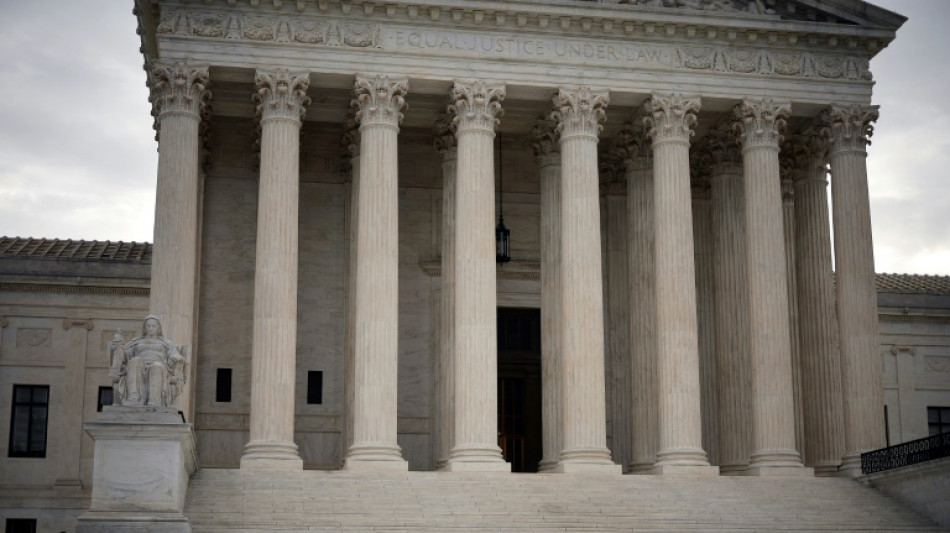
US Supreme Court upholds Native American adoption rights / Photo: CHIP SOMODEVILLA - GETTY IMAGES/AFP
 South African election results renew debate over identity-based voting

 South African voters report smoother local election but declining IEC trust

 Dolly Parton museum and Nashville hotel open after singer’s death

 George and Amal Clooney attend New York political-comedy reading

 British buyers pay substantial premiums for period-home appearance

 Thomas Markle released to house arrest after child-abuse-image charge

 Dawn of War 4 developers chose Adeptus Mechanicus for tactical variety

 Italy face unbeaten South Africa in Turin Nations Championship match

 ChatGPT interactive interface feature tested across six custom tools

 Freshways milk-price cut deepens pressure on UK dairy farms

 Labour and National remain virtually tied as New Zealand vote count advances

 The Good Daughter adapts Karin Slaughter thriller with Rose Byrne and Meghann Fahy

 Heavy-lift drone evacuates wounded Ukrainian soldier from frontline kill zone

 Morrison says West Brom recovered after pressure from successive derby losses

 Britain considers 2027 state visit for Ukraine’s Zelensky

 Anna Miltina Confronted with Racism Allegations on ProSieben Show

 German Auto Giants Face Existential Crisis as China Sales Plummet

 Cause of Death Revealed for 'Ellen' Producer Matthew Wright
The US Supreme Court on Thursday upheld a law that gives Native American families priority in adoptions and foster care placements of tribal children.
In a 7-2 vote, the nation's highest court rejected challenges to the Indian Child Welfare Act (ICWA) brought by a non-Native American couple seeking to adopt an Indian child and the state of Texas.
They had argued that the ICWA, passed by Congress in 1978, was unconstitutional and discriminates on the basis of race.
"The issues are complicated," said Justice Amy Coney Barrett, who authored the majority opinion.
"But the bottom line is that we reject all of petitioners' challenges to the statute, some on the merits and others for lack of standing," said Barrett, who is herself the mother of two adopted children of Haitian origin.
Like in Canada, Native American children in the United States were for decades removed from their biological parents and placed in boarding schools or with non-Indigenous families as part of a policy of forced assimilation.
Congress sought to bring an end to the practice with the passage of the ICWA, which set strict standards for removing Native American children from their parents and required tribal families to receive priority for foster care placements and adoptions.
Republican-led Texas, as well as families restricted by the ICWA from adopting Native American children, filed a legal challenge under the US Constitution's 14th Amendment, which limits the differentiation between citizens on the basis of race.
Several Native American tribes, backed by the administration of President Joe Biden and the powerful ACLU civil rights organization, countered that the law was not based on race but on Indigenous groups' sovereign rights.
Under US law, Native American tribes have a special status with their own legal jurisdictions and court systems.
The Supreme Court decided to intervene in the case after lower courts issued divergent opinions.
Biden welcomed the court ruling.
"Our Nation's painful history looms large over today's decision," the president said in a statement. "In the not-so-distant past, Native children were stolen from the arms of the people who loved them.
"The Indian Child Welfare Act was passed to protect the future of Tribal Nations and promote the best interests of Native children, and it does just that."
T.Ward--AMWN
