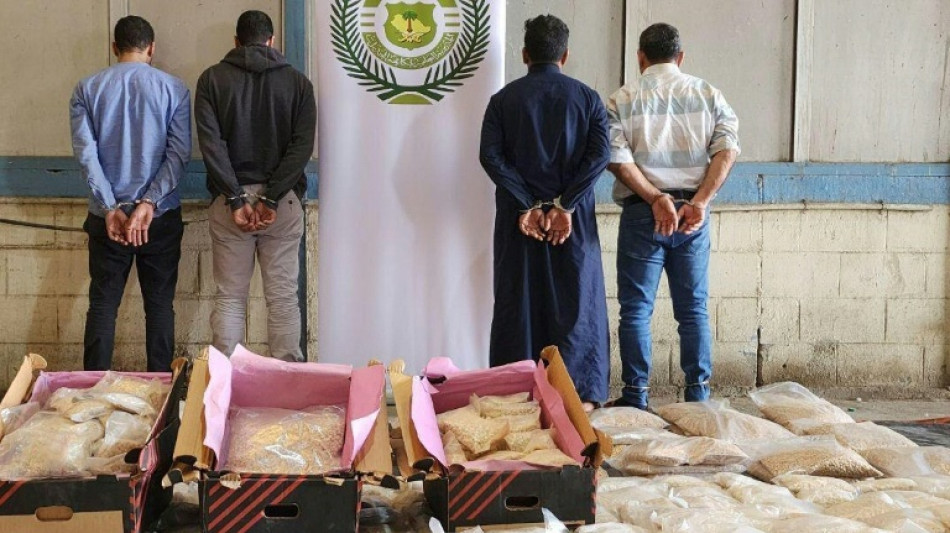
Raids, executions as Saudi Arabia wages war on drugs / Photo: - - SAUDI PRESS AGENCY/AFP/File
 South African election results renew debate over identity-based voting

 South African voters report smoother local election but declining IEC trust

 Dolly Parton museum and Nashville hotel open after singer’s death

 George and Amal Clooney attend New York political-comedy reading

 British buyers pay substantial premiums for period-home appearance

 Thomas Markle released to house arrest after child-abuse-image charge

 Dawn of War 4 developers chose Adeptus Mechanicus for tactical variety

 Italy face unbeaten South Africa in Turin Nations Championship match

 ChatGPT interactive interface feature tested across six custom tools

 Freshways milk-price cut deepens pressure on UK dairy farms

 Labour and National remain virtually tied as New Zealand vote count advances

 The Good Daughter adapts Karin Slaughter thriller with Rose Byrne and Meghann Fahy

 Heavy-lift drone evacuates wounded Ukrainian soldier from frontline kill zone

 Morrison says West Brom recovered after pressure from successive derby losses

 Britain considers 2027 state visit for Ukraine’s Zelensky

 Anna Miltina Confronted with Racism Allegations on ProSieben Show

 German Auto Giants Face Existential Crisis as China Sales Plummet

 Cause of Death Revealed for 'Ellen' Producer Matthew Wright
After a spate of arrests and executions for drug offences, Ibrahim, a dealer in Saudi Arabia, is not taking any chances.
"I don't deal with new clients or go to the clients myself," said the 37-year-old, using a pseudonym to protect his identity.
"They have to take on the risk," he told AFP from the Red Sea city of Jeddah, weeks after several of his customers were arrested.
Ibrahim is on the front lines of a war on drugs in Saudi Arabia, which has seen an influx of the addictive amphetamine captagon flooding in from war-torn Syria and Lebanon.
After becoming a major market, Saudi Arabia is hitting back, ending a moratorium on the death penalty for drug cases and launching a zealous crackdown.
The result is at least 20 executions for drug offences since last year, according to an AFP tally, and a sharp rise in arrests.
At least two Saudi security officers have been killed in drug raids, including one last week, according to state media.
"Several of my customers were recently arrested in a private compound," said Ibrahim, who mainly sells captagon and hashish. "This never used to happen before."
Acts of violence committed by drug users prompted the crackdown, a security official told AFP.
They include a recent case in which a drug addict killed his parents by dousing them with fuel and setting them on fire, said the official, who spoke on condition of anonymity because he is not authorised to speak to the press.
- Party pill -
Across Jeddah, roadside billboards urge citizens to report any illicit drug activities to the authorities.
While alcohol is illegal in the conservative country, it is also believed to be the world's biggest market for captagon, which is used by wealthy Saudis as a party pill and by workers to stay awake during long shifts.
While previous anti-drug campaigns targeted smuggled shipments, mainly from Syria and Lebanon, the latest initiative is zeroing in on dealers and users within the country.
Apparently to provide a deterrent, a nearly three-year moratorium on executions for drug crimes was scrapped last year. Saudi Arabia is one of the world's biggest users of capital punishment, executing 147 people in 2022.
"In the last year to two years, we have seen an uptick in internal arrests and the use of the death penalty (in drug cases)," said Caroline Rose of the New Lines Institute think tank.
The shift from border seizures to arrests of dealers is partly due to "a focus on security issues surrounding captagon and a recognition of just how deep some of these networks go", Rose told AFP.
The campaign is also aimed at keeping drugs out of the hands of Saudi youth, the drivers of an ambitious reform agenda to diversify the oil-dependent economy. Fifty-one percent of the 32.2 million population is under 30.
"Saudi Arabia is carrying out a huge economic project...and the youth are the main pillar of this project," said Sulaiman al-Oqaily, a Saudi political analyst.
- Addiction on the rise -
Rampant drug use is taking its toll, with more than 200,000 addicts in Saudi Arabia, according to health ministry figures cited by domestic media.
Growing numbers are seeking addiction treatment, mainly because they fear arrest, said Hamad al-Sheehan of the Rushd Specialized Center in Riyadh.
"After the recent campaign, the numbers have increased at the centre," the director of treatment said from his office, where at least 10 young men were waiting to be seen.
"We currently receive 1,000 people per month instead of only 100 previously."
He said that captagon and other methamphetamine-type drugs are among the most abused in the kingdom. Most of his patients are between 17 and 21 years old and half are women, he said.
If Sheehan's patients fear arrest, the crackdown is working, Oqaily said.
"The message is if you don't fear for yourself, you should fear the government," he said.
Last month, Interior Minister Prince Abdulaziz bin Saud bin Nayef warned drug dealers and smugglers that they will not escape.
"We are still at the beginning of the campaign," he said.
D.Kaufman--AMWN
