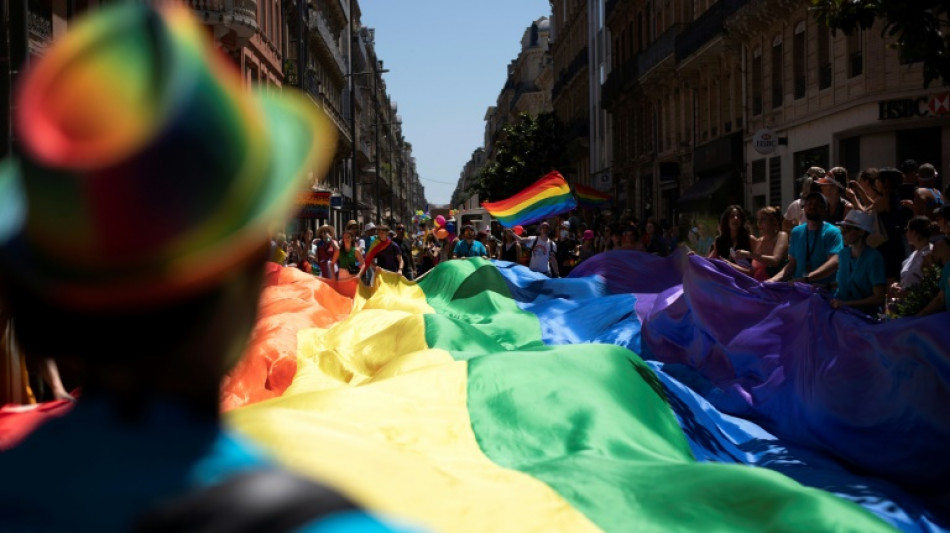
Surge in anti-LGBTQ disinformation targets Pride in Europe / Photo: Matthieu RONDEL - AFP
 South African election results renew debate over identity-based voting

 South African voters report smoother local election but declining IEC trust

 Dolly Parton museum and Nashville hotel open after singer’s death

 George and Amal Clooney attend New York political-comedy reading

 British buyers pay substantial premiums for period-home appearance

 Thomas Markle released to house arrest after child-abuse-image charge

 Dawn of War 4 developers chose Adeptus Mechanicus for tactical variety

 Italy face unbeaten South Africa in Turin Nations Championship match

 ChatGPT interactive interface feature tested across six custom tools

 Freshways milk-price cut deepens pressure on UK dairy farms

 Labour and National remain virtually tied as New Zealand vote count advances

 The Good Daughter adapts Karin Slaughter thriller with Rose Byrne and Meghann Fahy

 Heavy-lift drone evacuates wounded Ukrainian soldier from frontline kill zone

 Morrison says West Brom recovered after pressure from successive derby losses

 Britain considers 2027 state visit for Ukraine’s Zelensky

 Anna Miltina Confronted with Racism Allegations on ProSieben Show

 German Auto Giants Face Existential Crisis as China Sales Plummet

 Cause of Death Revealed for 'Ellen' Producer Matthew Wright
As Pride events got underway in Europe in June, disinformation and hate speech targeting the LGBTQ community spread across social media, triggering extreme online responses, including incitements to violence.
Advocacy groups across Europe said the deluge of toxic content online is part of an overall trend of rising anti-LGBTQ sentiment worldwide. But the community is coming under particular pressure during public events -- including those associated with Pride, they noted.
The surge in online disinformation and vitriol is all the more worrying after a spate of violence during Pride events last summer in Europe.
One social media post in Polish falsely stating that the army would create "LGBT units" was shared across Telegram, Twitter and Facebook in Serbia.
That prompted some users to comment that the new soldiers should be "burned at the stake", while others praised Hitler's persecution of gay men.
Another false claim, that the Arc de Triomphe in Paris had been turned into a rainbow art installation, went viral in multiple European languages. Facebook users responded with slurs -- one person calling for LGBTQ people to be burned and executed.
In Hungary, where government and pro-government media personalities often use anti-LGBTQ rhetoric, Pride celebrations were referred to online using derogatory, homophobic slurs.
Online, some posts smeared the LGBTQ community with claims of child abuse.
Claims that the community was a danger to society were also widespread.
Posts in Finnish and Croatian either missed or deliberately ignored the satirical nature of a book for adults by a Canadian comedian, Brad Gosse, falsely claiming it was "promoting sex to children" as part of a trans-rights campaign.
"If you think these are actually kids' books, you shouldn't be allowed to vote," he quipped on Twitter.
The wave of false claims and hate speech is part of an increasingly violent public discourse against LGBTQ people, say campaigners.
Some European countries -- such as Spain, Slovenia and Moldova -- have adopted new legislation protecting LGBTQ rights.
But a recent report by the Brussels-based ILGA-Europe (International Lesbian, Gay, Bisexual, Trans and Intersex Association) found that "the public discourse is becoming more polarised and violent, particularly against trans people".
A May 2023 European Digital Media Observatory (EDMO) report said anti-LGBTQ misinformation and disinformation was particularly prolific and "often incites hate against minorities, laws and institutions".
- 'The same tune'-
While some anti-LGBTQ false claims shared on social media in Europe in June first appeared in the United States, others originated in Russia.
AFP fact-checkers found that the video claiming to show Polish public television reporting that the country's army would open "LGBT units" was first shared on Russian propaganda channels in January.
"Russia and the US far-right are playing the same tune," Jakob Svensson, a professor of media and communication science at Malmo University, told AFP.
Svensson's research highlights a synergy between global actors framing progressive laws or the simple visibility of the LGBTQ community as an attack on "traditional values".
Such disinformation campaigns feed into European narratives: false claims about trans athletes filtered from social media in the US to Europe in 2023, where a far-right politician spread them further.
Researchers and campaigners say a lack of sufficient moderation on social media platforms exacerbates the problem.
Aleksandra Gavrilovic -- programme coordinator for the Serbian NGO for lesbian human rights Labris -- fears young people are particularly exposed to "content that is neither verified nor accurate".
The lack of consequences for those spreading false claims and hate speech "can also embolden anti-LGBTQ activists and bashers who feel impunity to attack", she warned.
- 'Hate campaigners and troll farms' -
The spike in anti-LGBTQ rhetoric around Pride events in Europe is part of a global trend.
Some US Pride celebrations have been scaled back this year, organisers told AFP, especially in states where politicians want to curtail rights, as false claims linking the community to paedophilia and Satanism have amassed across social media platforms.
The surge in disinformation and hate speech around Pride comes as campaigners highlight how physical attacks against LGBTQ people are rising generally in Europe.
ILGA-Europe said Europe and Central Asia had seen the "deadliest rise" in attacks in a decade in 2022 when it announced its annual review, a compilation of incident reports from 54 countries.
Oslo's yearly Pride parade was cancelled last year following a fatal shooting at LGBTQ venues. Bratislava was rocked by a similar attack in front of an LGBTQ bar.
Milos Kovacevic -- legal empowerment coordinator for Serbia-based NGO Da Se Zna! -- told AFP how physical attacks had surged alongside anti-LGBTQ claims online around EuroPride in Belgrade last September.
"Half of the incidents we registered in 2022 happened in August and September," he said.
The leap from online slurs to real-life danger is at the forefront of campaigners' minds.
Remy Bonny -- executive director of EU-wide LGBTQ advocacy group Forbidden Colours -- told AFP how he was targeted online by "hate campaigners and troll farms" earlier this year for trying to convince EU members to join a lawsuit against anti-LGBTQ laws in Hungary.
The director of Hungary's government-backed Center for Fundamental Rights tweeted that Bonny would not be allowed "near Hungarian children".
AFP found dozens of tweets in English from Twitter accounts with Hungarian usernames calling Bonny and LGBTQ people sexual predators.
"Everybody knows how dangerous it can be to publicly call someone a 'groomer' or 'paedophile' without any evidence," Bonny told AFP.
"This jeopardises my personal security."
O.Johnson--AMWN
