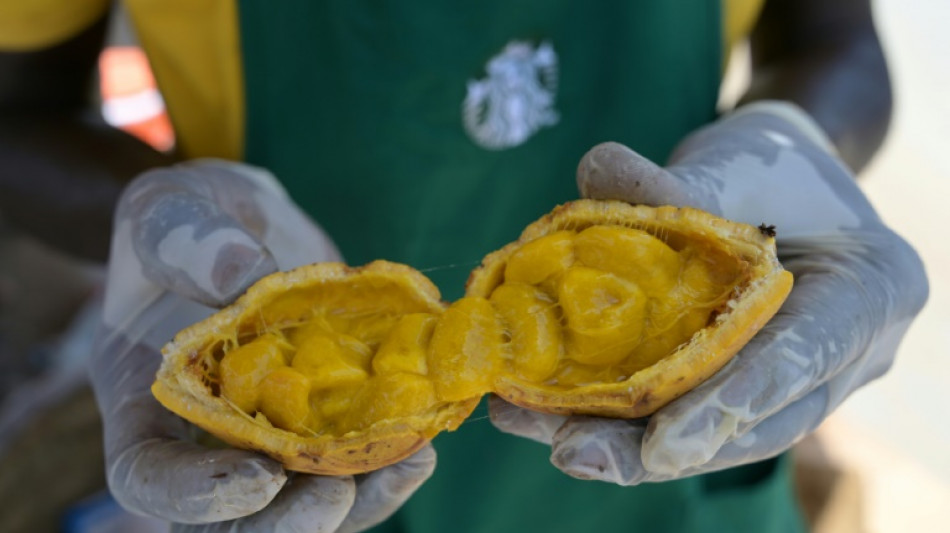
Senegalese go wild for prized 'maad' fruit / Photo: SEYLLOU - AFP
 South African election results renew debate over identity-based voting

 South African voters report smoother local election but declining IEC trust

 Dolly Parton museum and Nashville hotel open after singer’s death

 George and Amal Clooney attend New York political-comedy reading

 British buyers pay substantial premiums for period-home appearance

 Thomas Markle released to house arrest after child-abuse-image charge

 Dawn of War 4 developers chose Adeptus Mechanicus for tactical variety

 Italy face unbeaten South Africa in Turin Nations Championship match

 ChatGPT interactive interface feature tested across six custom tools

 Freshways milk-price cut deepens pressure on UK dairy farms

 Labour and National remain virtually tied as New Zealand vote count advances

 The Good Daughter adapts Karin Slaughter thriller with Rose Byrne and Meghann Fahy

 Heavy-lift drone evacuates wounded Ukrainian soldier from frontline kill zone

 Morrison says West Brom recovered after pressure from successive derby losses

 Britain considers 2027 state visit for Ukraine’s Zelensky

 Anna Miltina Confronted with Racism Allegations on ProSieben Show

 German Auto Giants Face Existential Crisis as China Sales Plummet

 Cause of Death Revealed for 'Ellen' Producer Matthew Wright
Outside a bustling fruit market in Senegal's Dakar region, three trucks are blocking the road while a dozen men sweat to unload the precious cargo.
Working in intense heat and racing against the clock, they are shifting 60 tonnes of maad -- a delicate tropical fruit which is massively popular in the West African state.
A yellow fruit with a pulp that has a distinctive sweet and sour savour and is rich in vitamins and fibre, maad comes from a vine called the Saba senegalensis, which grows wild and is common across the region.
The fruit's season is relatively short, running from May to August, which prompts a rush of sellers at street corners, hawking the delicacy with salt, sugar or chilli, blenderised into juice or turned into jam.
Maad has different names and spellings across West Africa, where it is eaten from Ivory Coast to Mali and Guinea -- but the lust for it is strongest in Senegal.
Countless jobs depend on the fruit, from harvesting and distribution to selling and processing.
At the Sandika market in Pikine, workers laboured to empty the trucks that had just arrived, sorting the maad according to ripeness.
- Rush to market -
"The unloading will be finished by the end of the day," said Dame Sarr, a 28-year-old wholesaler who with his uncle had invested six million CFA francs ($10,000) in the consignment.
They reckoned they could clear the equivalent of at least a thousand dollars in profit -- if the fruit was sold fast.
"If I don't shift the goods, I will have to cut the price tomorrow because with every passing day maad loses its quality," he explained, sitting under a parasol.
The good news was that several customers were already hovering around.
Sarr had separated out the finest fruit to sell for 4,200 francs for a bucket of 40 pieces. The others were on sale for half that price. A 20-kilogram (44-pound) box of maad cost between 20,000-25,000 francs.
"Maad is a very risky investment. It can't stand sunlight or rain, and transporting it is difficult," said market representative and salesman Djiby Sandika.
The fruit "best suits small-scale retailers, who make large profits," said Sarr.
- Southern delicacy -
In Senegal most maad grows in the southern Casamance region on vines that wrap themselves round trees in thickly-forested areas.
Picking the fruit is done by hand and involves using long sticks -- a labour that comes with added risk from snakes.
According to the Economy, Territory, Development and Service (ETDS) NGO, nearly 1,500 tonnes of maad are harvested annually in the Ziguinchor, Kedougou and Kolda areas.
Mariama Dieme, who heads a project to market maad production in Casamance, said that with better access, output could be trebled.
The fruit is already under threat from "over-exploitation," from fires used to burn stubble from fields and from damage caused by forest hunters, Dieme said.
The ETDS is fostering a programme for small-scale woman-led producers to make maad jam, juice or syrup and even export some of their production.
Maad jam sold in France via sellers on Instagram costs 25 euros ($27.38) for a 300 grams (10.5 ounces) jar, said Fatou Binetou Adour, a Senegalese who lives in Paris.
F.Bennett--AMWN
