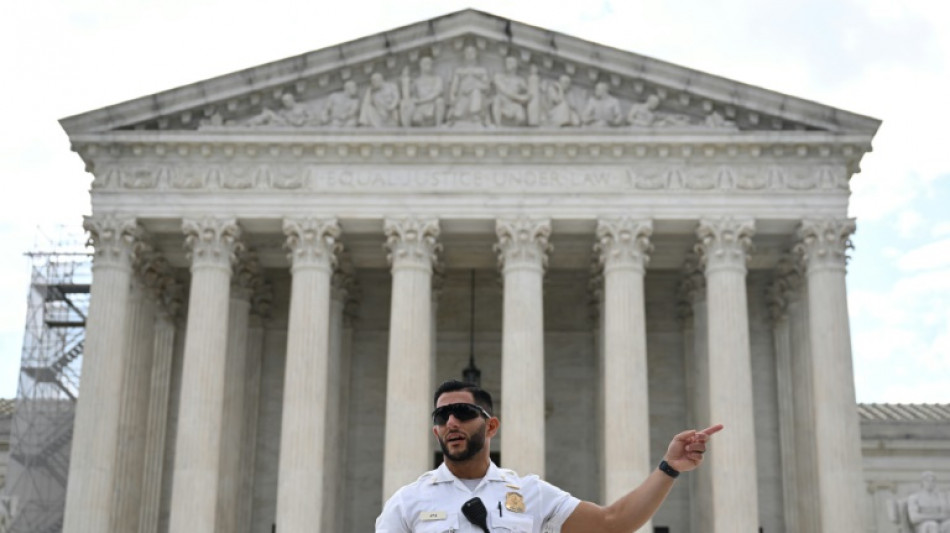
US Supreme Court bans the use of race in university admissions / Photo: Jim WATSON - AFP
 South African election results renew debate over identity-based voting

 South African voters report smoother local election but declining IEC trust

 Dolly Parton museum and Nashville hotel open after singer’s death

 George and Amal Clooney attend New York political-comedy reading

 British buyers pay substantial premiums for period-home appearance

 Thomas Markle released to house arrest after child-abuse-image charge

 Dawn of War 4 developers chose Adeptus Mechanicus for tactical variety

 Italy face unbeaten South Africa in Turin Nations Championship match

 ChatGPT interactive interface feature tested across six custom tools

 Freshways milk-price cut deepens pressure on UK dairy farms

 Labour and National remain virtually tied as New Zealand vote count advances

 The Good Daughter adapts Karin Slaughter thriller with Rose Byrne and Meghann Fahy

 Heavy-lift drone evacuates wounded Ukrainian soldier from frontline kill zone

 Morrison says West Brom recovered after pressure from successive derby losses

 Britain considers 2027 state visit for Ukraine’s Zelensky

 Anna Miltina Confronted with Racism Allegations on ProSieben Show

 German Auto Giants Face Existential Crisis as China Sales Plummet

 Cause of Death Revealed for 'Ellen' Producer Matthew Wright
The US Supreme Court on Thursday banned the use of race and ethnicity in university admissions, dealing a major blow to a decades-old practice that boosted educational opportunities for African-Americans and other minorities.
"The student must be treated based on his or her experiences as an individual -- not on the basis of race," Chief Justice John Roberts wrote in the majority opinion.
The justices broke six to three along conservative-liberal lines in the decision, which came after years of conservative antipathy to "affirmative action" policies that have sought diversity in school admissions and business and government hiring.
The court said that universities were free to consider an individual applicant's personal experience -- whether, for example, they grew up experiencing racism -- in weighing their application over applicants more academically qualified.
But deciding primarily based on whether the applicant is white, Black or other is itself racial discrimination, Roberts wrote.
"Our constitutional history does not tolerate that choice," he said.
The court sided with an activist group, Students for Fair Admissions, that sued the oldest private and public institutions of higher education in the country -- elite Harvard University and the University of North Carolina (UNC) -- over their admissions policies.
The group claimed that race-conscious admissions policies discriminated against equally or better-qualified Asian Americans competing to enter the two universities.
Harvard and UNC, like a number of other competitive US schools, consider an applicant's race or ethnicity as a factor to ensure a diverse student body and representation of minorities.
Such affirmative action policies arose from the Civil Rights Movement in the 1960s aiming to help address the legacy of discrimination in higher education against African Americans.
Thursday's ruling was a victory for conservatives, some who have argued that affirmative action is fundamentally unfair.
Others have said the policy has outlived its need because educational opportunities have vastly improved for Blacks and other minorities.
But the ruling was a major setback to progressives, one year after the court overturned the landmark 1973 "Roe v. Wade" decision guaranteeing a woman's right to abortion.
The end to federally guaranteed abortion rights almost immediately led to half of the 50 states banning or severely curtailing the practice.
The affirmative action ruling could have the same effect of many states and institutions halting programs designed to give disadvantaged minorities extra consideration in the competitive college admissions process.
Leading the dissenters, Justice Sonia Sotomayor said the decision "rolls back decades of precedent and momentous progress."
"In so holding, the Court cements a superficial rule of colorblindness as a constitutional principle in an endemically segregated society," she wrote.
L.Davis--AMWN
