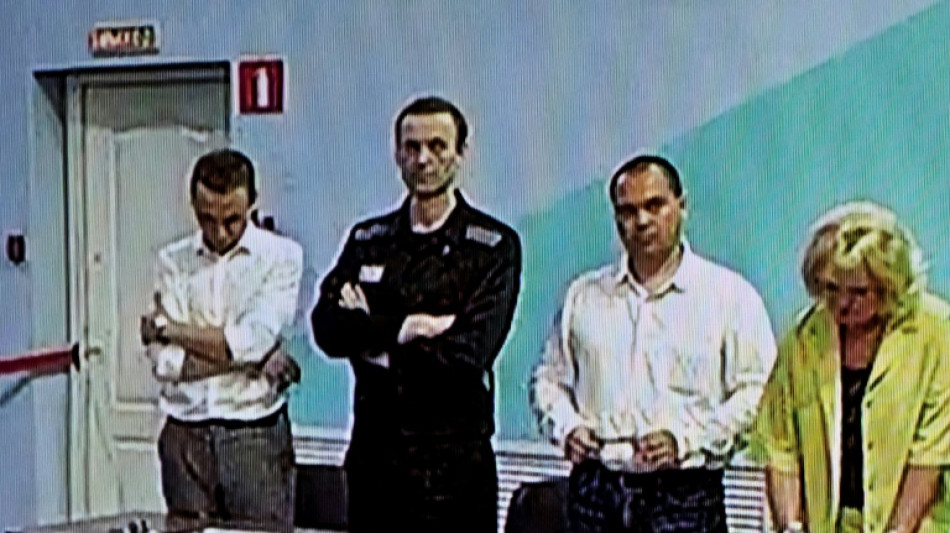
Russia jails Navalny for 19 years on extremism charges / Photo: Alexander NEMENOV - AFP
 South African election results renew debate over identity-based voting

 South African voters report smoother local election but declining IEC trust

 Dolly Parton museum and Nashville hotel open after singer’s death

 George and Amal Clooney attend New York political-comedy reading

 British buyers pay substantial premiums for period-home appearance

 Thomas Markle released to house arrest after child-abuse-image charge

 Dawn of War 4 developers chose Adeptus Mechanicus for tactical variety

 Italy face unbeaten South Africa in Turin Nations Championship match

 ChatGPT interactive interface feature tested across six custom tools

 Freshways milk-price cut deepens pressure on UK dairy farms

 Labour and National remain virtually tied as New Zealand vote count advances

 The Good Daughter adapts Karin Slaughter thriller with Rose Byrne and Meghann Fahy

 Heavy-lift drone evacuates wounded Ukrainian soldier from frontline kill zone

 Morrison says West Brom recovered after pressure from successive derby losses

 Britain considers 2027 state visit for Ukraine’s Zelensky

 Anna Miltina Confronted with Racism Allegations on ProSieben Show

 German Auto Giants Face Existential Crisis as China Sales Plummet

 Cause of Death Revealed for 'Ellen' Producer Matthew Wright
Russia on Friday handed jailed opposition leader Alexei Navalny 19 years behind bars on extremism charges, cementing a crackdown on voices critical of the ruling elite.
The heavy sentence against Navalny, who had mobilised massive protests, is the latest in a string of lawsuits against high-profile activists and ordinary Russians who have protested Russia's intervention in Ukraine.
Germany immediately called the ruling "pure injustice", the EU's chief slammed the verdict as "unacceptable", and the UN rights chief called on Russia to release Navalny "immediately".
"Alexei Navalny was sentenced to 19 years at a maximum security penal colony," spokesperson Kira Yarmysh said in a statement on social media.
AFP journalists watching the court session in a press centre at Navalny's prison said the 47-year-old smiled as the judge read the verdict and hugged another defendant before the grainy transmission cut.
A masked law enforcement officer in grey camouflage gear and flak jacket stood in front of the audience room.
The trial has been held behind closed doors at the IK-6 penal colony, a maximum-security prison some 250 kilometres (155 miles) east of Moscow, where Navalny is jailed.
"Thank you to everyone who came" his team said on Telegram, posting footage of two dozen people, seemingly outside the court.
Navalny is already serving a nine-year sentence in a maximum-security prison for "embezzlement", a charge that his supporters say was trumped up in retaliation for challenging President Vladimir Putin.
This is the first formally political case against the opposition leader, his team has said.
- 'Trying to intimidate' -
Navalny had said he expected the court to hand him a lengthy, "Stalinist" prison sentence and called on his supporters to resist Putin's rule in a statement Thursday.
"Please consider and realise that by jailing hundreds, Putin is trying to intimidate millions," he said.
Navalny has built a huge following on social media, where he has posted videos exposing alleged corruption among Russia's elite and mobilised massive anti-government protests.
Prosecutors said that Navalny created an organisation that undermined public security by carrying out "extremist activities".
His Anti-Corruption Foundation, that investigates graft among Russian officials, was banned for extremism in 2021.
Most of his close allies have fled the country.
Since launching full-scale hostilities against Ukraine last year, Russia has further cracked down on dissenting voices, pushing most of the country's beleaguered opposition movement abroad.
Navalny's last days before the verdict were spent in a punishment cell where he has been regularly sent over minor infringements of prison rules, according to his team.
In all, he has spent almost 200 days in the cell, according to his team, which has repeatedly accused prison authorities of harassing him.
He was arrested in 2021 after arriving in Moscow from Germany, where he had been recovering from a poisoning attack he blames on the Kremlin, sparking international condemnations.
- Severe penal colony -
Navalny said prison officials forced him to share a cell with a sickly inmate and subjected him and other prisoners to "torture by Putin", making them listen to the Russian president's speeches.
He has also complained of health problems and major weight loss since being jailed in a strict regime penal colony.
The judge said he would serve his additional sentence in an even more restrictive special prison.
In April, Navalny said he could be separately judged over terrorism charges and face life in prison.
His campaign offices around the country were declared extremist organisations in 2021 by authorities, putting employees, volunteers and supporters at greater risk of prosecution.
Over the summer two heads of regional offices, Lilia Chanysheva and Vadim Ostanin, were sentenced to seven-and-a-half and nine years respectively on extremism charges.
Thousands of Russians have been detained for protesting against Moscow's offensive in Ukraine, and some of the highest-profile activists including Vladimir Kara-Murza and Ilya Yashin are now behind bars.
P.Mathewson--AMWN
