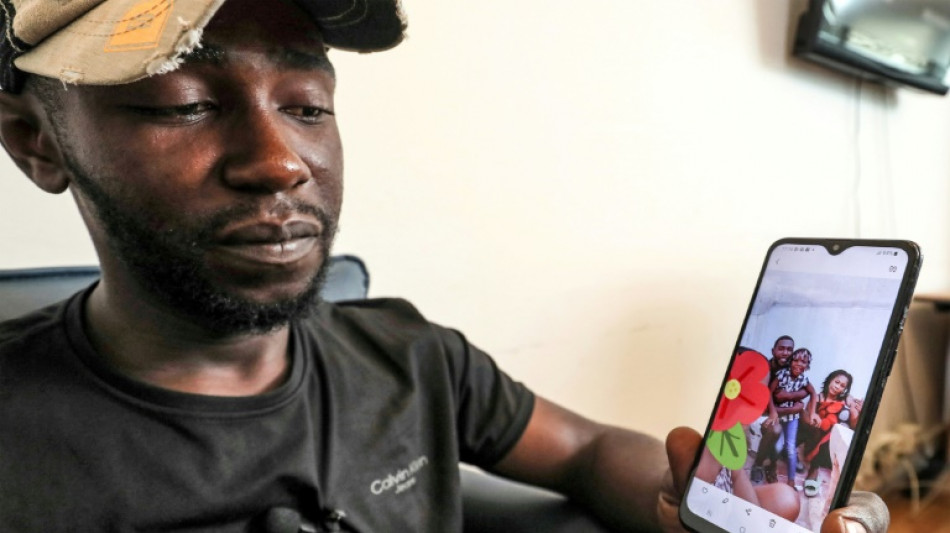
Lost in the Tunisia-Libya desert: one migrant's story / Photo: Mahmud Turkia - AFP
 South African election results renew debate over identity-based voting

 South African voters report smoother local election but declining IEC trust

 Dolly Parton museum and Nashville hotel open after singer’s death

 George and Amal Clooney attend New York political-comedy reading

 British buyers pay substantial premiums for period-home appearance

 Thomas Markle released to house arrest after child-abuse-image charge

 Dawn of War 4 developers chose Adeptus Mechanicus for tactical variety

 Italy face unbeaten South Africa in Turin Nations Championship match

 ChatGPT interactive interface feature tested across six custom tools

 Freshways milk-price cut deepens pressure on UK dairy farms

 Labour and National remain virtually tied as New Zealand vote count advances

 The Good Daughter adapts Karin Slaughter thriller with Rose Byrne and Meghann Fahy

 Heavy-lift drone evacuates wounded Ukrainian soldier from frontline kill zone

 Morrison says West Brom recovered after pressure from successive derby losses

 Britain considers 2027 state visit for Ukraine’s Zelensky

 Anna Miltina Confronted with Racism Allegations on ProSieben Show

 German Auto Giants Face Existential Crisis as China Sales Plummet

 Cause of Death Revealed for 'Ellen' Producer Matthew Wright
Pato looks at the picture on his phone. It shows him with his wife and daughter, all carefree smiles. "That's the last time we were happy," he says, completely traumatised.
A few months after the photograph was taken, his life was shattered.
A friend showed Pato, a migrant from Cameroon, a picture from the internet of two bodies huddled together on the desert sand.
It was of Pato's wife, 30-year-old Fati Dosso, and their six-year-old daughter Marie.
The three had become separated on a trek through the desert between Tunisia and Libya on a day in mid-July that changed Pato's life forever.
His real name is Mbengue Nyimbilo Crepin, but his nickname is Pato. After working for seven years at various jobs in Zuwara some 120 kilometres (75 miles) west of Tripoli, Pato, 30, decided to go to Tunisia with his Ivorian wife and child.
But unlike the thousands of sub-Saharan migrants who enter Tunisia planning to cross the Mediterranean for a better life in Europe, Pato and Fati just wanted to find a school for Marie.
- 'They abandoned us' -
They were obsessed with giving her a French-language education because "since she was born, she has never been to school", Pato told AFP from an undisclosed location near Tripoli. Other Africans had told him this would be possible in Tunisia, he said.
The first time they were intercepted was on July 13, in the Tunisian coastal town of Ben Guerdane.
They were sent back into the searing heat of the Libyan desert and later re-entered Tunisia by night without even realising they had done so.
Pato, Fati and Marie hadn't had water for 24 hours when they came across a woman and asked for some. She directed them to a mosque, and after just five minutes the Tunisian police arrived.
They took them to a police station where "there were a dozen or so other sub-Saharans who'd been picked up", Pato said.
"They beat us and searched us, then left us sitting on the sand in the sun" before taking them to another police post "where they hit us and said they'd send us back to Libya". Another group of around 30 sub-Saharans was there too.
"They took away our phones and smashed them in front of us, and took our IDs," Pato said.
He and his small family were driven in a truck with other Africans back to the border.
"They abandoned us there beside a trench, telling us to cross it and go straight ahead into Libya," he said. "They threatened us with guns."
- The weight of grief -
In the desert, Pato found he had reached his limit.
"I was completely exhausted. We'd been walking for four days with no food or water. I collapsed, and we were all crying.
"My wife asked me to try and get up, to keep going."
Pato managed to convince Fati herself to continue, to "try to save the child at least". He stayed behind.
Two weeks later, the weight of his grief is unbearable.
The picture of the two bodies in the desert has been seen worldwide at a time when human rights groups and the United Nations have denounced Tunisia for "expelling migrants" to its borders, despite its strenuous denials.
Media organisations including AFP have also gathered many testimonies on the Libyan side.
Pato and family were not among the hundreds of sub-Saharan migrants driven out of the port of Sfax, a main point of departure for illegal migration to Europe.
Those people were hounded out of the city after a Tunisian was stabbed to death in a July 3 altercation with migrants.
Pato, his wife and their little girl were just in the wrong place at the wrong time.
He only survived after two Sudanese gave him some water. Fati and Marie died of thirst in the vast expanse of desert.
- 'They are gone' -
Theirs were among 24 bodies humanitarian sources say have been found in the Libyan desert since the beginning of July.
Their "image haunts my soul", Pato told AFP.
"Every time I wake I look round to see if they are there.
"I've thought several times about killing myself," he said, staring straight ahead.
"I regret not being able to get up and keep on going with them. I'd have preferred they found three bodies in the desert."
Pato no longer has family in Cameroon, where he comes from a conflict-ridden area in the south. He has been in touch with HRW and Doctors Without Borders to obtain asylum seeker status, and also for psychological support.
He speaks softly, without anger, and recalls better days.
"I try to keep a lid on things by remembering the beautiful times we had together," he said.
"I have lots of wonderful memories," Pato said, scrolling through his pictures on a new phone bought with the help of friends.
Fati was his "motivation". She used to tell him: "Don't get discouraged -- we will achieve our goals."
Pato does not have the words to describe the years they spent together. Today he is despondent.
"My spirit is dead. This is just my body. My soul is with them and they are gone. I don't want anything any more."
J.Williams--AMWN
