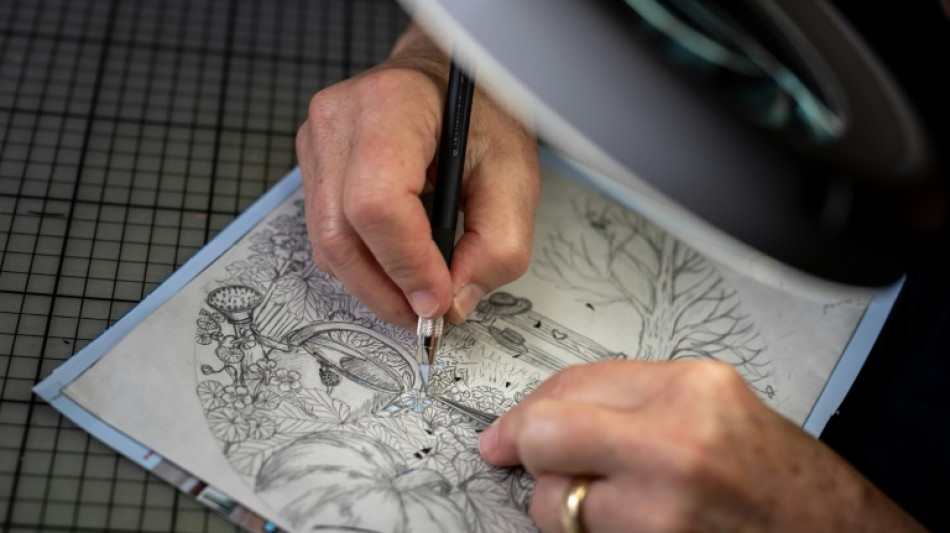
Swiss paper cutting artist takes the scissors to old ways / Photo: Fabrice COFFRINI - AFP
 South African election results renew debate over identity-based voting

 South African voters report smoother local election but declining IEC trust

 Dolly Parton museum and Nashville hotel open after singer’s death

 George and Amal Clooney attend New York political-comedy reading

 British buyers pay substantial premiums for period-home appearance

 Thomas Markle released to house arrest after child-abuse-image charge

 Dawn of War 4 developers chose Adeptus Mechanicus for tactical variety

 Italy face unbeaten South Africa in Turin Nations Championship match

 ChatGPT interactive interface feature tested across six custom tools

 Freshways milk-price cut deepens pressure on UK dairy farms

 Labour and National remain virtually tied as New Zealand vote count advances

 The Good Daughter adapts Karin Slaughter thriller with Rose Byrne and Meghann Fahy

 Heavy-lift drone evacuates wounded Ukrainian soldier from frontline kill zone

 Morrison says West Brom recovered after pressure from successive derby losses

 Britain considers 2027 state visit for Ukraine’s Zelensky

 Anna Miltina Confronted with Racism Allegations on ProSieben Show

 German Auto Giants Face Existential Crisis as China Sales Plummet

 Cause of Death Revealed for 'Ellen' Producer Matthew Wright
Marianne Dubuis stared intently through a magnifying glass, using a slim cutter to make tiny incisions in paper as she carved out delicate tableaux of life and human emotions.
The 64-year-old designer is reinventing the Swiss traditional art of paper cutting, which typically shows Alpine landscapes and cows heading to mountain pastures, by infusing a large dose of poetry and modernity.
Dubuis, a florist by training, told AFP that she has devoted herself to paper cutting since childhood and now spends around six hours a day on her passion.
At her home studio in Chateau d'Oex, in the Pays-d'Enhaut area where the Swiss tradition was born around 200 years ago, she showed off her craft, using scissors or a cutter to carve out intricate scenes inspired by the surrounding woods and the people she meets.
The works, either in black and white or in colour, have been shown in Switzerland, France, Germany and Japan.
Some of them, more than a metre (three feet) high, are on display until September 6 at the new Swiss Paper Cutting Centre in Chateau d'Oex, a picturesque village in the pre-Alps of western Switzerland.
"I am very proud of paper cutting, and what it represents of Switzerland. It is a way of representing our values, our roots," she said.
However, "if we keep doing the same things over and over, the tradition dies", said Dubuis, who wants to reinvent the art form in her own way.
- Classic Alpine scenes -
Paper cutting originated in Asia and spread to Europe around the 17th century.
Johann-Jakob Hauswirth, a farm worker who died in poverty in the 19th century, is considered the father of the art form in Switzerland.
When the opportunity arose, he took his scissors to scraps of paper and began creating naive representations of Alpine scenes, and the annual "poya" ritual of driving cows up the mountain to graze.
He would then leave them as a thank-you gift after a meal.
His works, as well as the more numerous creations of other masters in the field such as Louis Saugy and Christian Schwitzguebel, sell at auction for "several tens of thousands of francs (dollars)", according to Emmanuel Bailly, of the auction house Beurret & Bailly Auktionen.
Close to nature, Dubuis draws her inspiration from the forest.
Her cuttings, some of which likewise sell for tens of thousands of francs, reflect her emotions and also tell a life story, like a biography in carved paper.
"When I have a private commission, they come and tell me about their life," she said. "I put in what I feel about this person; the essence of what they told me."
- From William Tell to the UN -
This approach has brought comfort, help and relief, she said, citing a work created for a father who lost his son, or one for a couple on the verge of splitting up but who thought again after seeing the cutting representing the journey of their years together.
With Dubuis's work, "there is something spiritual", said Monique Buri, vice-president of the Swiss Paper Cutting Association, which has around 500 members.
Dubuis weaves in modernity with tradition to carve out images of Switzerland today.
At the end of 2021, she created a 50-square-centimetre work representing historical heroes like William Tell as well as chocolate, mountain rescue helicopters or the international organisations based in the country, such as the United Nations and the Red Cross.
Pierre Mottier, head of the association running the museum that houses the Swiss Paper Cutting Centre, said: "It's very nice to make little cows and chamois, but it's also very interesting to cut out other things."
Modernity also has its dangers, with an increasing number of companies making cuttings with lasers.
But Dubuis says she is not worried.
With laser machines, "the soul is missing".
D.Kaufman--AMWN
