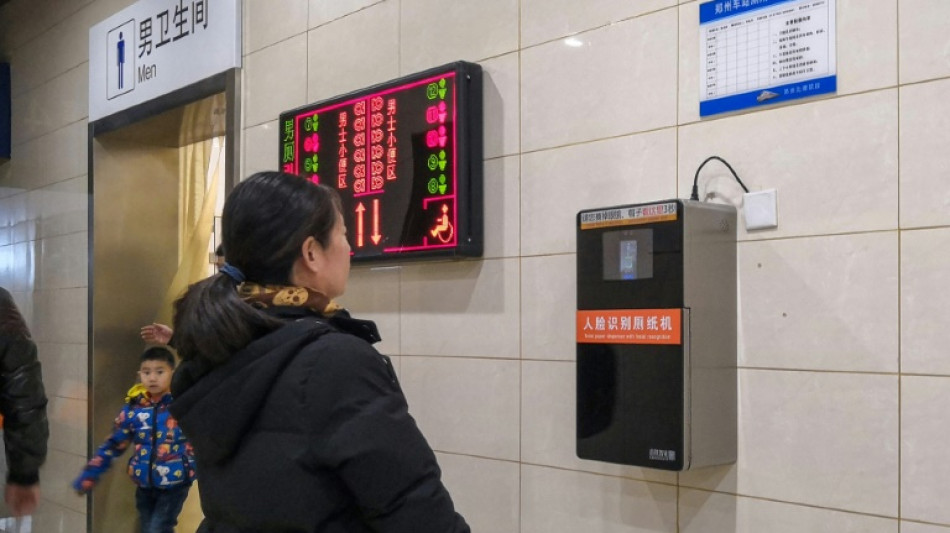
China drafts rules for using facial recognition data / Photo: STR - AFP/File
 South African election results renew debate over identity-based voting

 South African voters report smoother local election but declining IEC trust

 Dolly Parton museum and Nashville hotel open after singer’s death

 George and Amal Clooney attend New York political-comedy reading

 British buyers pay substantial premiums for period-home appearance

 Thomas Markle released to house arrest after child-abuse-image charge

 Dawn of War 4 developers chose Adeptus Mechanicus for tactical variety

 Italy face unbeaten South Africa in Turin Nations Championship match

 ChatGPT interactive interface feature tested across six custom tools

 Freshways milk-price cut deepens pressure on UK dairy farms

 Labour and National remain virtually tied as New Zealand vote count advances

 The Good Daughter adapts Karin Slaughter thriller with Rose Byrne and Meghann Fahy

 Heavy-lift drone evacuates wounded Ukrainian soldier from frontline kill zone

 Morrison says West Brom recovered after pressure from successive derby losses

 Britain considers 2027 state visit for Ukraine’s Zelensky

 Anna Miltina Confronted with Racism Allegations on ProSieben Show

 German Auto Giants Face Existential Crisis as China Sales Plummet

 Cause of Death Revealed for 'Ellen' Producer Matthew Wright
Firms using facial recognition in China will be required to obtain consent or legal permission before collecting personal information, draft regulations released Tuesday said, while stipulating the rules would not apply to some bodies.
China is one of the most surveilled societies on Earth, with thousands of CCTV cameras scattered across cities and facial recognition technology widely used in everything from day-to-day law enforcement to political repression.
Draft regulations released by China's Cyberspace Administration warned that use of the technology must "abide by laws and regulations, comply with public order, respect social morality, assume social responsibility, and fulfil duties to protect personal information."
Use of the technology to "analyse... ethnicity or religion" is prohibited, and the processing of facial data can only be carried out with the individual's consent or written legal permission, the law said.
It must also not be used to "endanger national security, harm public interests", or "disrupt social order", the regulations said.
Such technology may be used "only when there is a specific purpose and sufficient necessity, and when strict protection measures are taken", reads one article of the regulation.
But, it stipulated, the rules would not apply to those "not required by laws and administrative regulations to obtain personal consent". It did not specify what those were.
The regulations will enter effect on September 7 following a public consultation period.
A number of top Chinese facial recognition and surveillance firms have faced sanctions by the United States for their alleged role in repression.
State-owned surveillance giant Hikvision was blacklisted in the United States for allegedly helping Beijing carry out a "campaign of repression".
And Hong Kong-listed SenseTime was placed on a similar blacklist in 2019 over the use of its technology in mass surveillance in the western region of Xinjiang.
At an industry expo in Beijing in June, AFP saw a number of prominent firms showcasing tech that allowed them to identify "undesirable" behaviours and scan faces from more than 100 metres (yards) away.
T.Ward--AMWN
