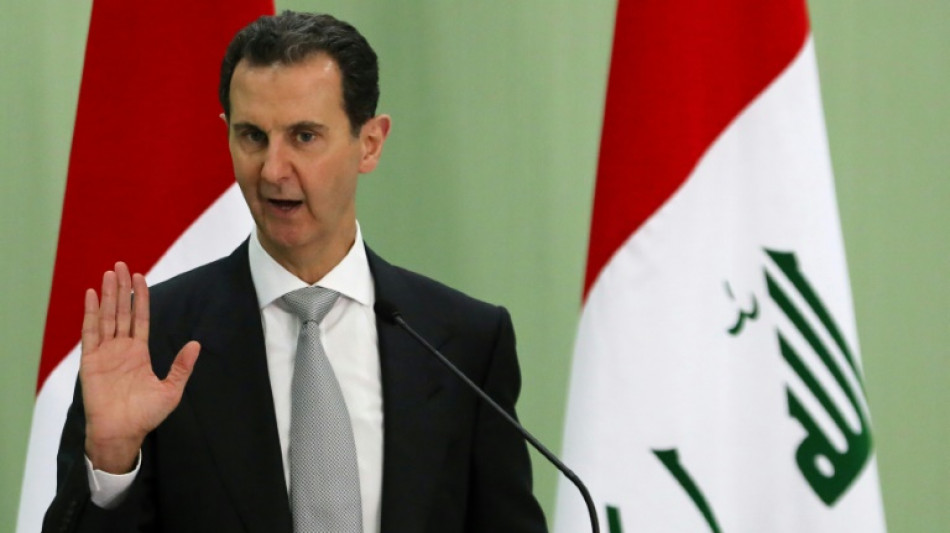
Assad says destroyed Syria infrastructure blocks refugee returns / Photo: LOUAI BESHARA - AFP/File
 South African election results renew debate over identity-based voting

 South African voters report smoother local election but declining IEC trust

 Dolly Parton museum and Nashville hotel open after singer’s death

 George and Amal Clooney attend New York political-comedy reading

 British buyers pay substantial premiums for period-home appearance

 Thomas Markle released to house arrest after child-abuse-image charge

 Dawn of War 4 developers chose Adeptus Mechanicus for tactical variety

 Italy face unbeaten South Africa in Turin Nations Championship match

 ChatGPT interactive interface feature tested across six custom tools

 Freshways milk-price cut deepens pressure on UK dairy farms

 Labour and National remain virtually tied as New Zealand vote count advances

 The Good Daughter adapts Karin Slaughter thriller with Rose Byrne and Meghann Fahy

 Heavy-lift drone evacuates wounded Ukrainian soldier from frontline kill zone

 Morrison says West Brom recovered after pressure from successive derby losses

 Britain considers 2027 state visit for Ukraine’s Zelensky

 Anna Miltina Confronted with Racism Allegations on ProSieben Show

 German Auto Giants Face Existential Crisis as China Sales Plummet

 Cause of Death Revealed for 'Ellen' Producer Matthew Wright
Syrian President Bashar al-Assad said Wednesday that the biggest obstacle to millions of refugees returning home is a lack of infrastructure, devastated by more than a decade of civil war.
The Syria conflict has killed more than 500,000 people, displaced millions and battered the country's infrastructure and industry since it began in 2011 with the government's repression of peaceful anti-government protests.
The war pulled in foreign powers and jihadists, and while the front lines have mostly quietened in recent years, large parts of the country's north remain outside government control.
Asked during an interview with Abu Dhabi-based Sky News Arabia television about the greatest challenge to refugee returns, Assad responded: "Logistically, infrastructure which terrorists destroyed".
"We have started general dialogue" with United Nations humanitarian bodies "on return projects", financing and UN demands, said Assad, citing a lack of water, electricity, schools and health care facilities.
Assad, who refers to all those opposed to the government as "terrorists", has seen increased engagement with Middle East countries this year.
Syria was readmitted to the Arab League in May, ending more than a decade of regional isolation during which some powers bet on his demise.
Lebanon, Jordan, Turkey, Iraq and Egypt host at least 5.5 million refugees, according to the United Nations, and refugee returns have been a key issue at recent regional discussions.
But as countries have increased calls for refugees to return, rights groups warned against forced returns and raised safety fears, saying some returnees have faced arrest or persecution, allegations which Assad denied in the interview.
Regional countries are also seeking cooperation from Damascus on issues including fighting the drug trade.
"When there is war and the state is weakened," the drug trade flourishes and "this is normal", Assad said.
"The countries that contributed to creating chaos in Syria bear the responsibility for this, not the Syrian state," he added.
An AFP investigation last year found that Syria has become a narco state, with the $10 billion captagon industry dwarfing all other exports and funding both Assad and many of his enemies.
The Syrian president pointed to dialogue between Damascus and Arab officials on fighting the drug trade.
"We have a shared interest in eliminating this phenomenon," he said.
Arab outreach to Assad gained momentum this year after a deadly February 6 earthquake struck Syria and Turkey, and accelerated as regional rivals Saudi Arabia and Iran agreed to restore bilateral ties the following month in a surprise China-brokered deal.
Analysts say Assad is hoping wealthy Gulf states can help fund reconstruction, although Western sanctions are likely to deter investment and broader international funding remains elusive without a UN-backed political settlement.
P.Silva--AMWN
