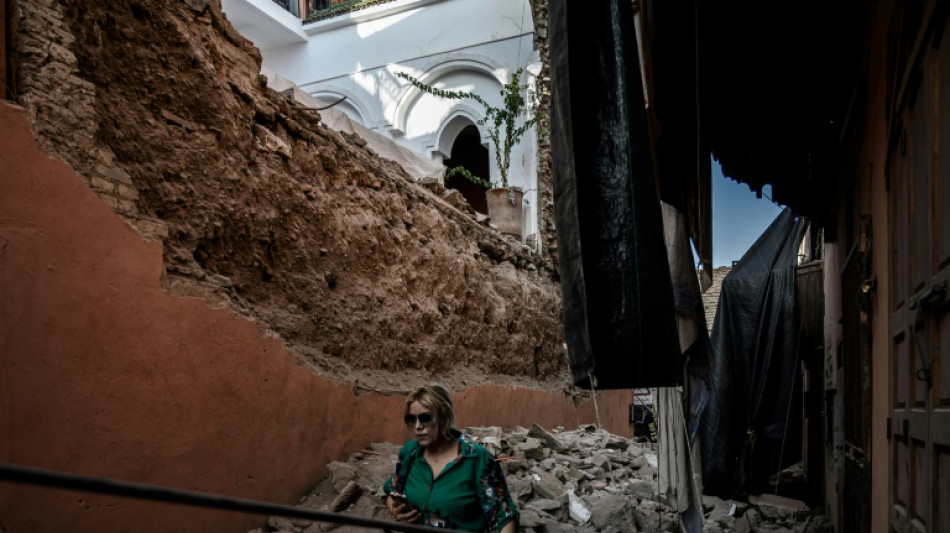
Historic Marrakesh hit hard by Morocco quake / Photo: Philippe LOPEZ - AFP
 South African election results renew debate over identity-based voting

 South African voters report smoother local election but declining IEC trust

 Dolly Parton museum and Nashville hotel open after singer’s death

 George and Amal Clooney attend New York political-comedy reading

 British buyers pay substantial premiums for period-home appearance

 Thomas Markle released to house arrest after child-abuse-image charge

 Dawn of War 4 developers chose Adeptus Mechanicus for tactical variety

 Italy face unbeaten South Africa in Turin Nations Championship match

 ChatGPT interactive interface feature tested across six custom tools

 Freshways milk-price cut deepens pressure on UK dairy farms

 Labour and National remain virtually tied as New Zealand vote count advances

 The Good Daughter adapts Karin Slaughter thriller with Rose Byrne and Meghann Fahy

 Heavy-lift drone evacuates wounded Ukrainian soldier from frontline kill zone

 Morrison says West Brom recovered after pressure from successive derby losses

 Britain considers 2027 state visit for Ukraine’s Zelensky

 Anna Miltina Confronted with Racism Allegations on ProSieben Show

Fatima Sanoussi's wrinkled hand tapped the wall in Marrakesh's historic medina on Sunday. Her house was able to withstand the 6.8-magnitude earthquake that rocked Morocco, but many others did not.
"Now that's what I call solid," said the 68-year-old in a yellow jellaba and black kerchief on her head, before sweeping away dust and stones from the arch leading to her modest home.
Marrakesh has a rich architectural heritage, and much of it suffered damage in Friday's quake, the strongest ever to hit the North African country.
Some parts of the 700-hectare (1,730-acre) medina and its network of alleyways saw significant damage, with mounds of rubble and crumpled buildings.
The 12th-century walls that surround the millennium-old city, founded by the Almoravid dynasty, have also been partly disfigured by the tremor.
Al-Haouz province, site of the quake's epicentre, suffered the most. It is around 70 kilometres (45 miles) southwest of Marrakesh, Morocco's main tourist attraction.
By Sunday, the death toll has reached more than 2,100.
"After a disaster like this, the most important thing is to preserve human life," said Eric Falt, UNESCO's regional director for the Maghreb.
"But we also have to plan immediately for the second phase, which includes rebuilding schools and cultural property affected by the earthquake."
- 'Destruction' -
Marrakesh is full of such places that have been on the UN cultural agency's World Heritage list since 1985.
The vast Jemaa el-Fna square is just one: the huge open area on the edge of the medina is known for its snake charmers and henna hawkers among other attractions.
Just hours after the quake struck, Falt led a UNESCO team into the medina on a visit to inspect the damage.
"The damage is much more significant than we expected," he said.
"There are significant cracks on the emblematic Koutoubia minaret, and the minaret of the Kharbouch mosque is almost completely destroyed," Falt said.
A few metres (yards) from this damaged mosque on Jemaa el-Fna square, vendors waiting for passing trade sat on their stools. Across the street, a 1960s-era cafe remained open to customers, despite now having a large crack in an interior wall.
The city's ramparts "have also been damaged in many places", said Falt.
"But the most badly affected district is the Mellah (the former Jewish quarter) where there has been widespread destruction of old houses."
One-storey houses of stone that shone pink in the sun have been reduced to rubble. Iron bars and other makeshift patchwork can be seen here and there to prop up sagging walls.
- Reinforced riads -
Historic sites in the city have certainly benefited from restoration work in recent years and the skills of master craftspeople in the art of tadelakt, the application of layers of lime-based plaster.
But that has not been the case with every building.
"There are major disparities," said Frenchman Sylvain Schroeder, who owns a riad in the Grawa district. Dozens of riads that grace the medina have become a major draw for tourists.
The tranquility of Schroeder's riad with its brightly coloured zellige tiles stands in stark contrast to the devastation that has befallen some nearby buildings.
He said that when the quake hit, "the water in the pool moved, but that was all. Everything else is intact."
"Like many recently restored riads, we have reinforced concrete frames here," he said. "The structure has been reinforced."
It's a different story on the other side of the narrow street, where the walls of a residential building looked as if they could collapse.
"With the slightest rain, they could come down like a house of cards," Schroeder said.
P.Martin--AMWN

