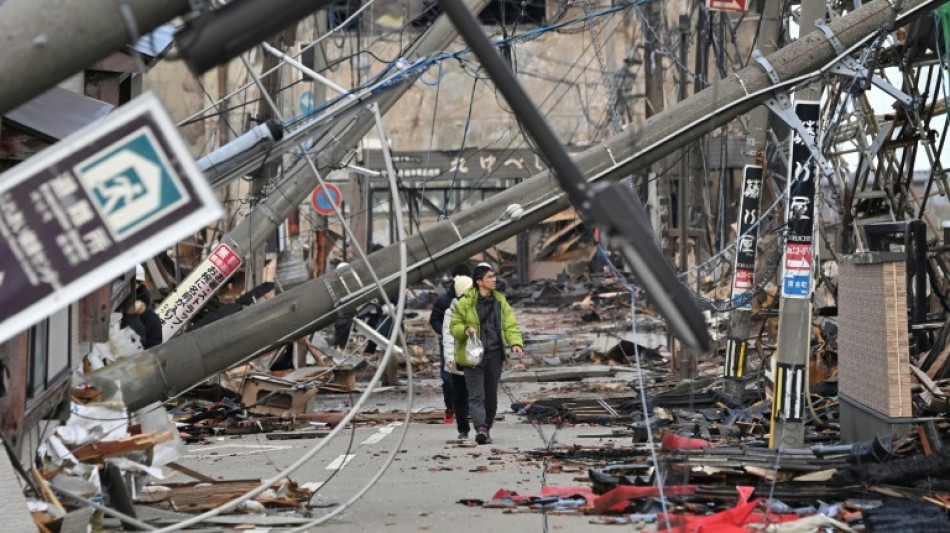
Under rubble, hopes fade for survivors of Japan quake / Photo: Kazuhiro NOGI - AFP
 Dana White Confirms Flight to Washington for Trump Meeting on Press Secretary Role

 Dengue Fever Expands Into High Himalayas as Climate Change Warms Nepal

 IoT Refrigerator Hacks Disrupt Blood Labs and Supermarkets Across Europe and US

 Post-election pressures complicate US and Israeli decisions on Iran

 UN members approve talks on treaty protocol against environmental crime

 Family-run West Sussex beach café prepares for first winter season

 CT scans reveal health and burial clues from Egypt’s Braided Lady mummy

 Oxford faces complaints over lecturer’s classroom attire

 Kyren Wilson and John Higgins reach International Championship snooker final

 New Zealand and Tonga meet for place in Rugby League World Cup final

 Reports of unsafe AI-toy responses renew calls for child-safety rules

 Juneau food network combines difficult supply routes with deep sharing traditions

 India climbs green-transition ranking after first emissions decline in 25 years

 Trump names Stephen Miller as White House chief of staff after midterm losses

 Restored Albanian tower houses anchor new rural tourism trail

 Sonia Gandhi reflects on family tragedy and reluctant political career

 Pope Leo begins three-country South American tour in Uruguay

 Khawaja says entire Australia camp knew of 2018 ball-tampering plan
Thousands of Japanese rescuers, some with sniffer dogs, on Thursday battled rubble and blocked roads as hopes faded for dozens listed as missing three days after a devastating earthquake that killed at least 84.
Hundreds of people in more than a dozen communities remained cut off in Ishikawa prefecture in central Japan, devastated by the 7.5-magnitude quake on New Year's Day.
Regional governor Hiroshi Hase told a disaster management meeting that as of 4:00 pm (0700 GMT), 72 hours after the quake, "the survival rate of those in need of rescue is said to drop precipitously".
Many cheered on social media late Thursday news reports that a woman in her 80s trapped on the ground floor of her house had been rescued three days after the quake.
"Incredible! Hope she'll get better," one user wrote on X, formerly Twitter.
"Rescue team, thank you!," said another.
Prime Minister Fumio Kishida told a press conference that the quake is "the worst catastrophe" in recent years, adding that access to the hardest-hit Noto Peninsula region remained challenging because of its geography and because of the aftershocks that followed the quake.
"The situation remains difficult, but we will continue to do our utmost to support the victims," he said.
- 'No body inside' -
The powerful main tremor, followed by hundreds of aftershocks, injured at least 330 people, local authorities said.
Authorities published a list on Thursday of 179 people whose whereabouts were unknown.
With hundreds sleeping in emergency shelters, further scenes of destruction were seen by AFP in the coastal towns of Anamizu and Wajima, including burnt-out cars in a market area ravaged by fire.
Thousands of soldiers, firefighters and police officers from across Japan combed through the rubble of collapsed wooden houses and toppled commercial buildings for signs of life.
Elza, a black sniffer dog with pointy ears, moved carefully between tiles torn from roofs and wooden beams littering the ground, looking for an elderly resident believed buried under the rubble. Nearby, a voice pleaded from a crowd of local residents, "Please, Elza, find her."
Elza's owner Yasuhiro Morita, working with a rescue unit in Wajima, said the dog was trained to bark when it finds a body.
"But today, she just wandered off toward bystanders instead, which likely means there was no body inside," Morita told AFP.
- No power -
Military hovercraft delivered heavy construction equipment and vehicles to the devastated port city by sea.
Around 30,000 households were without electricity in Ishikawa on the Sea of Japan coast, and 89,800 homes there and in two neighbouring regions had no water.
Access was blocked to small communities in the hardest-hit Noto Peninsula region -- with 300 people desperately waiting for aid at a school in the town of Ooya in the Suzu area.
"Even if I give my food to my children, it is not enough at all. I have eaten almost nothing for the past two days," a woman in her 30s with three children in Suzu told the Asahi Shimbun newspaper.
- 'Critical' 72 hours -
In the city of Nanao, police managing traffic told drivers that one of the main roads leading to Wajima had been prioritised for emergency vehicles, and workers said they were rationing car fuel.
Monday's main shockwave triggered tsunami waves at least 1.2 metres (four feet) high in Wajima, and a series of smaller tsunamis were reported elsewhere.
Broadcaster NHK reported that one person was swept away by the tsunami in Noto's Suzu area, with the coastguard investigating.
Japan experiences hundreds of earthquakes every year and most cause no damage, with strict building codes in place for more than four decades.
Earthquakes have hit the Noto region with intensifying strength and frequency over the past five years.
The country is haunted by a massive 9.0-magnitude undersea quake in 2011, which triggered a tsunami that left around 18,500 people dead or missing.
It also swamped the Fukushima atomic plant, causing one of the worst nuclear disasters in history.
C.Garcia--AMWN
