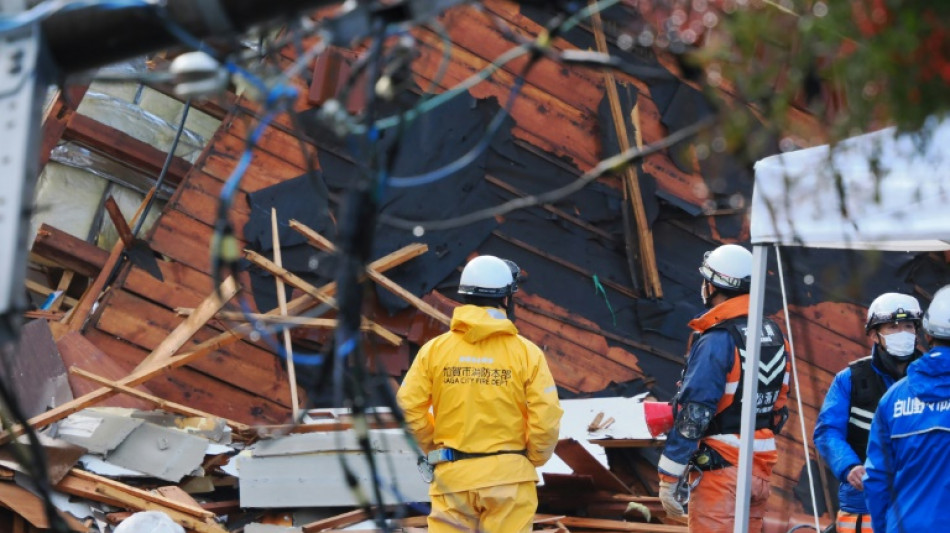
Elderly woman pulled from rubble five days after Japan quake / Photo: Toshifumi KITAMURA - AFP
 Dana White Confirms Flight to Washington for Trump Meeting on Press Secretary Role

 Dengue Fever Expands Into High Himalayas as Climate Change Warms Nepal

 IoT Refrigerator Hacks Disrupt Blood Labs and Supermarkets Across Europe and US

 Post-election pressures complicate US and Israeli decisions on Iran

 UN members approve talks on treaty protocol against environmental crime

 Family-run West Sussex beach café prepares for first winter season

 CT scans reveal health and burial clues from Egypt’s Braided Lady mummy

 Oxford faces complaints over lecturer’s classroom attire

 Kyren Wilson and John Higgins reach International Championship snooker final

 New Zealand and Tonga meet for place in Rugby League World Cup final

 Reports of unsafe AI-toy responses renew calls for child-safety rules

 Juneau food network combines difficult supply routes with deep sharing traditions

 India climbs green-transition ranking after first emissions decline in 25 years

 Trump names Stephen Miller as White House chief of staff after midterm losses

 Restored Albanian tower houses anchor new rural tourism trail

 Sonia Gandhi reflects on family tragedy and reluctant political career

 Pope Leo begins three-country South American tour in Uruguay

 Khawaja says entire Australia camp knew of 2018 ball-tampering plan
A woman in her 90s trapped for five days under rubble caused by a huge earthquake in central Japan was rescued against the odds, but snow and storms were further complicating relief efforts on Sunday.
At least 128 people have died since the 7.5 magnitude tremor on New Year's Day and its aftershocks -- a toll sure to rise, with 195 others reported missing, according to local authorities.
The shockwaves toppled buildings, sparked a major fire and triggered tsunami waves over a metre high on the Sea of Japan side of the main island of Honshu.
The hope of finding survivors usually fades three days after a destructive quake.
But an elderly woman spent five days under the wreckage of a collapsed house in the city of Suzu on the hard-hit Noto Peninsula before being saved on Saturday.
She was taken to hospital and was able to hold a conversation, according to public broadcaster NHK.
"Hang in there!" rescuers were heard calling to the woman in police footage from the rainy scene published by local media.
"You're gonna be OK!" they shouted. "Stay positive!"
A Tokyo police spokesman confirmed to AFP that the rescue had been carried out by officers from Tokyo and Fukuoka, but he could not give further details.
Not all were so lucky. In the town of Anamizu, a 52-year-old man who lost his 21-year-old son and his parents-in-law waited to hear news of his wife, his other three children and more family members.
"I want them to be alive. It's unthinkable that I could be left alone," he told NHK.
- Sleet and snow -
On Sunday, rain, sleet and snow made the recovery efforts of thousands of police, troops and other rescuers even more challenging.
The cold weather is also likely to worsen conditions for more than 28,800 people in 404 government shelters.
Continuous rain has increased the risk of fresh landslides, while heavy snow through Monday could cause more buildings to collapse under its weight, the regional government warned.
At least 2,000 people in many communities on the remote peninsula have been cut off by damaged roads, with some of an estimated 1,000 landslides also blocking aid vehicles.
That means relief materials have been slow to reach areas suffering water and power outages.
Around 20,700 households in the wider Ishikawa region remained without electricity on Sunday. More than 66,100 households were without water.
"The first priority has been to rescue people under the rubble, and to reach isolated communities," Prime Minister Fumio Kishida said in an interview with NHK on Sunday.
The military has sent small groups of troops to each of the isolated communities on foot, he said.
The government has also "deployed various police and fire department helicopters" to reach them, Kishida added.
"In parallel with these efforts, we need to improve the conditions in shelters, and the health of those suffering in the disaster," because they may have to stay in place for extended periods, he warned.
In Anamizu, rescuers in heavy-duty orange or blue waterproof suits were seen carrying the body of a landslide victim covered in a blue tarp under a toppled pylon.
And among the widespread destruction in the city of Wajima, the traditional red gate of one shrine remained standing, but the view through it was a now-familiar mess of splintered wood and toppled beams.
But in a coastal village called Akasaki, visited by AFP, no houses had collapsed -- thanks to their unusual design.
To withstand the rough environment at the tip of a headland, the houses have few glass windows, and the exterior walls are made from sturdy wooden slats layered horizontally.
"I felt so encouraged, because the village was still there standing," said Masaki Sato, who maintains one of the homes remotely.
Japan experiences hundreds of earthquakes every year, though most cause no damage with strict building codes in place for more than four decades.
But many structures are older, especially in rapidly ageing communities in rural areas like Noto.
The country is haunted by the monster quake of 2011 that triggered a tsunami, left around 18,500 people dead or missing and caused a nuclear catastrophe at the Fukushima plant.
Japan's last earthquake disaster to cause more than 100 deaths was in 2016 in the southern city of Kumamoto, where 276 people died.
F.Schneider--AMWN
