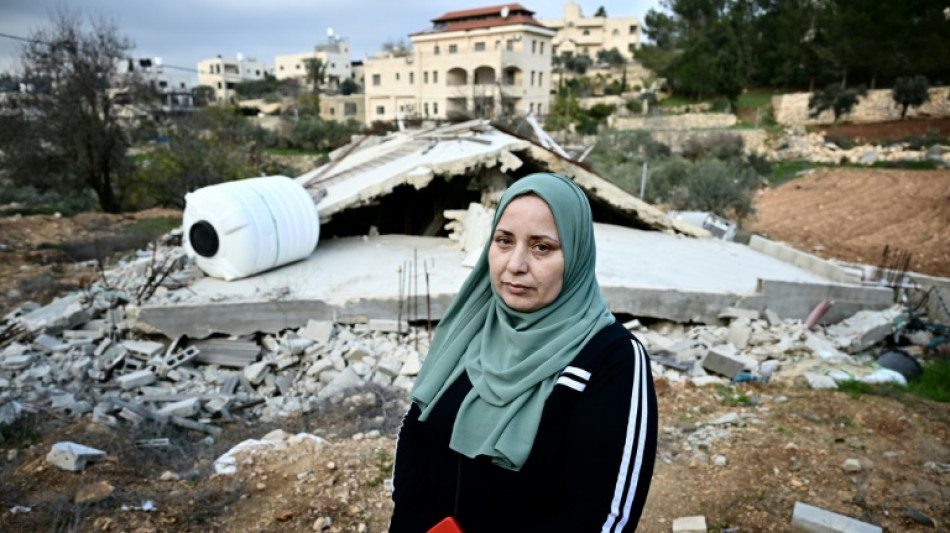
Palestinian village fears Israel wartime demolitions / Photo: Alberto PIZZOLI - AFP
 Dana White Confirms Flight to Washington for Trump Meeting on Press Secretary Role

 Dengue Fever Expands Into High Himalayas as Climate Change Warms Nepal

 IoT Refrigerator Hacks Disrupt Blood Labs and Supermarkets Across Europe and US

 Post-election pressures complicate US and Israeli decisions on Iran

 UN members approve talks on treaty protocol against environmental crime

 Family-run West Sussex beach café prepares for first winter season

 CT scans reveal health and burial clues from Egypt’s Braided Lady mummy

 Oxford faces complaints over lecturer’s classroom attire

 Kyren Wilson and John Higgins reach International Championship snooker final

 New Zealand and Tonga meet for place in Rugby League World Cup final

 Reports of unsafe AI-toy responses renew calls for child-safety rules

 Juneau food network combines difficult supply routes with deep sharing traditions

 India climbs green-transition ranking after first emissions decline in 25 years

 Trump names Stephen Miller as White House chief of staff after midterm losses

 Restored Albanian tower houses anchor new rural tourism trail

 Sonia Gandhi reflects on family tragedy and reluctant political career

 Pope Leo begins three-country South American tour in Uruguay

 Khawaja says entire Australia camp knew of 2018 ball-tampering plan
Dabbing away tears, Ghadeer al-Atrash stood before her bulldozed home in a Palestinian village abutting Israeli settlements, a fate feared by hundreds of villagers as Israel ramps up demolitions during wartime.
Destruction of homes built without Israeli-issued permits, which campaigners say are nearly impossible for Palestinians to obtain due to Israel's restrictive planning policy, have roiled occupied territories for years.
But campaigners say the wartime demolitions illustrate the wider impact of the war, triggered by the October 7 attack by Hamas militants against Israel, on Palestinian communities beyond the Gaza Strip.
Atrash, a divorced mother-of-two, scrounged together about 200,000 shekels ($54,000) to build a house in Al-Walaja, a village carved into hillside terraces and olive farms that is divided between the Israeli-occupied West Bank and east Jerusalem.
"My son dropped out of college. We saved money, borrowed money," Atrash, 43, told AFP, standing in front of concrete debris from her house that was demolished last February.
"I had built it to get away from exhaustion and misery, for stability in my life."
Dozens of Al-Walaja families with pending demolition orders fear the same fate.
Since October 7 the government has accelerated demolitions in Palestinian areas, in what campaigners call collective punishment that threatens to inflame tensions already heightened by the fighting.
Since the attack, 444 Palestinians in Area C -- West Bank territory under full Israeli control -- and annexed east Jerusalem have been displaced following demolitions due to a lack of permits, according to the United Nations humanitarian agency (OCHA).
This represents a 36 percent increase in displacement since the beginning of 2023, OCHA said.
The Al-Walaja part impacted by demolitions falls under east Jerusalem, where the Israeli activist group Ir Amim said destructions jumped more than 50 percent in the three months since October 7 compared to the rest of 2023.
- 'Anxiety and fear' -
"Whether I'm sitting, sleeping or eating, I keep thinking about what they are going to do to us and our house," said Mahmoud Abu Khiarah, a 28-year-old construction worker and father-of-three who built a house in 2017 on ancestral land in Al-Walaja.
"There's anxiety and fear."
Municipal authorities in Jerusalem redirected AFP's request for comment to the finance ministry and COGAT, a military body responsible for civilian affairs in the Palestinian territories. Neither of them responded.
The Israeli Supreme Court has stayed demolition orders for 38 houses in Al-Walaja, which has a population of about 3,000. At least six houses that are not part of the freeze, including Abu Khiarah's, face an imminent risk, Ir Amim said.
The Hamas attack which triggered the war resulted in about 1,140 deaths in Israel, most of them civilians, according to an AFP tally based on official figures.
Israel's retaliatory bombardment of Gaza has claimed at least 22,835 lives in the Palestinian territory so far, according to the health ministry in Hamas-ruled Gaza.
Fuelling fears of a broader escalation, the jump in demolitions comes amid rising settler violence, military raids and movement restrictions facing Palestinians in the occupied territories.
At the heart of the demolitions is what OCHA calls Israel's "discriminatory" planning policy.
Since 1967 when Israel occupied the West Bank and annexed east Jerusalem, authorities never made a zoning plan for the Al-Walaja area under its jurisdiction, making it impossible for residents to build legally.
"Residents have to choose between uprooting themselves from Al-Walaja, where they were born and their families live, to building without a permit and risking demolitions," Aviv Tatarsky, an Ir Amim researcher, told AFP.
- 'Live on streets' -
Israel claims the whole of Jerusalem as its undivided capital. Many Palestinians view demolitions as an attempt to push them out of annexed east Jerusalem, which they want as the capital of a future Palestinian state.
The sprawling Jewish settlements of Gilo and Har Gilo -- illegal under international law -- have already encroached on Al-Walaja land.
The village is also hemmed in by the kilometres-long West Bank barrier -- built by Israel in the early 2000s against Palestinian violence -- which has cut off residents from pastureland and freshwater springs.
Many Palestinians with demolition orders say they choose to tear down their own homes to evade high government levies and the cost of renting the municipality's bulldozers.
"Israel, as the occupying power, is obligated to protect the Palestinians," Greg Puley, acting head of OCHA's office for occupied Palestinian territories, told AFP.
"Palestinians must have access to a fair and equitable planning system."
Al-Walaja's residents have taken it upon themselves to raise funds to develop a zoning plan with the help of an Israeli planner.
The detailed proposal, seen by AFP, was submitted to Israeli planning authorities in early October.
In early December, the Supreme Court granted a request by authorities for up to four months to review it, legal records show.
While they do so, the threat of demolitions persists.
"If they demolish our house we will live on the streets," Abu Khiarah said, cradling his toddler in his arms.
S.F.Warren--AMWN
